南京云锦:一台大花楼织机,两个人,一天织出几厘米
韵和鸣 · 韵和鸣公众号 · 2026/11/8 12:00:00 · 2 阅读
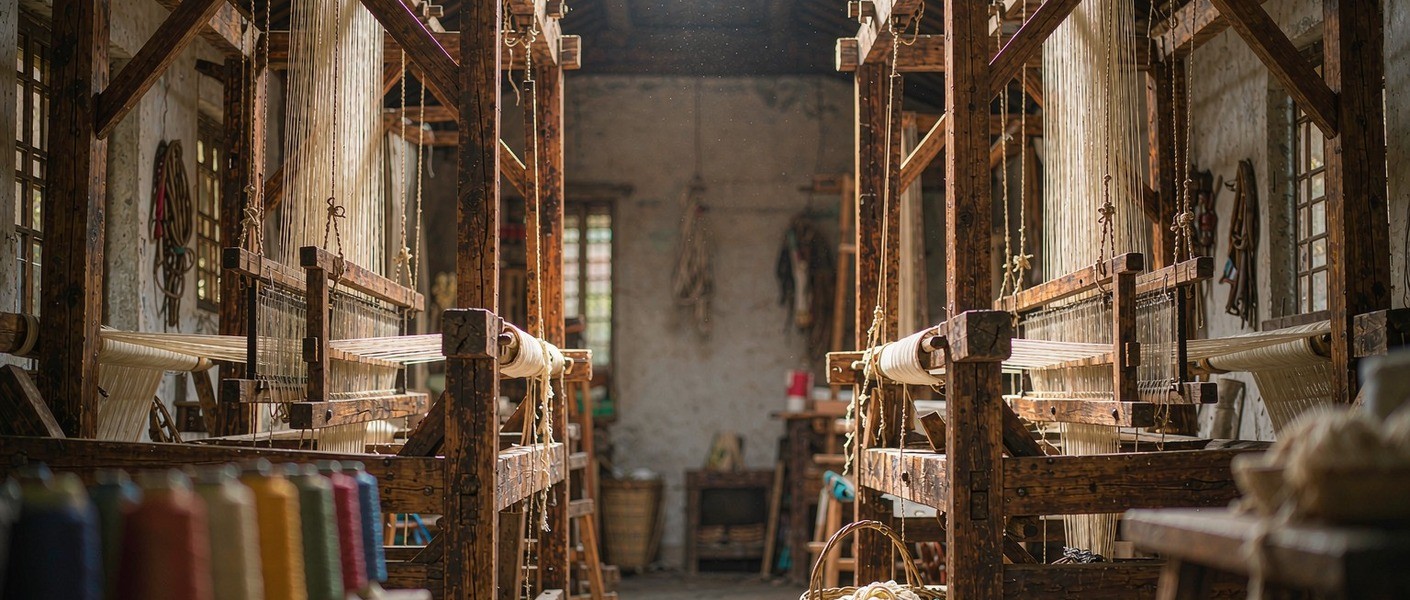
有一种织物,名字里带云。图案绚丽、纹饰华美,看着像天边堆起来的霞。它出在南京,叫云锦,与四川的蜀锦、苏州的宋锦并称中国三大名锦。讲它得从一台织机说起,那台机器有四米多高,要两个人一起才转得动。
▍一、起源地:为什么偏偏是南京
南京在长江下游,水路通四方,周边是传统蚕桑产区。东晋义熙十三年,公元 417 年,朝廷在建康设锦署,被视为云锦诞生的标志。此后一千六百年,织造没离开过这座城市。
把它推到顶点的是皇家订单。元代起云锦成为御用之物,清代设江宁织造署,织造、采买、解运都在此。机户、染坊、挑花匠、金线铺沿秦淮河排开,形成完整链条。
▍二、工艺特色:两个人一台机
云锦织造用的是束综提花机中最复杂的一种,妆花环形大花楼木织机,学界一般认为这种机型成形于十五世纪。机器分上下两层,楼上坐拽花工,按花本逐根提起经线;楼下坐织手,投梭、打纬、盘织。两人靠口令配合,一天下来成品长度以厘米计。
难在「挖花盘织」。普通织锦的纬线从头通到尾,云锦的妆花要按花纹一段段断纬、换色、盘织,一匹布上可有十几二十种颜色。费工,却让花纹自由起落、颜色随意更换。
所谓南京云锦木机妆花手工织造技艺,是指以束综提花木织机由两人配合、用手工妆花(断纬挖花盘织)方式织造丝织锦缎的传统技艺;2006 年列入国家级非物质文化遗产名录,编号 Ⅷ-13,申报地区为江苏省南京市。
大花楼织机的经面迎着窗光,上千根经线绷成一片细密的竖纹
流传至今的品种主要有妆花、织金、库锦、库缎。织金以金线取胜,「寸锦寸金」说的不只是贵,也是工时。
▍三、文化价值:纹样里的一套秩序
云锦的纹样不随意。龙、蟒、凤、麒麟各有等级,云纹、江崖海水、缠枝莲各有位置,一件袍服上的图案排布,对应穿戴者的身份与场合。帝制时代的织造带着规矩,错一根线可能就错一个等级。
今天看云锦,价值在两层。一层是技术史,它把提花织造的复杂性推到手工时代的顶端;另一层是城市记忆,织造、织户、机坊与秦淮河的生活纠缠了几百年,云锦是这段历史留下的实物证据。
▍四、传承现状:研究所、织机与新人
1950 年代,南京成立云锦研究所,把散落的手艺人聚起来恢复生产,并系统整理纹样与工艺。2006 年这项技艺列入国家级非物质文化遗产名录;2009 年 9 月 30 日,南京云锦织造技艺入选联合国教科文组织人类非物质文化遗产代表作名录。
织手在经面下投梭,手边一只竹篮里放着几卷不同色的纬线
难处很实在。学一台大花楼织机,先学拽花,认花本与经线,光记口令就要几个月,独立上机往往以年计。工时长、产量低,愿意坐下来的年轻人不多。近些年云锦进入高级服装与文创产品,订单结构变了,「会用」的人去处更多,「会做」的人更显紧缺。
▍五、问答
问 | 南京云锦为什么被叫作「寸锦寸金」
答 | 因为工时。云锦靠大花楼木织机由两人配合手工织造,妆花要按花纹断纬换色,一天产量以厘米计。加上金银线的用料,成本自然上去。这句话说的是工艺与时间的比值,不是市场报价。
问 | 云锦和宋锦、蜀锦有什么区别
答 | 三者并称中国三大名锦,产地与工艺取向不同。云锦出南京,用大花楼织机与妆花断纬,颜色多、纹样大,历史上主要供皇家服饰;宋锦出苏州,重纬显花,色调沉稳,多用于书画装裱与服饰;蜀锦出成都,以经线起花见长。差别落在机器、织法与用途上。
问 | 韵和鸣会做云锦这类织锦吗
答 | 品类里有织锦。韵和鸣以漆、竹、绣、银、锦、瓷等方向做全国范围的非遗手工品严选,器物与非遗老师联名,来源、工序、署名写在说明里。织锦这条路走得谨慎,因为手工与机器在外观上距离很近,一旦讲不清工序,严选就没有意义。
📩 非遗项目 | 匠人举荐 | 跨境出海 | 线下联营
欢迎留言或后台联系,我们与匠人同行。
—— 韵和鸣 · 与匠人同行
〖 遗 〗
相关搜索 | RELATED SEARCHES
南京云锦 · 云锦 大花楼织机 · 妆花 工艺 · 中国三大名锦 · 江宁织造 · 云锦 非遗
English
Nanjing sits on the lower Yangtze amid traditional sericulture country. In 417 CE the Eastern Jin court set up a brocade office in Jiankang, taken as the beginning of yunjin; sixteen centuries on, weaving never left.
Imperial demand lifted it: from the Yuan it dressed the court, and in the Qing a Jiangning weaving bureau handled production, purchasing and shipment. Weaving households, dye works, pattern drafters and gold-thread shops lined the Qinhuai into a complete chain.
Yunjin uses the most complex of drawlooms, the circular great flower tower loom for zhuanghua, generally dated to the fifteenth century. It has two levels: a pattern puller above lifts warp threads one by one to the draft, a weaver below throws the shuttle, beats the weft and works the supplementary threads. The two coordinate by call and response, and a day's output is measured in centimetres.
The difficulty is discontinuous weft. In ordinary brocade the weft runs the full width; in zhuanghua it is cut, recoloured and worked section by section, so one bolt may carry twenty colours. Slow, yet it lets motifs rise and fall freely and colour change at will.
The technique is hand weaving of silk brocade on a drawloom worked by two people using discontinuous supplementary wefts; it entered the national list of intangible cultural heritage in 2006, numbered VIII-13, declared by Nanjing City in Jiangsu.
The warp face of a great flower tower loom against window light, a thousand threads drawn into fine vertical lines
The types still made include zhuanghua, zhijin, kujin and kuduan. Zhijin wins by gold thread. The saying that yunjin is sold by the inch of gold speaks of hours as much as price.
Cultural Value: An Order Written in Pattern
Yunjin patterns were not free. Dragons, pythons, phoenixes and qilin carried rank, and cloud scrolls, standing waves and lotus scrolls had their places; a robe's arrangement matched the wearer's status. Under imperial rule weaving was governed by rules, and one wrong thread could mean one wrong rank.
Its value lies in two layers: technical history, where it pushed drawloom complexity to the limit of the hand-working age, and urban memory, where bureaus, households, loom shops and river life were tangled for centuries.
Transmission Today: Institutes, Looms and Newcomers
In the 1950s Nanjing set up a research institute for yunjin, gathering scattered craftspeople to resume production and organising patterns and process. In 2006 the technique entered the national list, and on 30 September 2009 it was inscribed on UNESCO's Representative List.
A weaver throwing the shuttle beneath the warp, a bamboo basket of coloured weft spools at hand
The difficulty is concrete. Learning the loom starts with pulling the pattern and memorising the calls, which alone takes months, and independent work takes years. Hours are long, output small, and few young people will sit down to it. Lately yunjin has entered couture and derivative goods, so those who can use it have more places to go and those who can make it grow scarcer.
Why is Nanjing yunjin said to be worth its weight in gold?
Because of hours. Two people work the loom by hand and zhuanghua cuts and changes weft section by section, so a day yields centimetres. Add gold and silver threads and cost follows. The phrase measures craft against time, not a market price.
How does yunjin differ from Song and Shu brocade?
The three are counted together, differing in place and approach. Yunjin comes from Nanjing with the great flower tower loom and discontinuous weft, many colours and large motifs, historically for court dress; Song brocade from Suzhou uses multiple wefts with a restrained palette, often for mounting paintings; Shu brocade from Chengdu is known for pattern formed in the warp. Loom, method and use divide them.
Does YUNHEMING work with brocades like yunjin?
Brocade is among our categories. YUNHEMING curates handmade heritage work nationwide across lacquer, bamboo, embroidery, silver, brocade and porcelain, co-signed with the makers, with provenance, process and credit stated. We move carefully with brocade because hand and machine look close from outside, and once the process cannot be stated, selection means nothing.
One loom, two people, a few centimetres a day. A stubborn pace, and the one that preserved the hardest technical memory of the hand-working age. Not everything slow must be kept, yet someone has to record it while it still turns.
ICH Projects · Artisan Referrals · Global Distribution · Salon Partnerships
你可能还感兴趣
苗族银饰锻制技艺:三十多道工序,做一身能走路的银
苗族银饰锻制技艺以三十多道工序,将银料制成头饰、颈饰、胸饰等整套盛装。本文梳理其产区、流变、錾刻与焊接特点,并说明为何用料分量不能替代工艺判断及其传承难题。
韵和鸣 · 2026/10/24 · 107 阅读
一件漆器该有多重,手感不会说谎
严选器物,看纹样、看款识、看证书,都是明面上的事。但有一道标准写不进任何参数表——上手。同一尺寸的两只漆盘,一只压手温润,一只轻飘干瘪,差别从何而来?这次把"分量"这件事拆开讲。说到底,重量是工序的记账本。
韵和鸣 · 2026/10/14 · 55 阅读
漆器能不能装热水?苏绣会不会勾丝?四个常被问到的问题
后台每周都会收到一批重复的问题,大多集中在"买回去怎么用":漆器能不能装热水、能不能进洗碗机,苏绣小饰品日常会不会勾丝,绣品怎么装框才不伤绣面。今天一次答清,另外说说怎么分辨一个品牌是不是"挂名非遗"。说到底,能不能用得久,才是检验的起点。
韵和鸣 · 2026/10/24 · 54 阅读
一盏博山琉璃:颜色是炉火给的,不是颜料调的
博山琉璃的颜色由矿石、着色配方和炉温共同形成,鸡油黄等色料并非烧成后涂在表面。文章介绍挑料、吹制、塑型、灯工和内画,说明流纹、气泡与壁厚如何反映手工过程,并提供观察颜色、过渡和口沿的选器方法。
韵和鸣 · 2026/10/12 · 53 阅读
一张蔚县剪纸,彩色的刻刀活
严选录这一期看一张不太一样的剪纸:它不用剪刀,用刻刀;不止红色,还带着点染出来的粉与绿。河北张家口蔚县的剪纸,是剪纸大家族里"反着来"的一支——别处以剪为主、以红为正,蔚县以刻代剪、以点彩上色。说到底,这两个"反着来"的本质,是蔚县人把剪纸从窗前的女红,做成了作坊里的分工手艺:看懂了这一点,才算看懂了这张纸。
韵和鸣 · 2026/10/13 · 52 阅读
一枚漆书签:小物件为什么反而更考验手艺
漆书签体量小,却同时暴露胎体稳定、漆层附着、边缘打磨与日常耐用度。挑选时先看薄厚与侧面,再摸边缘和转角,比只看纹样更能判断小件工序是否扎实,也值得问清售后修复。
韵和鸣 · 2026/10/24 · 48 阅读