徽墨:一锭墨要晾上半年,黑是从松烟里扫出来的
韵和鸣 · 韵和鸣公众号 · 2026/11/7 12:00:00 · 1 阅读
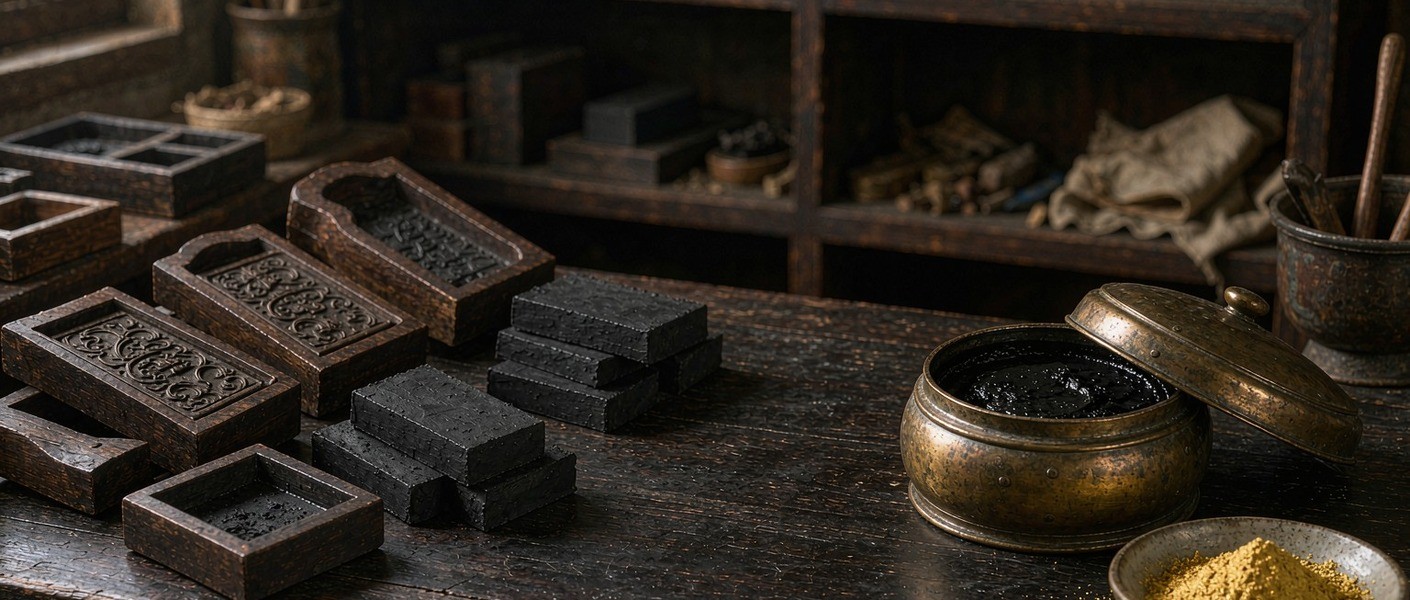
写字的人多,见过制墨的人少。一锭徽墨握在手里很轻,背后的时间却很重:采烟、和胶、杵捣、压模、晾墨、描金,其中晾墨这一环,一两的墨锭要在恒温恒湿的晾墨场里待上半年。
▍一、起源地
徽墨出自古徽州府,今天的安徽歙县、黄山一带。这里有制墨的两个前提:松与好水。松烟墨取老松枝干烧烟,徽州多山多松,原料就在门口;境内新安江水系清澈,漂洗烟料、调和胶液都用得上。
▍二、历史背景
据人民网与安徽省人民政府网站刊载的制墨业记述,唐末制墨名家奚超为避战乱,携家人自易州南迁至歙州,见当地松优质佳、江水清澈,便留此重操旧业。其子奚廷珪向当地墨工求教,改进了捣烟与和胶的方法,所制之墨丰肌腻理、光泽如漆,被南唐后主李煜视为珍宝,奚氏一族获赐国姓,改姓为李,「李墨」由此得名。
北宋宣和三年,也就是 1121 年,宋徽宗把歙州改名为徽州,「徽墨」之名正式出现并沿用至今。明清两代徽州成为全国制墨中心,清末民初以胡开文等四家最知名,胡氏「地球墨」1915 年在巴拿马博览会获金质奖章。
墨模与压好的墨锭摆在深色木案上,旁边是一只铜制墨盒
▍三、工艺特色
按国家级代表性传承人周美洪向媒体介绍的说法,现代制墨分炼烟、和胶、制墨、晾墨、整理、描金、包装、墨模制作等十一道工序。炼烟分两路:松烟取松枝,烟窑长二三十米,每隔数米开孔出烟,烟煤附在窑壁,冷却后扫下;油烟在密闭烟房点油灯,灯上扣瓷碗,烟熏在碗底。
和胶之前烟料要漂洗去杂,配比要看烟料粗细、胶质、时令与销地。和好之后反复杵捣,墨馃从恒温炕炉取出,在墨墩上用锤翻打,据周美洪介绍,每次平均两百下。老话讲轻胶十万杵:打不够,墨松易碎;打过头,胶性被破坏,磨出的墨色发灰。
压入墨模、脱模之后进入晾墨。晾墨场恒温恒湿、避光,一两的墨锭要晾六个月,二两的要八个月甚至更久;墨锭三成干时锉边,五成干时检查平整度,八成干时包封入库。最后一道是描金,用胶水拌国画颜料与铜金粉在墨面填彩。
晾墨架上密密排开的墨锭,深黑的长条沿木格一列列铺过去
所谓徽墨,是指以松烟、桐油烟、漆烟与胶为主要原料,经炼烟、和胶、杵捣、制墨、晾墨、描金等工序制成的书画用墨,因产于古徽州府而得名。徽墨制作技艺于 2006 年列入国家级非物质文化遗产名录(来源:人民网、安徽省人民政府网站)。
▍四、文化价值
墨是文房四宝之一,也是书画的颜料本体。好坏不写在包装上,写在纸上:色泽是否黑润,入纸是否不晕,舔笔是否不胶,经年是否褪色。徽墨的配方与工序,本质上是为这几件事服务的。
在徽州,墨还承担过另一重角色。商号记账、契约书写、族谱修缮、匾额题字都要用墨;一锭好墨既是读书人家的体面,也是商帮往来的凭信。
▍五、传承现状
难处很具体。工序多、耗时长,一锭墨从采烟到描金最少要大半年;捶墨是体力活,晾墨是等待活,两样都不讨年轻人喜欢。周美洪在受访时讲过,一张桌子、一把椅子、一个人就是一辈子。
另一面是需求在回来。随着传统文化受到关注、书法进课堂等活动推开,制墨行情有所好转,给带徒添了些底气。真正的关口仍在人手上。
▍问答
问 | 徽墨和瓶装墨汁有什么区别,为什么还要磨墨
答 | 差别在成分与浓度。徽墨是松烟或油烟配胶制成的固体,用时在砚上加水研磨,浓淡由水和时间控制,层次更丰富,附着力也更稳;瓶装墨汁为便利做了调配,写小楷与勾线时容易见锋芒不足。
问 | 韵和鸣会做文房类的非遗器物吗
答 | 品类上覆盖漆、竹、绣、银、锦、瓷等方向,文房器物在关注范围内。标准始终是同一条:只选真正的非遗手工品,只与传承人本人合作,器物与老师联名,署名与工序一并写清。
▍说在最后
一锭墨的寿命比写字的人长。它被磨短、被写尽,最后只剩一枚小小的墨头,那枚墨头里仍然留着半年的晾晒和两百下的捶打。
你家里还有砚台和墨吗?上一次磨墨是什么时候?留言聊聊。
📩 非遗项目 | 匠人举荐 | 跨境出海 | 线下联营
欢迎留言或后台联系,我们与匠人同行。
—— 韵和鸣 · 与匠人同行
〖 遗 〗
相关搜索 | RELATED SEARCHES
徽墨 制作技艺 · 徽墨 怎么用 · 松烟墨 油烟墨 区别 · 安徽 歙县 非遗 · 文房四宝 墨
English
Hui ink comes from the old Huizhou prefecture, today's Shexian county and the Huangshan area of Anhui. Two conditions make it possible: pine and good water. Pine-soot ink burns the limbs of old pines, and Huizhou is mountain country thick with them; the clear Xin'an river serves for washing soot and blending glue.
As accounts published by People's Daily Online and the Anhui provincial government record, the late-Tang ink master Xi Chao moved south from Yizhou to Shezhou to escape war, found fine pine and clear water, and stayed to resume his work. His son Xi Tinggui learned from local makers and improved the methods of pounding soot and blending glue, producing ink of dense body and lacquer-like sheen that the last ruler of Southern Tang treasured, granting the family the imperial surname Li. Hence the name Li ink.
In 1121, Emperor Huizong renamed Shezhou as Huizhou, and the name Hui ink entered use and stayed. Through the Ming and Qing, Huizhou was the centre of ink making nationwide, with four houses best known by the late Qing, among them Hu Kaiwen, whose Globe Ink took gold at the 1915 Panama exposition.
Ink moulds and pressed sticks on a dark wooden bench, a brass ink case beside them
According to Zhou Meihong, a national-level bearer of the craft, modern ink making runs through eleven steps including soot refining, glue blending, forming, drying, finishing, gilding, packing and mould cutting. Soot comes two ways: pine soot burned in a kiln twenty to thirty metres long, swept off the walls once cool; oil soot from lamps in a sealed room, each capped with a bowl that catches the smoke.
Before gluing, soot is washed; the ratio depends on coarseness, glue quality, season and destination. The blend is pounded repeatedly: paste comes off a warmed hearth and is struck on a block, two hundred blows to a round by Zhou's account. The saying goes light glue, a hundred thousand blows: too few and the ink is brittle, too many and the glue breaks down.
Pressed and released, the sticks go to drying: a constant-climate, light-free room where a one-tael stick rests six months, a two-tael stick eight or more. Edges are filed at three-tenths dry, flatness checked at five-tenths, and the stick wrapped at eight-tenths. The last step is gilding, filling the surface with painting pigment and gold powder bound in glue.
Ink sticks laid in dense rows on a drying rack, long black bars running along the wooden grid
Hui ink is writing and painting ink made mainly from pine soot, tung-oil soot, lacquer soot and glue, through refining, blending, pounding, forming, drying and gilding, named for the old Huizhou prefecture. The craft entered the national intangible heritage list in 2006, per People's Daily Online and the Anhui provincial government website.
Ink is one of the four treasures of the studio and the pigment itself for brush and painting. Its quality is not printed on the box but shown on paper: whether the black is deep, whether it stays where the brush puts it, whether the brush loads without sticking. The formula and the steps exist to serve exactly these.
In Huizhou, ink carried another role. Ledgers, contracts, genealogies and plaque inscriptions all needed it; a fine stick was the dignity of a scholarly household and a token of trust between merchant houses.
The difficulties are concrete. Many steps, long duration, half a year at minimum; pounding is physical, drying is waiting, and neither appeals to the young. Zhou Meihong said in an interview that the work is one table, one chair, one person for a lifetime.
The other side is returning demand. As traditional culture draws attention and calligraphy enters classrooms, the market has improved, giving apprenticeship some ground. The real gate remains hands.
How does Hui ink differ from bottled ink, and why grind at all?
The difference is composition and control. Hui ink is a solid of soot and glue ground with water on a stone, so density is set by water and time, giving more gradation and steadier adhesion. Bottled ink is formulated for convenience, and for small script or fine lines the edge often shows.
Does YUNHEMING work with studio-related heritage objects?
The range covers lacquer, bamboo, embroidery, silver, brocade and porcelain, with studio objects among those watched. The standard is the same: only genuine handmade heritage work, only with the bearers themselves, co-signed with the master and with credit and process stated.
A stick of ink outlives the hand that writes with it. Ground down until only a stub remains, the stub still holds half a year of drying and two hundred blows.
Do you still keep an inkstone and a stick at home? When did you last grind ink? Tell us below.
ICH Projects · Artisan Referrals · Global Distribution · Salon Partnerships
你可能还感兴趣
苗族银饰锻制技艺:三十多道工序,做一身能走路的银
苗族银饰锻制技艺以三十多道工序,将银料制成头饰、颈饰、胸饰等整套盛装。本文梳理其产区、流变、錾刻与焊接特点,并说明为何用料分量不能替代工艺判断及其传承难题。
韵和鸣 · 2026/10/24 · 107 阅读
一件漆器该有多重,手感不会说谎
严选器物,看纹样、看款识、看证书,都是明面上的事。但有一道标准写不进任何参数表——上手。同一尺寸的两只漆盘,一只压手温润,一只轻飘干瘪,差别从何而来?这次把"分量"这件事拆开讲。说到底,重量是工序的记账本。
韵和鸣 · 2026/10/14 · 55 阅读
漆器能不能装热水?苏绣会不会勾丝?四个常被问到的问题
后台每周都会收到一批重复的问题,大多集中在"买回去怎么用":漆器能不能装热水、能不能进洗碗机,苏绣小饰品日常会不会勾丝,绣品怎么装框才不伤绣面。今天一次答清,另外说说怎么分辨一个品牌是不是"挂名非遗"。说到底,能不能用得久,才是检验的起点。
韵和鸣 · 2026/10/24 · 54 阅读
一盏博山琉璃:颜色是炉火给的,不是颜料调的
博山琉璃的颜色由矿石、着色配方和炉温共同形成,鸡油黄等色料并非烧成后涂在表面。文章介绍挑料、吹制、塑型、灯工和内画,说明流纹、气泡与壁厚如何反映手工过程,并提供观察颜色、过渡和口沿的选器方法。
韵和鸣 · 2026/10/12 · 53 阅读
一张蔚县剪纸,彩色的刻刀活
严选录这一期看一张不太一样的剪纸:它不用剪刀,用刻刀;不止红色,还带着点染出来的粉与绿。河北张家口蔚县的剪纸,是剪纸大家族里"反着来"的一支——别处以剪为主、以红为正,蔚县以刻代剪、以点彩上色。说到底,这两个"反着来"的本质,是蔚县人把剪纸从窗前的女红,做成了作坊里的分工手艺:看懂了这一点,才算看懂了这张纸。
韵和鸣 · 2026/10/13 · 52 阅读
一枚漆书签:小物件为什么反而更考验手艺
漆书签体量小,却同时暴露胎体稳定、漆层附着、边缘打磨与日常耐用度。挑选时先看薄厚与侧面,再摸边缘和转角,比只看纹样更能判断小件工序是否扎实,也值得问清售后修复。
韵和鸣 · 2026/10/24 · 48 阅读