杨柳青木版年画:半印半绘,一张画里的四百年
韵和鸣 · 韵和鸣公众号 · 2026/11/6 12:00:00 · 1 阅读
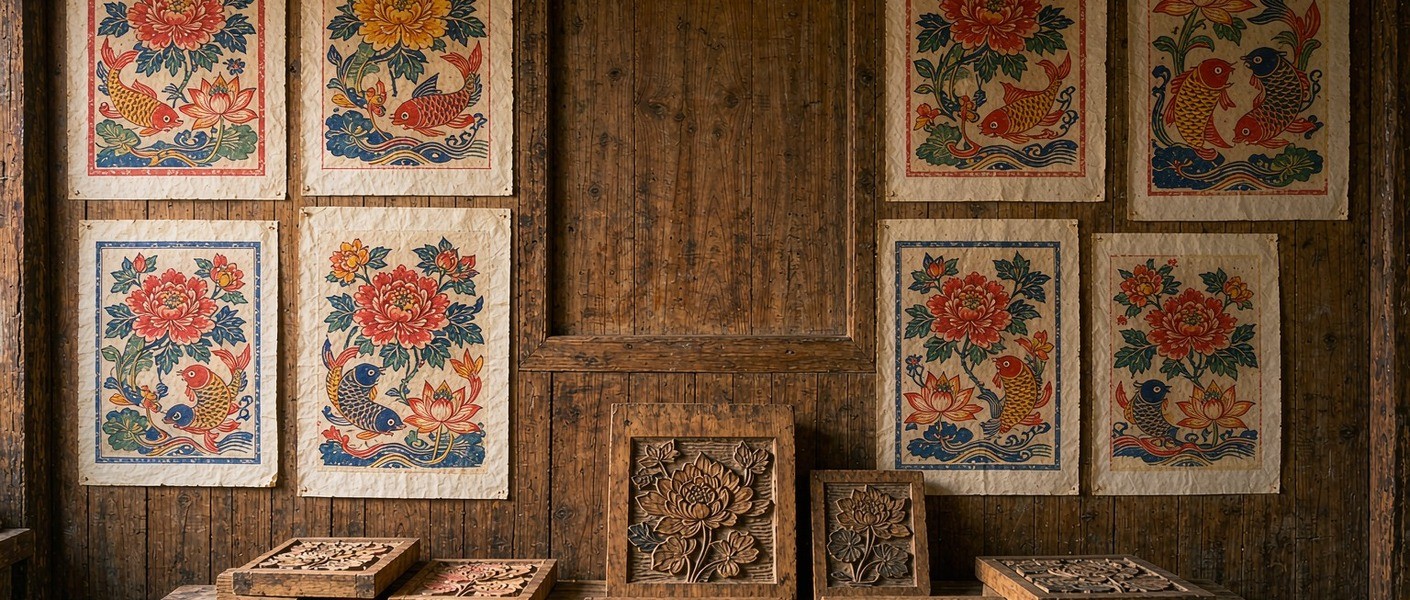
年画是中国人贴在门上墙上的祝福。天津西青区杨柳青镇的木版年画,2006 年列入国家级非物质文化遗产名录,与苏州桃花坞年画并称「南桃北柳」。它的看家本事叫「半印半绘」:木版印骨架,手工上血肉,一张画是印出来的,也是画出来的。
▍一、名称与起源地
杨柳青木版年画产于天津市西青区杨柳青镇。镇子贴着京杭大运河,明清漕运兴盛时,南来北往的船把这里的画带到各地。据央广网报道,鼎盛时期这座运河边的小镇「家家会点染,户户善丹青」,是远近闻名的年画之乡。一门贴在墙上的手艺,长在一个通航的码头上,不是巧合。
运河边的古镇街巷,沿街立面挂着一排排年画
▍二、历史背景
据人民日报客户端与央广网的介绍,杨柳青木版年画始兴于明代,至清代雍乾嘉年间为鼎盛期,传承至今四百多年。早期是工艺简单的过稿画,画师完稿后摹拓多份填色;后来需求激增,才引入木版印刷,先印墨线坯子,再套印色版,最后手工彩绘细部。年画的题材从门神到娃娃,从戏文到时事,被称为民间生活的「百科全书」。
▍三、工艺特色
杨柳青年画共五道工序:勾、刻、印、绘、裱。勾是画师起稿;刻是把稿子反刻在杜梨木版上,木质坚硬、纹理细腻,一个版要经得住印几百张;印是套印墨线与色版;绘是手工彩绘,人物的脸和手尤其讲究,行话叫「开手脸」,一张小脸要晕染十余遍才透出活气;裱是托裱成幅。据中国新闻网报道,正是「半印半绘」让每张年画独一无二。
工作台上梨木版与印好的线稿并排,一旁排开颜料碟
▍四、文化价值
年画是中国年俗的组成部分,杨柳青是其中的一处高地。代表作《莲年有馀》里,胖娃娃怀抱大鱼、手持莲花,据中国新闻网对传承人的采访介绍,那条鱼融合了金鱼尾、鲫鱼身与鲤鱼头,娃娃的发型半是男辫半是女箍,取儿女双全之意,莲花谐「连」,寓意连年有余。一张画把一个家庭的愿望说得齐全,这种图像语言是文字之外的另一种记录。
▍五、传承现状
现代印刷的冲击是实打实的,据央广网报道,高仿机器印刷品一度挤压手工年画的市场。转机来自两头:一头是存护,天津杨柳青画社作为国家级非遗项目保护单位,自 1958 年成立以来完整传承五道技艺体系,珍藏古版 6400 余块;老一辈传承人几十年间搜集修复散落各地的古版画稿上百块。另一头是更新,「玉成号」画庄已传至第七代,新一代把国潮元素与年轻审美带进创作,线上科普与非遗进校园同步在做。年画从墙上走到了屏幕上,再往哪里走,看接棒的人。
杨柳青木版年画 2006 年列入国家级非物质文化遗产名录,产地为天津市西青区杨柳青镇,与苏州桃花坞木版年画并称「南桃北柳」。(来源:央广网、天津市文化和旅游局)
▍问答
问 | 杨柳青年画为什么叫半印半绘,和全印刷年画差在哪
答 | 差在「绘」这一道。全印刷年画印完即成品,张张相同;杨柳青年画印出墨线与色版后,脸和手等关键部位由手工一笔笔晕染,一张小脸要上十余遍颜色。所以杨柳青的成品没有两张完全一样,人物有「活气」,这是机器印不出来的。
问 | 年画买回去怎么保存
答 | 怕光、怕潮、怕折。纸本彩绘经不住长期日晒,颜色会褪;潮湿会引霉斑与粘连。常悬挂宜避直射光,收藏时平放夹在无酸纸间,勿卷折。旧画破损不要自行修补,托裱修复要交专业装裱师。
问 | 年画在韵和鸣的品类里吗
答 | 目前整合的是漆、竹、绣、银、锦、瓷六条线,年画不在其中。但介绍它是这个栏目的本分,看见全国各处的好手艺,本就是韵和鸣在做的事。品类可以慢慢扩,门槛不会变:真非遗、真匠人、核心工序手工完成。
📩 非遗项目 | 匠人举荐 | 跨境出海 | 线下联营
欢迎留言或后台联系,我们与匠人同行。
—— 韵和鸣 · 与匠人同行
〖 遗 〗
相关搜索 | RELATED SEARCHES
杨柳青年画 · 半印半绘 工艺 · 南桃北柳 · 木版年画 国家级非遗 · 年画 保存
English
Yangliuqing prints come from the town of the same name in Xiqing district, Tianjin, hard against the Grand Canal. When canal shipping boomed in the Ming and Qing, boats carried the town's pictures to every quarter. At its height, as CNR reported, this canal-side town saw "every household skilled in tinting, every door practised in brushwork". A craft meant for walls growing up on a working wharf is no coincidence.
Streets of the canal-side old town, rows of New Year prints hung along the facades
As People's Daily's client service and CNR introduce it, the craft rose in the Ming and peaked through the Yongzheng, Qianlong and Jiaqing reigns of the Qing, over four hundred years of continuous practice. Early works were simple transfer drawings, a master's outline traced and coloured by hand; surging demand later brought in woodblock printing, first the ink outline, then colour blocks, and hand painting for the finer parts. Subjects ran from door gods to plump babies, from opera scenes to current events, earning prints the name of an encyclopaedia of common life.
Five steps compose the craft: drawing, cutting, printing, painting and mounting. Drawing sets the composition; cutting carves it in reverse into hard, fine-grained pearwood blocks built to survive hundreds of impressions; printing lays the ink outline and colour blocks; painting is done by hand, faces and hands above all, what the trade calls "opening the face", a small face washed over a dozen times before it glows; mounting finishes the sheet. As China News Service reported, it is this half printed, half painted method that leaves every print unlike any other.
On the workbench a pearwood block beside a printed outline, paint dishes arrayed nearby
New Year prints belong to China's festival customs, and Yangliuqing is one of its high grounds. In the classic Abundance Year After Year, a plump child holds a lotus and cradles a great fish; as China News Service was told by the bearer, that fish fuses the tail of a goldfish, the body of a crucian and the head of a carp, while the child's hair is half a boy's queue and half a girl's fringe, wishing for both sons and daughters, the lotus punning on "year after year". One sheet speaks a household's whole wish; this picture-language is a record writing keeps alongside words.
Modern printing has bitten hard; as CNR reported, high-fidelity machine copies once squeezed the handmade market. The turn comes from two ends. One is safekeeping: the Tianjin Yangliuqing Fine Arts Press, the item's national protecting body, has carried the five-step system intact since 1958 and keeps some 6,400 antique blocks, while the older generation of bearers spent decades gathering and restoring scattered blocks and drafts, a hundred-odd in all. The other is renewal: the Yuchenghao studio has reached its seventh generation, the young bringing guochao elements and younger taste into new work, alongside online outreach and heritage classes in schools. From wall to screen the prints have moved; where they go next lies with those taking the baton.
Yangliuqing woodblock New Year prints entered the national intangible heritage list in 2006, first batch, from Yangliuqing town, Xiqing district, Tianjin, paired with Suzhou's Taohuawu as "peach of the south, willow of the north". (Sources: CNR; Tianjin Municipal Bureau of Culture and Tourism)
Why is Yangliuqing called half printed, half painted, and how does it differ from fully printed pictures?
The difference is the painting. A fully printed sheet leaves the press finished, identical by the thousand; Yangliuqing prints, after the outline and colour blocks, take hand-work on the faces and hands, a small face washed with colour a dozen times. No two finished sheets are exactly alike, and the figures carry a living glow no machine lays down.
How should a print be kept at home?
It fears light, damp and creasing. Painted paper cannot take long sunlight without fading, and humidity invites mould and sticking. Hang away from direct light; for storage lay flat between acid-free sheets and never roll or fold. Damaged old prints should not be patched at home; mounting and repair belong to a professional conservator.
Are New Year prints among YUNHEMING's categories?
The six lines held at present are lacquer, bamboo, embroidery, silver, brocade and porcelain; prints are not among them. Yet introducing them is this column's duty, for seeing the country's good crafts is what the brand does. Categories may grow slowly; the threshold will not: genuine heritage, genuine makers, core steps by hand.
What pictures did your family paste at New Year? Is there one you studied at the doorstep as a child? Tell us in the comments.
ICH Projects · Artisan Referrals · Global Distribution · Salon Partnerships
你可能还感兴趣
苗族银饰锻制技艺:三十多道工序,做一身能走路的银
苗族银饰锻制技艺以三十多道工序,将银料制成头饰、颈饰、胸饰等整套盛装。本文梳理其产区、流变、錾刻与焊接特点,并说明为何用料分量不能替代工艺判断及其传承难题。
韵和鸣 · 2026/10/24 · 107 阅读
一件漆器该有多重,手感不会说谎
严选器物,看纹样、看款识、看证书,都是明面上的事。但有一道标准写不进任何参数表——上手。同一尺寸的两只漆盘,一只压手温润,一只轻飘干瘪,差别从何而来?这次把"分量"这件事拆开讲。说到底,重量是工序的记账本。
韵和鸣 · 2026/10/14 · 55 阅读
漆器能不能装热水?苏绣会不会勾丝?四个常被问到的问题
后台每周都会收到一批重复的问题,大多集中在"买回去怎么用":漆器能不能装热水、能不能进洗碗机,苏绣小饰品日常会不会勾丝,绣品怎么装框才不伤绣面。今天一次答清,另外说说怎么分辨一个品牌是不是"挂名非遗"。说到底,能不能用得久,才是检验的起点。
韵和鸣 · 2026/10/24 · 54 阅读
一盏博山琉璃:颜色是炉火给的,不是颜料调的
博山琉璃的颜色由矿石、着色配方和炉温共同形成,鸡油黄等色料并非烧成后涂在表面。文章介绍挑料、吹制、塑型、灯工和内画,说明流纹、气泡与壁厚如何反映手工过程,并提供观察颜色、过渡和口沿的选器方法。
韵和鸣 · 2026/10/12 · 53 阅读
一张蔚县剪纸,彩色的刻刀活
严选录这一期看一张不太一样的剪纸:它不用剪刀,用刻刀;不止红色,还带着点染出来的粉与绿。河北张家口蔚县的剪纸,是剪纸大家族里"反着来"的一支——别处以剪为主、以红为正,蔚县以刻代剪、以点彩上色。说到底,这两个"反着来"的本质,是蔚县人把剪纸从窗前的女红,做成了作坊里的分工手艺:看懂了这一点,才算看懂了这张纸。
韵和鸣 · 2026/10/13 · 52 阅读
一枚漆书签:小物件为什么反而更考验手艺
漆书签体量小,却同时暴露胎体稳定、漆层附着、边缘打磨与日常耐用度。挑选时先看薄厚与侧面,再摸边缘和转角,比只看纹样更能判断小件工序是否扎实,也值得问清售后修复。
韵和鸣 · 2026/10/24 · 48 阅读