黎锦:一部穿在身上的史书,和四道不肯省的手艺
韵和鸣 · 韵和鸣公众号 · 2026/11/3 12:00:00 · 1 阅读
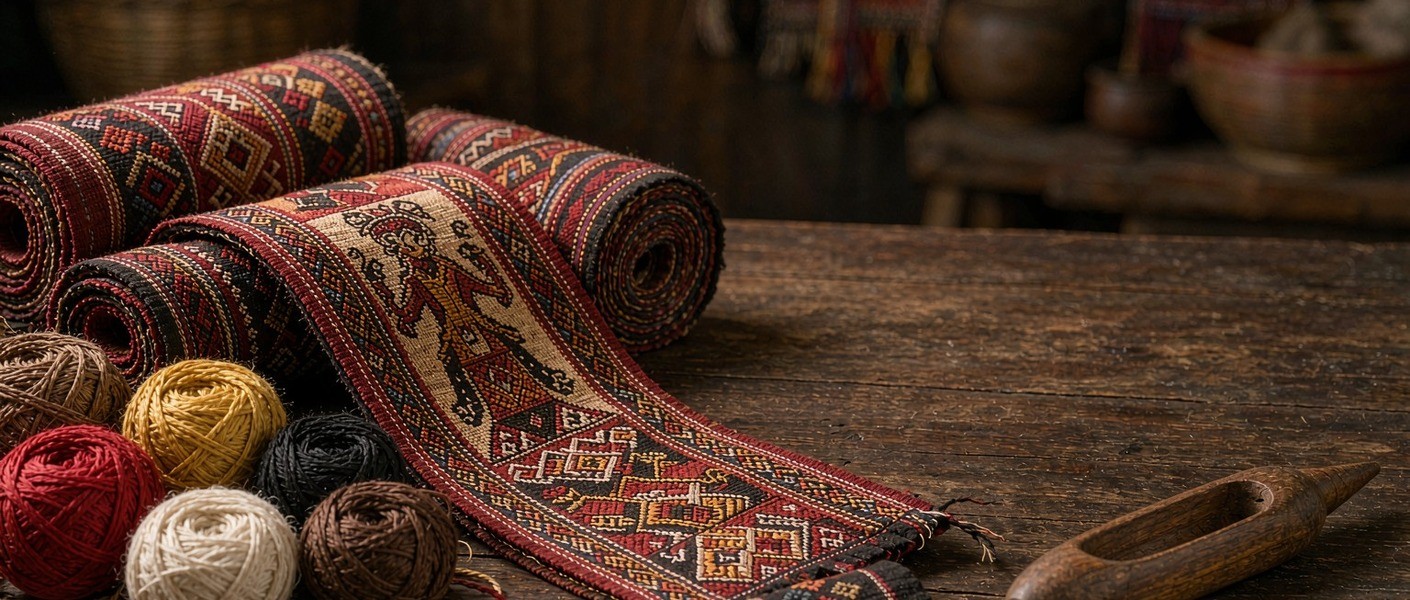
在没有文字的年代,一个民族会把历史织进布里。海南岛上的黎族就是这样记事的。黎锦不是一块花布,它的纹样里记着祖先、图腾、婚嫁与节气;能做这块布的手艺,叫黎族传统纺染织绣技艺。
▍名称与起源地
黎族传统纺染织绣技艺,是海南省黎族妇女用棉、麻等天然纤维制作衣物与生活用品的传统手工艺,由纺、染、织、绣四类技艺构成完整体系,成品统称为黎锦。据中国非物质文化遗产网项目页,该项目 2006 年列入国家级非物质文化遗产名录,项目序号 369,项目编号 Ⅷ-19,类别为传统技艺;保护单位分布于五指山市、白沙黎族自治县、保亭黎族苗族自治县、乐东黎族自治县与东方市。
黎锦筒裙的局部,几何纹样在棉线上层层排开
▍历史背景
这门手艺的年头可以从文献里往回追。据公开史料记载,《尚书·禹贡》有「岛夷卉服,厥篚织贝」之句,「岛夷」指海南岛黎族先民,「织贝」是棉织品;西汉时已有精美的「广幅布」被征作岁贡。宋人周去非《岭外代答》记下黎单、黎饰、鞍搭等名目,说明当时的织造已有多种规格。
因为织造技术长期保存在家庭与村寨内部,黎锦常被称为中国纺织史的活化石。
▍工艺特色
四大工艺各有门道。纺,用的是手捻纺轮与脚踏纺车,原料取自当地的木棉与野麻。染,染料以植物的叶、花、树皮、树根为主,天然矿物颜料为辅。
最特别的是絣染。它先扎经线,再染线,最后才织布,把扎、染、织三道工序连在一起完成,纹样在织造之前就已经定好。这一路数在我国织染体系里极为少见。
织,靠的是踞腰织机与脚踏织机。踞腰织机极为古老,织者以腰身控制经线张力,靠手提综,能在窄幅上织出复杂图案。绣,分单面绣与双面绣,其中白沙润方言区女子上衣的双面绣最为著名,两面都看不到线头。
踞腰织机上的经线,扎结处留出未染的白痕
▍文化价值
黎锦的图案据项目页介绍有一百六十种以上,多取人物、动物、植物与生活用具。在过去,不同图案、色彩与风格的黎锦,曾是区分血缘部落群体的标志。
黎锦中的珍品叫龙被,又称大被,史称崖州被。它集纺、染、织、绣于一体,制作精巧,历代曾作为海南进贡的珍品。一块龙被上能看到这门手艺的全部四个环节,这也是它被看作技艺顶点之一的原因。
▍传承现状
据中国非物质文化遗产网项目页的保护实践总结,2009 年该项目列入联合国教科文组织急需保护的非物质文化遗产名录;据公开报道,2024 年 12 月,联合国教科文组织保护非物质文化遗产委员会审议通过将其转入人类非物质文化遗产代表作名录。
保护工作也已铺开。海南省陆续制定《黎族传统纺染织绣技艺传承人保护培养暂行办法》等规范性文件;省级财政投入专项资金,在项目五个保护单位所在地的村一级命名了十六个传承村、十六个传习所,在市县一级建立五个传习馆。国家级代表性传承人容亚美在项目页上有载。
▍问答
问 | 黎锦是哪个民族的手艺,产自哪里
答 | 是海南黎族的手艺,主要流传于五指山、白沙、保亭、乐东、东方等市县。据中国非物质文化遗产网项目页,黎族传统纺染织绣技艺 2006 年列入国家级非物质文化遗产名录,项目编号 Ⅷ-19,由纺、染、织、绣四道技艺构成,成品统称黎锦。
问 | 絣染和普通扎染有什么不同
答 | 顺序不同。絣染先扎经线、再染线、最后才织布,纹样在织造之前就已被扎结决定;普通扎染多在织好的布上扎结后入染。絣染把扎、染、织连成一道工序,这也是它在我国织染体系中少见的原因。
问 | 韵和鸣的品类里有织锦和刺绣吗
答 | 有。韵和鸣以国家级非遗平遥推光漆器髹饰技艺起家,如今整合漆、竹、绣、银、锦、瓷多个门类,织锦与刺绣都在其中。收进来的门槛不分产地:必须是真正的非遗手工品,只与传承人本人合作,核心工序手工完成。
▍说在最后
一门手艺记着什么,往往不看它写了什么,看它织了什么。你家乡有没有这样一块「会记事的布」?留言说说,我们去看。
📩 非遗项目 | 匠人举荐 | 跨境出海 | 线下联营
欢迎留言或后台联系,我们与匠人同行。
—— 韵和鸣 · 与匠人同行
〖 遗 〗
相关搜索 | RELATED SEARCHES
黎锦 黎族传统纺染织绣技艺 · 海南 五指山 黎锦 非遗 · 絣染 扎染 区别 · 踞腰织机 是什么 · 龙被 崖州被 黎锦
English
The traditional Li spinning, dyeing, weaving and embroidery technique is the craft by which Li women in Hainan make clothing and household items from cotton, hemp and other natural fibres. It forms a complete system of four skills, and the resulting cloth is known collectively as Li brocade. According to the project page on the China Intangible Cultural Heritage website, the item was listed as a national-level intangible cultural heritage item in 2006, with serial number 369, project code Ⅷ-19, in the traditional craftsmanship category; protecting bodies are located in Wuzhishan, Baisha, Baoting, Ledong and Dongfang.
A detail of a Li brocade skirt, geometric patterns laid out row upon row in cotton thread
The craft's age can be traced back through texts. According to publicly available historical records, the Tribute of Yu in the Book of Documents speaks of "the island peoples in grass cloth, their baskets of woven cowries", where the island peoples are the Li ancestors of Hainan and woven cowries means cotton cloth; by the Western Han, fine "broad-width cloth" was being levied as annual tribute. Zhou Qufei's Lingwai Daida of the Song dynasty records names such as lidan, lishi and anda, showing that weaving then already came in several grades.
Because the weaving technique was long preserved within households and villages, Li brocade is often called a living fossil of Chinese textile history.
Each of the four skills has its own discipline. Spinning uses a hand-twisted spindle whorl and a treadle spinning wheel, with local kapok and wild hemp as raw material. Dyeing uses plant leaves, flowers, bark and roots as the main dyestuffs, with natural mineral pigments as a supplement.
The most distinctive is warp-binding dyeing. The warp is tied first, then dyed, and only afterwards woven; binding, dyeing and weaving are completed as one continuous sequence, and the pattern is fixed before weaving begins. This route is rare within China's dyeing and weaving systems.
Weaving relies on the back-strap loom and the treadle loom. The back-strap loom is extremely old; the weaver controls warp tension with the body and lifts heddles by hand, producing complex patterns on a narrow width. Embroidery comes in single-sided and double-sided forms, the double-sided work on women's jackets in the Run dialect area of Baisha being the best known, with no thread ends visible on either face.
Warp threads on a back-strap loom, the tied sections left undyed in white
According to the project page, Li brocade patterns number more than 160, mostly drawn from figures, animals, plants and household implements. In the past, differing patterns, colours and styles marked out kin-based tribal groups.
The treasure among Li brocades is the dragon quilt, also called the great quilt and known in history as the Yazhou quilt. It combines spinning, dyeing, weaving and embroidery in one piece, is finely made, and was offered as tribute from Hainan through successive dynasties. A single dragon quilt shows all four stages of the craft at once, which is why it is regarded as one of its highest points.
According to the protection summary on the China Intangible Cultural Heritage project page, the item was inscribed in 2009 on UNESCO's List of Intangible Cultural Heritage in Need of Urgent Safeguarding; by public reports, in December 2024 the UNESCO Intergovernmental Committee approved its transfer to the Representative List of the Intangible Cultural Heritage of Humanity.
Protection work has also been extended. Hainan has issued normative documents including the Interim Measures for the Protection and Training of Bearers of the Traditional Li Spinning, Dyeing, Weaving and Embroidery Technique; provincial funds have been allocated, sixteen transmission villages and sixteen teaching houses have been named at village level across the five protecting bodies, and five teaching halls established at city and county level. The national-level representative bearer Rong Yamei is recorded on the project page.
Which people's craft is Li brocade, and where is it made?
It is the craft of the Li people of Hainan, mainly transmitted in Wuzhishan, Baisha, Baoting, Ledong and Dongfang. According to the China Intangible Cultural Heritage project page, the traditional Li spinning, dyeing, weaving and embroidery technique was listed as a national-level item in 2006 under project code Ⅷ-19, made up of four skills, with the cloth known as Li brocade.
How does warp-binding dyeing differ from ordinary tie-dye?
The order differs. Warp-binding dyeing ties the warp, dyes the thread and only then weaves, so the pattern is decided by the ties before weaving begins; ordinary tie-dye usually binds and dyes cloth that is already woven. Warp-binding joins the three stages into one sequence, which is why it is rare in China's dyeing and weaving traditions.
Does YUNHEMING's range include brocade and embroidery?
Yes. YUNHEMING began with Pingyao polished lacquerware, a national-level item, and now covers lacquer, bamboo, embroidery, silver, brocade and porcelain, with both brocade and embroidery included. The threshold does not vary by origin: genuine handmade heritage work, collaboration only with the bearers themselves, and core steps done by hand.
What a craft remembers is often found not in what it wrote but in what it wove. Is there such a remembering cloth where you come from? Leave a comment and we will go and see.
ICH Projects · Artisan Referrals · Global Distribution · Salon Partnerships
你可能还感兴趣
苗族银饰锻制技艺:三十多道工序,做一身能走路的银
苗族银饰锻制技艺以三十多道工序,将银料制成头饰、颈饰、胸饰等整套盛装。本文梳理其产区、流变、錾刻与焊接特点,并说明为何用料分量不能替代工艺判断及其传承难题。
韵和鸣 · 2026/10/24 · 100 阅读
一件漆器该有多重,手感不会说谎
严选器物,看纹样、看款识、看证书,都是明面上的事。但有一道标准写不进任何参数表——上手。同一尺寸的两只漆盘,一只压手温润,一只轻飘干瘪,差别从何而来?这次把"分量"这件事拆开讲。说到底,重量是工序的记账本。
韵和鸣 · 2026/10/14 · 54 阅读
漆器能不能装热水?苏绣会不会勾丝?四个常被问到的问题
后台每周都会收到一批重复的问题,大多集中在"买回去怎么用":漆器能不能装热水、能不能进洗碗机,苏绣小饰品日常会不会勾丝,绣品怎么装框才不伤绣面。今天一次答清,另外说说怎么分辨一个品牌是不是"挂名非遗"。说到底,能不能用得久,才是检验的起点。
韵和鸣 · 2026/10/24 · 53 阅读
一盏博山琉璃:颜色是炉火给的,不是颜料调的
博山琉璃的颜色由矿石、着色配方和炉温共同形成,鸡油黄等色料并非烧成后涂在表面。文章介绍挑料、吹制、塑型、灯工和内画,说明流纹、气泡与壁厚如何反映手工过程,并提供观察颜色、过渡和口沿的选器方法。
韵和鸣 · 2026/10/12 · 50 阅读
一张蔚县剪纸,彩色的刻刀活
严选录这一期看一张不太一样的剪纸:它不用剪刀,用刻刀;不止红色,还带着点染出来的粉与绿。河北张家口蔚县的剪纸,是剪纸大家族里"反着来"的一支——别处以剪为主、以红为正,蔚县以刻代剪、以点彩上色。说到底,这两个"反着来"的本质,是蔚县人把剪纸从窗前的女红,做成了作坊里的分工手艺:看懂了这一点,才算看懂了这张纸。
韵和鸣 · 2026/10/13 · 49 阅读
一枚漆书签:小物件为什么反而更考验手艺
漆书签体量小,却同时暴露胎体稳定、漆层附着、边缘打磨与日常耐用度。挑选时先看薄厚与侧面,再摸边缘和转角,比只看纹样更能判断小件工序是否扎实,也值得问清售后修复。
韵和鸣 · 2026/10/24 · 47 阅读