建窑建盏:一色入窑,出窑万彩
韵和鸣 · 韵和鸣公众号 · 2026/11/2 12:00:00 · 1 阅读
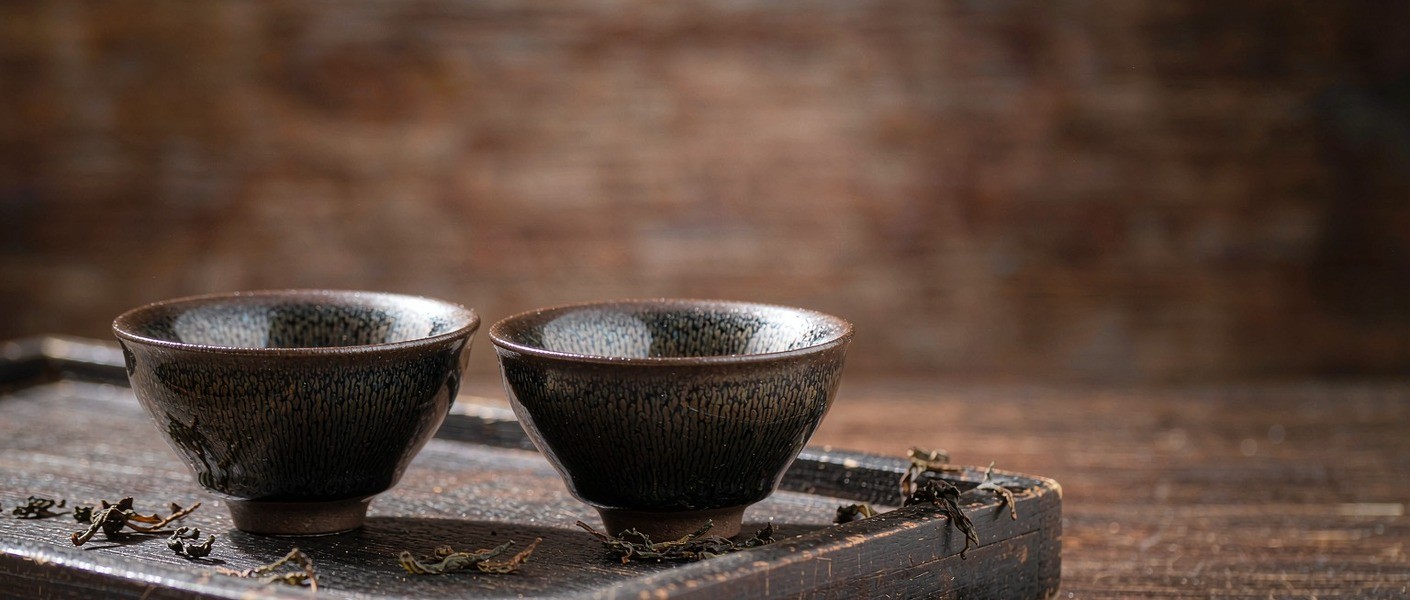
所谓建盏,指的是福建南平建阳一带烧造的黑釉茶盏;一只看似全黑的碗,釉面里藏着兔毫、油滴、鹧鸪斑与曜变。中国陶瓷史上,黑瓷的高峰出现在闽北。建窑建盏烧制技艺于 2011 年列入第三批国家级非物质文化遗产代表性项目名录,产地核心在福建省南平市建阳区水吉镇。一只看起来只有黑色的碗,釉面里藏着兔毫、油滴、鹧鸪斑与曜变。
▍一、起源地:一条溪,一座山,一种含铁的土
建窑遗址散布在水吉镇的芦花坪、牛皮仑、大路后门、营长乾等地。据福建省文物局公开资料,遗址中最长的龙窑斜长 135.6 米,2001 年被国务院公布为第五批全国重点文物保护单位。
这里能烧出建盏,靠的是三样东西:含铁量高的胎土与釉料,山间的柴,以及南浦溪提供的水路。溪水汇入建溪、闽江,直通海路,器物烧成后可以顺流出去。
闽北窑址旁的溪谷与远山,柴烧与外运都曾依赖这条水路
▍二、历史背景:从晚唐到两宋,再到失而复得
据公开资料,建窑创烧于晚唐五代,早期以青瓷为主,五代末至北宋初开始烧造黑瓷,两宋时期达到鼎盛。南宋晚期,随着闽地黑釉瓷生产中心南移、饮茶风俗变化等因素,建盏逐渐退出日常,烧制技艺一度失传。
转机出现在二十世纪。1979 年,由中央工艺美院、福建省科委、福建省轻工所、建阳瓷厂等联合组成的攻关小组开始仿古建盏实验,1981 年研制出仿宋兔毫盏;此后油滴、鹧鸪斑、曜变等品种陆续复烧成功。
▍三、工艺特色:十三道工序,最后一道交给火
据公开资料,建盏烧制一般要经过选瓷矿、碎土、淘洗、配料、陈腐、练泥揉泥、拉坯、修坯、素烧、上釉、装窑、焙烧等十三道工序。
关键在于两处。一处是泥与釉的含铁量,它决定了胎的厚重与釉的走向;另一处是焙烧时的高温与还原气氛,兔毫、油滴这些结晶纹样是在窑内高温下自然析出,难以完全由人工控制。行内所谓「入窑一色,出窑万彩」,说的就是这一步的不可控。
黑釉茶盏的口沿特写,釉面析出细密的丝状结晶
▍四、文化价值:为斗茶而生的一只碗
茶色白,宜黑盏。(蔡襄《茶录》,宋代茶书)
两宋斗茶,以茶沫「色白为贵」。黑釉建盏与白色茶沫形成强烈反差,便于验看;且胎体厚重,利于茶汤保温。蔡襄《茶录》中「茶色白,宜黑盏」一句,说的正是这件事。束口、敛口、撇口、敞口等器型,也都是围绕点茶的需要长出来的。
建盏也随海上丝绸之路远行。据公开资料,宋元时期建盏与建窑系黑釉瓷销往日本、朝鲜半岛、东南亚等地,在世界陶瓷史与茶史上占有独特位置。
▍五、传承现状:名录、地标与一代代人
制度层面,建窑建盏烧制技艺 2011 年列入第三批国家级非物质文化遗产代表性项目名录;2016 年,建盏获国家地理标志保护产品,产地范围明确为南平市建阳区现辖行政区域;2018 年,该技艺入选首批国家传统工艺振兴目录。
人的层面,技艺恢复之后靠师徒接续。据公开资料,孙建兴是第四批国家级非物质文化遗产项目建窑建盏烧制技艺代表性传承人,自 1972 年起从事陶瓷研究,1979 年参与恢复建窑项目,研制出金兔毫、金油滴、鹧鸪斑等多种建盏;其女孙莉为建盏烧制技艺省级代表性传承人。
▍问答
问 | 建窑建盏烧制技艺是哪一年列入国家级非遗名录的
答 | 2011 年,列入第三批国家级非物质文化遗产代表性项目名录。建盏于 2016 年获国家地理标志保护产品,产地范围为南平市建阳区现辖行政区域;该技艺于 2018 年入选首批国家传统工艺振兴目录。
问 | 兔毫、油滴这些釉面花纹是画上去的吗
答 | 这些纹样在窑内高温与还原气氛中自然析出,属结晶效果,人工难以完全控制,并非描绘或绘制而成。这也是同一窑里每件作品釉色都有差别的原因;具体的呈色机理与工艺细节以专业研究与匠人实践为准。
问 | 韵和鸣只做平遥推光漆器吗,还看别的地方的手艺吗
答 | 起家技艺是平遥推光漆器髹饰技艺,但品牌的视野覆盖全国,整合漆、竹、绣、银、锦、瓷六大矩阵,只选真正的非遗手工品。建盏这类其他省份的技艺,我们同样会去看、去记录、去讲给更多人听。
▍说在最后
一只黑碗里能有多少种光,窑火说了不算,出窑那一刻才算。中国这样的手艺还有很多,我们一天讲一项,慢慢讲。
📩 非遗项目 | 匠人举荐 | 跨境出海 | 线下联营
欢迎留言或后台联系,我们与匠人同行。
—— 韵和鸣 · 与匠人同行
〖 遗 〗
相关搜索 | RELATED SEARCHES
建窑建盏 烧制技艺 · 建盏 兔毫 油滴 区别 · 福建 南平 建阳 非遗 · 国家级非遗 2011 第三批 · 建盏 地理标志 产品
English
Origin: A Stream, a Hill, an Iron-Rich Clay
The Jian kiln sites spread across Luhuaping, Niupilun, Daluhoumen and Yingchangqian in Shuiji Town. According to published material from the Fujian Provincial Cultural Heritage Bureau, the longest dragon kiln at the site runs 135.6 metres on the slope and was announced by the State Council in 2001 as a fifth-batch national key protected cultural relic unit.
Three things made Jian ware possible here: iron-rich body clay and glaze, firewood from the hills, and the water route offered by the Nanpu Stream. The stream joins the Jianxi and Minjiang rivers and reaches the sea, so finished ware could travel out downstream.
A valley and distant hills beside a northern Fujian kiln site; both firing and shipping once relied on this waterway
History: From Late Tang to the Song, Then Lost and Found
According to public sources, the Jian kiln began firing in the late Tang and Five Dynasties, producing mainly celadon at first and turning to black ware from the end of the Five Dynasties into the early Northern Song, reaching its height in the Song. In the late Southern Song, as production centres for black-glazed ware in Fujian moved south and tea customs changed, Jian ware withdrew from daily use and its technique was lost for a time.
The turn came in the twentieth century. In 1979 a joint task force formed by the Central Academy of Arts and Design, the Fujian Science and Technology Commission, the Fujian Light Industry Institute and the Jianyang porcelain factory began experiments to reproduce old Jian ware, succeeding in 1981 with a Song-style hare's fur bowl; oil spot, partridge mottle and yohen varieties followed.
Craft: Thirteen Steps, the Last Left to Fire
According to public sources, making a Jian bowl generally passes through thirteen steps: selecting ore, crushing, washing, mixing, ageing, kneading, throwing, trimming, biscuit firing, glazing, loading the kiln and firing.
Two points are critical. One is the iron content of clay and glaze, which sets the weight of the body and the behaviour of the glaze; the other is the high temperature and reduction atmosphere during firing, since crystalline effects such as hare's fur and oil spot precipitate naturally in the kiln and cannot be fully controlled by hand. The trade saying, one colour enters the kiln and ten thousand emerge, refers to this uncontrollability.
Close view of the rim of a black-glazed tea bowl, fine crystalline threads precipitated in the glaze
Cultural Value: A Bowl Made for Tea Competitions
E> For white tea, a black bowl is fitting.
In Song tea competitions, whiter froth was prized. Black-glazed Jian ware set the white froth in sharp contrast, making it easy to judge, and the thick body kept the tea warm. Cai Xiang's Record of Tea states plainly that white tea suits a black bowl. Shapes such as the contracted, narrowed, flared and open mouths all grew around the needs of whisked tea.
Jian ware also travelled the maritime silk road. According to public sources, during the Song and Yuan periods Jian ware and related black-glazed ceramics were sold to Japan, the Korean peninsula and Southeast Asia, holding a distinctive place in the history of world ceramics and tea.
Transmission Today: Listing, Geographical Indication, Generations
Institutionally, the Jian ware firing technique entered the third batch of national representative ICH items in 2011; in 2016 Jian ware obtained national geographical indication product protection, with the production area defined as the current administrative area of Jianyang District, Nanping; in 2018 the technique was included in the first national catalogue for revitalising traditional crafts.
On the human side, the craft has continued through masters and apprentices since its recovery. According to public sources, Sun Jianxing is a representative bearer of the Jian ware firing technique in the fourth national batch; he has worked in ceramics research since 1972, joined the Jian kiln restoration project in 1979, and developed gold hare's fur, gold oil spot and partridge mottle among other varieties. His daughter Sun Li is a provincial-level representative bearer of the technique.
In which year was the Jian ware firing technique listed as a national ICH item?
In 2011, in the third batch of national representative ICH items. Jian ware obtained national geographical indication product protection in 2016, with the production area set as the current administrative area of Jianyang District, Nanping, and the technique entered the first national catalogue for revitalising traditional crafts in 2018.
Are hare's fur and oil spot patterns painted on?
These patterns precipitate naturally under high temperature and a reduction atmosphere in the kiln as crystalline effects, difficult to control by hand rather than painted or drawn on. This is why pieces from the same kiln differ in glaze colour; the precise mechanism of colour formation and process details follow specialised research and the practice of makers.
Does YUNHEMING only work with Pingyao polished lacquerware, or does it look at crafts elsewhere?
The craft it began with is the Pingyao polished lacquerware decoration technique, yet the brand's view spans the country, bringing together six families of craft, lacquer, bamboo, embroidery, silver, brocade and porcelain, and selecting only genuine handmade heritage pieces. Crafts from other provinces, Jian ware among them, are equally things we go to see, record and tell others about.
How many kinds of light a black bowl can hold is not decided by the kiln fire but by the moment it comes out. China holds many crafts of this kind; we will tell one a day, slowly.
ICH Projects · Artisan Referrals · Global Distribution · Salon Partnerships
你可能还感兴趣
苗族银饰锻制技艺:三十多道工序,做一身能走路的银
苗族银饰锻制技艺以三十多道工序,将银料制成头饰、颈饰、胸饰等整套盛装。本文梳理其产区、流变、錾刻与焊接特点,并说明为何用料分量不能替代工艺判断及其传承难题。
韵和鸣 · 2026/10/24 · 100 阅读
一件漆器该有多重,手感不会说谎
严选器物,看纹样、看款识、看证书,都是明面上的事。但有一道标准写不进任何参数表——上手。同一尺寸的两只漆盘,一只压手温润,一只轻飘干瘪,差别从何而来?这次把"分量"这件事拆开讲。说到底,重量是工序的记账本。
韵和鸣 · 2026/10/14 · 54 阅读
漆器能不能装热水?苏绣会不会勾丝?四个常被问到的问题
后台每周都会收到一批重复的问题,大多集中在"买回去怎么用":漆器能不能装热水、能不能进洗碗机,苏绣小饰品日常会不会勾丝,绣品怎么装框才不伤绣面。今天一次答清,另外说说怎么分辨一个品牌是不是"挂名非遗"。说到底,能不能用得久,才是检验的起点。
韵和鸣 · 2026/10/24 · 53 阅读
一盏博山琉璃:颜色是炉火给的,不是颜料调的
博山琉璃的颜色由矿石、着色配方和炉温共同形成,鸡油黄等色料并非烧成后涂在表面。文章介绍挑料、吹制、塑型、灯工和内画,说明流纹、气泡与壁厚如何反映手工过程,并提供观察颜色、过渡和口沿的选器方法。
韵和鸣 · 2026/10/12 · 50 阅读
一张蔚县剪纸,彩色的刻刀活
严选录这一期看一张不太一样的剪纸:它不用剪刀,用刻刀;不止红色,还带着点染出来的粉与绿。河北张家口蔚县的剪纸,是剪纸大家族里"反着来"的一支——别处以剪为主、以红为正,蔚县以刻代剪、以点彩上色。说到底,这两个"反着来"的本质,是蔚县人把剪纸从窗前的女红,做成了作坊里的分工手艺:看懂了这一点,才算看懂了这张纸。
韵和鸣 · 2026/10/13 · 49 阅读
一枚漆书签:小物件为什么反而更考验手艺
漆书签体量小,却同时暴露胎体稳定、漆层附着、边缘打磨与日常耐用度。挑选时先看薄厚与侧面,再摸边缘和转角,比只看纹样更能判断小件工序是否扎实,也值得问清售后修复。
韵和鸣 · 2026/10/24 · 47 阅读