湘绣:一根丝线劈开,狮虎的毛才立得起来
韵和鸣 · 韵和鸣公众号 · 2026/11/10 12:00:00 · 1 阅读
中国四大名绣里,苏绣以雅,蜀绣以秀,粤绣以艳,湘绣以"活"。狮虎是它的招牌,鬅毛针把兽毛绣得根根立起,走两步回头看,那双眼睛像在跟人。这门绣活在长沙一带传了两千多年,靠的是一根线劈到极细之后还能把光留住。
▍一、起源地:长沙与沙坪
湘绣发源在湖南长沙一带。据中新网二〇二六年十月二十九日的报道,沙坪湘绣以长沙开福区沙坪街道为核心产区,是湘绣的典型代表,沙坪因此被称为"中国湘绣之乡"。
▍二、历史背景:两千年与二十年
湘绣的历史常被写作两千多年,这个说法指长沙一带刺绣传统的长度,马王堆汉墓出土的绣品是这条线上最早的实物见证之一。作为一个风格明确的绣种,它是在清代中后期随绣庄兴起、画师参与、针法体系化才成形的。
据中新网报道,二〇〇六年湘绣入选国家级非物质文化遗产名录,此后"沙坪湘绣"获评国家非物质文化遗产保护与传承基地,并获国家地理标志产品保护。这两件事把一门地方手艺放进国家保护的框架,也给了它一个可以对外说明的身份。
所谓湘绣,指以湖南长沙一带为产区、以蚕丝线在绸缎等底料上刺绣的传统美术类技艺,2006 年列入国家级非物质文化遗产名录(首批);此后沙坪湘绣获评国家非物质文化遗产保护与传承基地,并获国家地理标志产品保护。(据中国新闻网 2026 年 10 月 29 日报道)
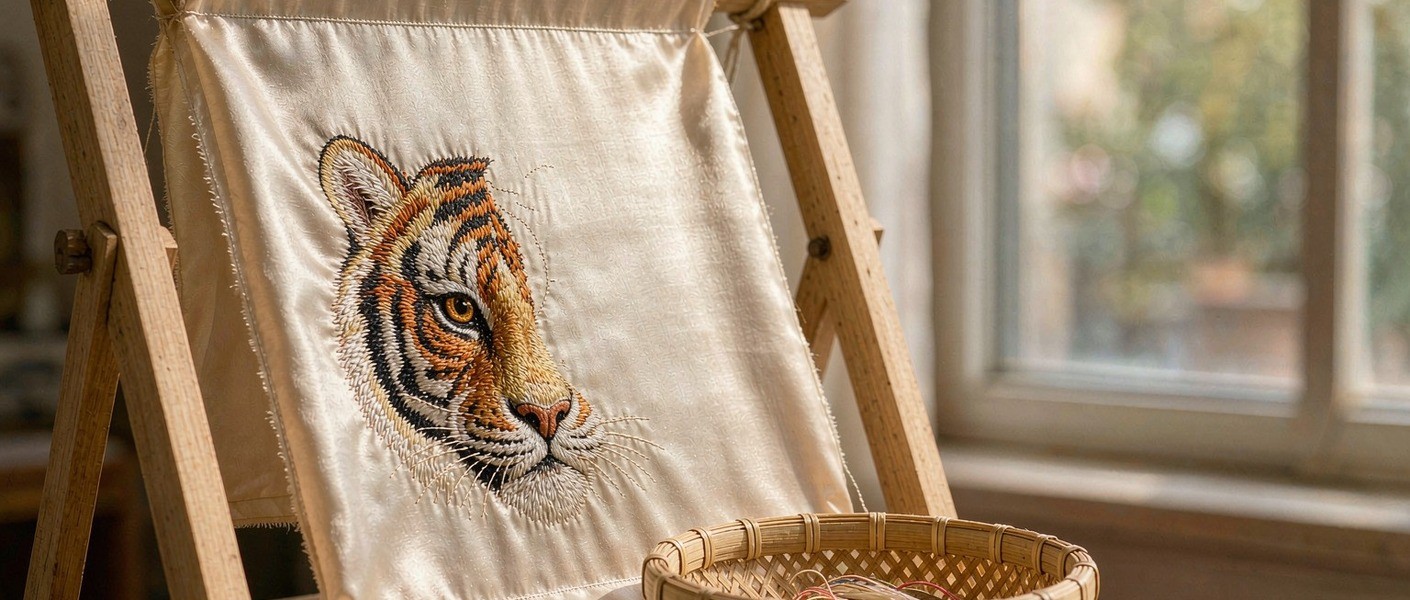
绣架上绷着一块素色绸面,一只绣到一半的虎头只完成了眼睛与鼻梁
▍三、工艺特色:劈线、鬅毛、双面
湘绣的头一道功夫在线上。一根蚕丝线可以劈成许多细丝,劈得越细,绣面越柔,光在丝上的走向也越可控。这一步全凭指尖,劈不匀,后面的针法都白搭。
第二道是鬅毛针。狮虎的毛要立起来,才有那股气势。做法是把针脚按毛的生长方向层层叠压,起针短、收针长,绣完用手指轻拨,毛会微微弹起。湘绣的绣法有十五种,每种又含多种针法,归纳起来七十余种。
第三道是双面。双面绣要求同一块底料正反两面图案都完整,线头不外露;更高一层的双面异绣,两面题材、针法、颜色都不同。这一门对走线与藏头要求极高,业内把它看作湘绣工艺的高点。
绣绷上并排摆着十几枚缠好丝线的小线板,颜色由浅到深排开
▍四、文化价值:绣花能生香
民间对湘绣有一句流传很广的评语:绣花能生香,绣鸟能听声,绣虎能奔跑,绣人能传神。四句说的都是同一件事,绣品要越过"像",走到"活"。
这也是湘绣在生活里的位置。据中新网报道,它传统上多用于婚嫁日用与家居陈设,如今拓展到轻奢饰品、空间软装、高端服饰,并与菊花石等湖南物产跨界结合。用途变了,那套针法体系没有变。
▍五、传承现状:绣工、产值与出海
据中新网二〇二六年十月二十九日的报道,沙坪湘绣年产值二点五亿元,吸纳近万名绣工;湖南省沙坪湘绣博物馆二〇〇七年创建、二〇一〇年开放,累计接待四百万人次。这门手艺有产业,也进了旅游与研学。
出海这条线也在走。据同一篇报道,当地出口的湘绣以高端定制为主,面向西欧、日韩、东南亚;欧洲客户更感兴趣的是结合当地文化的题材,如名人名画与肖像定制。
▍六、问答
问 | 湘绣是国家级非遗吗,什么时候列入的
答 | 是。二〇〇六年湘绣列入国家级非物质文化遗产名录,此后沙坪湘绣被评定为国家非物质文化遗产保护与传承基地,并获国家地理标志产品保护。它属于中国四大名绣之一,产区以长沙开福区沙坪街道为核心。
问 | 手工湘绣和机绣怎么分辨
答 | 看三处。看背面,手工的背面线迹有走向与起落,机绣的背面往往整齐得像另一幅画;看光,手工劈线细,光泽随角度连续变化,机绣的光更平;看针脚的微小差异,手工每一针深浅略有不同,机器的一致性反而成了破绽。
问 | 韵和鸣想买真正的非遗手工品,有什么可以问
答 | 可以直接问三件事:这件是谁做的、在哪里做的、哪些工序是手工完成的。韵和鸣的器物覆盖漆、竹、绣、银、锦、瓷等品类,每一件都能说清来源;当下有什么,可以到公众号后台或线下会客厅询问,会如实介绍来历与做法。
▍说在最后
湘绣最动人的地方,是把一根线劈到几乎看不见,再让这点看不见的东西去承担一只老虎的气势。手艺的门槛有时不在动作多复杂,而在愿不愿意在一个极小的尺度上,把同一件事反复做下去。
📩 非遗项目 | 匠人举荐 | 跨境出海 | 线下联营
欢迎留言或后台联系,我们与匠人同行。
—— 韵和鸣 · 与匠人同行
〖 遗 〗
相关搜索 | RELATED SEARCHES
湘绣 · 湘绣 鬅毛针 · 沙坪湘绣 · 双面绣 双面异绣 · 湘绣 国家级非遗 · 湘绣 怎么分辨 手工 机绣
English
Xiang embroidery began around Changsha in Hunan. China News Service reported on 29 October 2026 that Shaping embroidery, centred on Shaping subdistrict in Kaifu district, is the typical representative of the tradition, which is why Shaping is called the hometown of Chinese Xiang embroidery.
The location is no accident. Central Hunan produced silk, and Changsha was long a trading port with water routes to Hankou and Shanghai, so the craft had both material and market. Embroidery houses gathered painters, embroiderers and mounters under one roof, which is how needlework moved from household sewing to a finely divided trade.
The two-thousand-year figure refers to the length of the embroidery tradition around Changsha, with the Han tomb finds at Mawangdui among its earliest physical witnesses. Xiang embroidery as a distinct style with a clear character took shape later, through the Qing dynasty as embroidery houses rose, painters joined in and stitch systems were codified.
China News Service reports that Xiang embroidery entered the national intangible cultural heritage list in 2006, after which Shaping embroidery was designated a national base for heritage protection and transmission and gained geographical indication protection. Listing and indication together placed a regional craft inside a national framework and gave it an identity that can be stated abroad.
Xiang embroidery is the traditional fine-art technique practised around Changsha in Hunan, stitching silk thread onto satin grounds. It entered the first batch of the national list in 2006, and Shaping embroidery was later designated a national base for heritage protection and transmission and gained geographical indication protection, according to China News Service on 29 October 2026.
A plain silk panel on a frame, a half-worked tiger head with only the eyes and bridge of the nose done
The first skill is in the thread. One silk strand can be split into many filaments; the finer the split, the softer the surface and the more controllable the way light travels. All of it is done by fingertip. An uneven split undoes every stitch that follows.
The second is the pengmao stitch. A lion or tiger needs its fur standing to carry force. Stitches are layered along the direction of growth, short where they start and long where they end, so that a light brush of the finger makes the fur spring. China News Service notes that Xiang embroidery counts some fifteen methods, each holding several stitches, seventy-odd in all.
The third is doubleness. Double-sided work requires a complete image on both faces of one ground, with no thread ends showing; the harder variant differs in subject, stitch and colour between the two sides. Routing and hiding ends become exacting, which is why the trade treats it as the high point of the craft.
According to the same report, a piece passes through drafting, plate-making, printing, thread matching and embroidery, then inspection, pressing and framing. Only then is it finished. Stitching is one segment; drawing comes before and mounting after.
A dozen small bobbins wound with silk laid out beside an embroidery hoop, shades running light to dark
Cultural Value: Embroidery That Seems To Smell of Flowers
A well-known saying about Xiang embroidery runs: embroider a flower and it seems to smell, a bird and you seem to hear it, a tiger and it seems to run, a person and the spirit comes through. All four say one thing: the work must pass beyond likeness into life.
That is also its place in daily life. The report notes that Xiang embroidery was traditionally used for wedding goods and home display, and now extends to accessories, interior textiles and high-end clothing, and is combined with other Hunan materials such as chrysanthemum stone. From dowry to interior, the use changed; the stitch system did not.
Transmission: Hands, Output and Going Abroad
China News Service reported on 29 October 2026 that Shaping embroidery reaches an annual output value of 250 million yuan and employs nearly ten thousand embroiderers, and that the Hunan Shaping Xiang Embroidery Museum was founded in 2007 by the head of a local embroidery firm and opened in 2010, having received four million visitors since. The figures show an industry, and show the craft inside tourism and study programmes.
Export is moving too. The same report says local firms export mainly high-end commissioned work to Western Europe, Japan, Korea and Southeast Asia, and that European clients favour subjects tied to their own culture, such as local portraits and famous paintings.
The difficulties remain. The report notes that some producers pass machine embroidery off as handwork at low prices, while those holding to handwork with a stable team of embroiderers grow fewer. Capacity and authenticity are the two questions the craft cannot avoid.
Is Xiang embroidery national-level heritage, and when was it listed?
Yes. Xiang embroidery entered the national list in 2006, after which Shaping embroidery was designated a national base for heritage protection and transmission and gained geographical indication protection. It is one of China's four great embroidery traditions, centred on Shaping in Changsha's Kaifu district.
How do you tell hand embroidery from machine work?
Three places. The reverse: handwork shows direction and lift in the stitching, while machine work often looks like a second picture. The light: hand-split thread shifts lustre continuously with angle, machine work reads flatter. The small differences: hand stitches vary slightly in depth, and machine consistency becomes the giveaway.
If I want genuine heritage handwork, what should I ask?
Ask three things: who made it, where, and which steps were done by hand. YUNHEMING covers lacquer, bamboo, embroidery, silver, brocade and porcelain, and every piece can be traced. What is currently available can be asked through the official account or at the offline Salon, where provenance and process are described as they are.
What moves people most about Xiang embroidery is that a thread is split until it is nearly invisible, and then that invisible thing is asked to carry the force of a tiger. The threshold of a craft is sometimes not how complex the motion is, but whether someone will repeat one small act at the smallest possible scale.
ICH Projects · Artisan Referrals · Global Distribution · Salon Partnerships
你可能还感兴趣
苗族银饰锻制技艺:三十多道工序,做一身能走路的银
苗族银饰锻制技艺以三十多道工序,将银料制成头饰、颈饰、胸饰等整套盛装。本文梳理其产区、流变、錾刻与焊接特点,并说明为何用料分量不能替代工艺判断及其传承难题。
韵和鸣 · 2026/10/24 · 117 阅读
一件漆器该有多重,手感不会说谎
严选器物,看纹样、看款识、看证书,都是明面上的事。但有一道标准写不进任何参数表——上手。同一尺寸的两只漆盘,一只压手温润,一只轻飘干瘪,差别从何而来?这次把"分量"这件事拆开讲。说到底,重量是工序的记账本。
韵和鸣 · 2026/10/14 · 58 阅读
漆器能不能装热水?苏绣会不会勾丝?四个常被问到的问题
后台每周都会收到一批重复的问题,大多集中在"买回去怎么用":漆器能不能装热水、能不能进洗碗机,苏绣小饰品日常会不会勾丝,绣品怎么装框才不伤绣面。今天一次答清,另外说说怎么分辨一个品牌是不是"挂名非遗"。说到底,能不能用得久,才是检验的起点。
韵和鸣 · 2026/10/24 · 57 阅读
一张蔚县剪纸,彩色的刻刀活
严选录这一期看一张不太一样的剪纸:它不用剪刀,用刻刀;不止红色,还带着点染出来的粉与绿。河北张家口蔚县的剪纸,是剪纸大家族里"反着来"的一支——别处以剪为主、以红为正,蔚县以刻代剪、以点彩上色。说到底,这两个"反着来"的本质,是蔚县人把剪纸从窗前的女红,做成了作坊里的分工手艺:看懂了这一点,才算看懂了这张纸。
韵和鸣 · 2026/10/13 · 55 阅读
一盏博山琉璃:颜色是炉火给的,不是颜料调的
博山琉璃的颜色由矿石、着色配方和炉温共同形成,鸡油黄等色料并非烧成后涂在表面。文章介绍挑料、吹制、塑型、灯工和内画,说明流纹、气泡与壁厚如何反映手工过程,并提供观察颜色、过渡和口沿的选器方法。
韵和鸣 · 2026/10/12 · 55 阅读
大漆和化学漆怎么分?挑漆器前先答这四问
文章从大漆与化学漆的材料和光泽、手工与机器制品的触感和细节、赠礼器形及出口市场四方面回答挑漆器的问题。闻、看、掂、敲可作为综合观察线索,但仍需结合材质说明、制作工序与匠人来路判断。
韵和鸣 · 2026/10/12 · 52 阅读