龙泉青瓷:一层釉要上几遍,才烧得出那口「粉青」
韵和鸣 · 韵和鸣公众号 · 2026/11/9 12:00:00 · 1 阅读
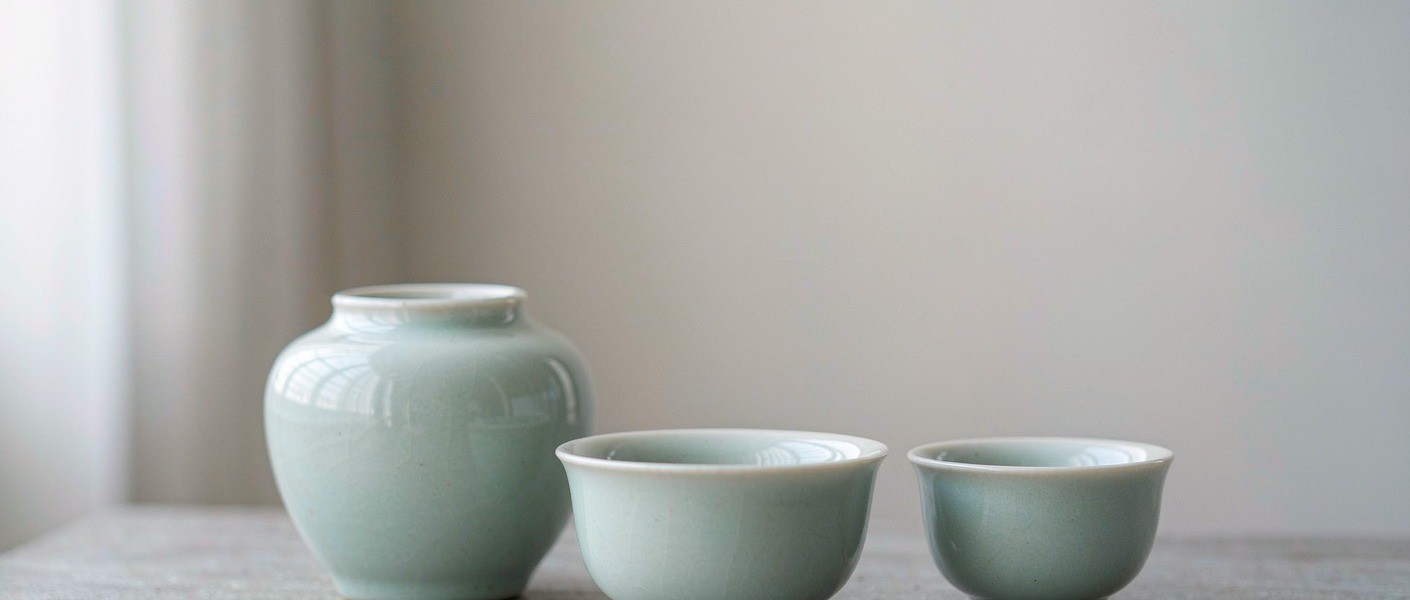
青瓷的颜色最难说清。「青如玉、明如镜、声如磬」是流传最广的九个字,但见过粉青的人会知道,那不是颜色,是一个深度。它来自浙江西南的一条江边,一种含铁的土,和窑里一千三百度上下的火候。
▍一、起源地:为什么是龙泉
龙泉在浙江西南,瓯江上游,浙闽赣三省交界。山里有瓷土,也有一种叫紫金土的含铁粘土,含铁量高,是釉色的关键。瓯江通水路,柴薪取自山林,窑场沿溪而建,原料、燃料与运输凑在一处。
所谓龙泉青瓷传统烧制技艺,是指以浙江龙泉一带的瓷土、紫金土、石灰石和石英为原料,以手工拉坯成型、家传配料、高温烧制青瓷的传统手工技艺;2006 年列入国家级非物质文化遗产名录,2009 年列入联合国教科文组织人类非物质文化遗产代表作名录。
据龙泉市政府网站介绍,龙泉青瓷始于三国两晋,盛于宋元。当地制瓷人吸取越窑与瓯窑的技术,逐步烧出青如玉、明如镜、声如磬的特点。宋代五大名窑中的哥窑,就在这一带。
▍二、历史背景:一千七百年,两次入名录
从三国两晋算起,龙泉的窑火延续了一千七百多年。龙泉窑已发现的古窑址有三百多处。
2006 年,龙泉青瓷烧制技艺列入国家级非物质文化遗产名录。2009 年 9 月 30 日,联合国教科文组织保护非物质文化遗产政府间委员会第四次会议在阿布扎比审议通过,龙泉青瓷传统烧制技艺列入《人类非物质文化遗产代表作名录》,是以陶瓷类项目入选的中国项目。
一排烧成的青瓷杯摆在木板上,釉面在自然光里泛出淡淡的粉青
▍三、工艺特色:七十多道工序里的三个关键
据中国非物质文化遗产网的表述,流程从原料的粉碎、淘洗、陈腐和练泥开始,经成型、晾干、修坯、装饰、素烧、上釉、装匣、装窑,最后在龙窑内以木柴烧成,业内常说七十多道工序。
三个关键最能说明它难在哪。头一个是配料,釉方长期靠家传,铁的含量差一点,颜色就从粉青滑向灰黄。第二个是施釉,青瓷讲究厚釉,一件器物要反复上釉多次,釉层厚了才出那种温润的深度,但厚釉容易流、容易缩,失败率随之上去。第三个是火候,龙窑烧松柴,窑温要到一千三百度左右。
还有一道看不见的功夫叫开片。釉与胎收缩率不同,冷却时釉面会裂出细纹。控制得当,纹路成为装饰;控制不当,就是缺陷。这门手艺把本该算失误的事,做成了审美的一部分。
施过釉的坯体装进匣钵,旁边放着一只刚出窑的梅子青小罐
▍四、文化价值:把「青」变成了一种标准
青瓷在中国审美里位置特殊。它不靠纹饰取胜,靠的是釉色与器形的关系。粉青偏淡,像雨后远山;梅子青偏浓,像未熟的梅子。两种都会随光线变化。
▍五、传承现状:从家族到学院
据中国非物质文化遗产网的项目保护实践总结,2009 年入选人类非遗名录后,龙泉青瓷的传承方式由家族传承扩大到家族、师徒与学院派并行。当地建有青瓷博物馆、行业协会与传承基地,并与高校合作开展非遗进校园。
据龙泉市政府网站 2024 年 8 月的介绍,龙泉剑瓷产业有市场主体七千五百余家,从业人员三万余人;量大了之后,手工与量产之间的界线怎么守,是另一重压力。
▍六、问答
问 | 龙泉青瓷是国家级非遗吗,什么时候列入世界名录的
答 | 是。2006 年列入国家级非物质文化遗产名录;2009 年 9 月 30 日,联合国教科文组织保护非物质文化遗产政府间委员会第四次会议将其列入《人类非物质文化遗产代表作名录》。
问 | 韵和鸣会做青瓷这类器物吗
答 | 瓷是六大矩阵之一,与漆、竹、绣、银、锦并列。选瓷与选漆器同一套标准:只选真正的非遗手工品,只与传承人本人合作,工序要守得住手工完成。龙泉青瓷这类项目品牌持续关注,具体在售以公众号与线下会客厅的说明为准。
▍说在最后
一件青瓷的成败,最后落在两件说不准的事上:釉的厚薄,火的脾气。人能做的,是把配料记住、把遍数守住、把窑看住,剩下的交给那一夜。把确定性做到尽头,再接受不确定,大概就是这口青最难仿的地方。
📩 非遗项目 | 匠人举荐 | 跨境出海 | 线下联营
欢迎留言或后台联系,我们与匠人同行。
—— 韵和鸣 · 与匠人同行
〖 遗 〗
相关搜索 | RELATED SEARCHES
龙泉青瓷 · 龙泉青瓷 粉青 梅子青 · 青瓷 烧制技艺 · 龙泉 龙窑 · 青瓷 茶具 · 人类非遗 青瓷
English
Longquan sits where Zhejiang, Fujian and Jiangxi meet, on the upper Ou River. The hills hold porcelain stone and an iron-rich clay called zijin tu, whose iron is the key to the glaze. The river carried goods, firewood came from nearby forests, kilns were built along streams, and material, fuel and transport happened to sit together.
Longquan celadon is the traditional craft that takes local porcelain stone, iron-rich clay, limestone and quartz from the Longquan area, shapes vessels by hand on the wheel, glazes them by family formula and fires them at high temperature; it entered China's national list in 2006 and the UNESCO Representative List in 2009.
According to the city government website, celadon began here in the Three Kingdoms and Jin periods and flourished in the Song and Yuan. Potters drew on the Yue and Ou kilns to reach that jade-like colour, mirror-like surface and chime-like ring. The Ge kiln, one of the five famous Song kilns, belongs to this area.
History: Seventeen Centuries, Two Listings
Counting from the Three Kingdoms and Jin, the kilns have burned for over seventeen hundred years. Longquan is among the celadon systems with the longest production, the widest spread of kiln sites and the largest output in Chinese ceramics, with more than three hundred ancient sites identified.
In 2006 the technique entered China's national list of intangible cultural heritage. On 30 September 2009 the UNESCO intergovernmental committee, meeting in Abu Dhabi, inscribed Longquan celadon on the Representative List of the Intangible Cultural Heritage of Humanity, a Chinese entry in the ceramic category.
A row of fired celadon cups on a wooden board, the glaze giving off a faint pale green in daylight
The Craft: Three Keys in Seventy-odd Steps
According to the China intangible cultural heritage website, Longquan celadon uses local porcelain stone, iron-rich clay, limestone and quartz, shaped by hand, glazed by family formula and fired at high temperature. The sequence runs from crushing, washing, ageing and wedging through forming, drying, trimming, decorating, bisque firing, glazing, saggaring and loading to firing with wood in a dragon kiln. The trade speaks of more than seventy steps.
Three keys explain the difficulty. The glaze recipe, long kept in families: a small shift in iron turns pale green toward grey-yellow. Application: celadon wants thick glaze in repeated passes, since depth comes with thickness, but thick glaze runs and shrinks and failures rise. Fire: dragon kilns burn pine near 1,300 degrees, and the reducing atmosphere is judged by eye.
One skill is invisible: crackle control. Glaze and body shrink differently, so fine cracks open as a piece cools. Managed well they ornament; managed badly they are a fault. The craft turned a would-be defect into beauty.
A glazed body set into a saggar, a freshly unloaded plum-green jar beside it
Cultural Value: Turning Green into a Standard
Celadon holds a particular place in Chinese taste. It wins not by ornament but by the relation between glaze and form. Pale green reads like hills after rain; plum green like unripe fruit. Neither is flat; both shift with light, which is why writers returned to them for centuries.
According to the project's protection review on that website, after the 2009 inscription transmission widened from family lines to family, apprenticeship and academic training in parallel. The city has a celadon museum, an industry association and transmission bases, and works with universities on campus programmes.
On scale, the city government website said in August 2024 that its sword and celadon industries counted more than 7,500 registered entities and over 30,000 workers. That shows a real industry and a second pressure: once volume grows, how the line between handwork and mass production is held.
Is it national-level heritage, and when did it join the world list?
Yes. It entered the national list in 2006, and on 30 September 2009 the UNESCO intergovernmental committee inscribed it on the Representative List.
Does YUNHEMING carry celadon?
Porcelain is one of the six matrices, with lacquer, bamboo, embroidery, silver and brocade. The standard matches lacquer: genuine handmade heritage work, only with the bearers themselves, and the process must hold by hand. Longquan celadon is followed closely; current availability is stated by the official account and the Salon.
Whether a piece succeeds comes down to two uncertain things: how thick the glaze sits and what mood the fire is in. What a maker can do is remember the recipe, keep the count of passes, watch the kiln; the rest belongs to that night. Pushing certainty to its limit and then accepting uncertainty is probably why this green is so hard to copy.
ICH Projects · Artisan Referrals · Global Distribution · Salon Partnerships
你可能还感兴趣
苗族银饰锻制技艺:三十多道工序,做一身能走路的银
苗族银饰锻制技艺以三十多道工序,将银料制成头饰、颈饰、胸饰等整套盛装。本文梳理其产区、流变、錾刻与焊接特点,并说明为何用料分量不能替代工艺判断及其传承难题。
韵和鸣 · 2026/10/24 · 117 阅读
一件漆器该有多重,手感不会说谎
严选器物,看纹样、看款识、看证书,都是明面上的事。但有一道标准写不进任何参数表——上手。同一尺寸的两只漆盘,一只压手温润,一只轻飘干瘪,差别从何而来?这次把"分量"这件事拆开讲。说到底,重量是工序的记账本。
韵和鸣 · 2026/10/14 · 58 阅读
漆器能不能装热水?苏绣会不会勾丝?四个常被问到的问题
后台每周都会收到一批重复的问题,大多集中在"买回去怎么用":漆器能不能装热水、能不能进洗碗机,苏绣小饰品日常会不会勾丝,绣品怎么装框才不伤绣面。今天一次答清,另外说说怎么分辨一个品牌是不是"挂名非遗"。说到底,能不能用得久,才是检验的起点。
韵和鸣 · 2026/10/24 · 57 阅读
一张蔚县剪纸,彩色的刻刀活
严选录这一期看一张不太一样的剪纸:它不用剪刀,用刻刀;不止红色,还带着点染出来的粉与绿。河北张家口蔚县的剪纸,是剪纸大家族里"反着来"的一支——别处以剪为主、以红为正,蔚县以刻代剪、以点彩上色。说到底,这两个"反着来"的本质,是蔚县人把剪纸从窗前的女红,做成了作坊里的分工手艺:看懂了这一点,才算看懂了这张纸。
韵和鸣 · 2026/10/13 · 55 阅读
一盏博山琉璃:颜色是炉火给的,不是颜料调的
博山琉璃的颜色由矿石、着色配方和炉温共同形成,鸡油黄等色料并非烧成后涂在表面。文章介绍挑料、吹制、塑型、灯工和内画,说明流纹、气泡与壁厚如何反映手工过程,并提供观察颜色、过渡和口沿的选器方法。
韵和鸣 · 2026/10/12 · 55 阅读
大漆和化学漆怎么分?挑漆器前先答这四问
文章从大漆与化学漆的材料和光泽、手工与机器制品的触感和细节、赠礼器形及出口市场四方面回答挑漆器的问题。闻、看、掂、敲可作为综合观察线索,但仍需结合材质说明、制作工序与匠人来路判断。
韵和鸣 · 2026/10/12 · 52 阅读