阳新布贴:一块黑布上贴出来的楚地颜色
韵和鸣 · 韵和鸣公众号 · 2026/10/31 12:00:00 · 7 阅读
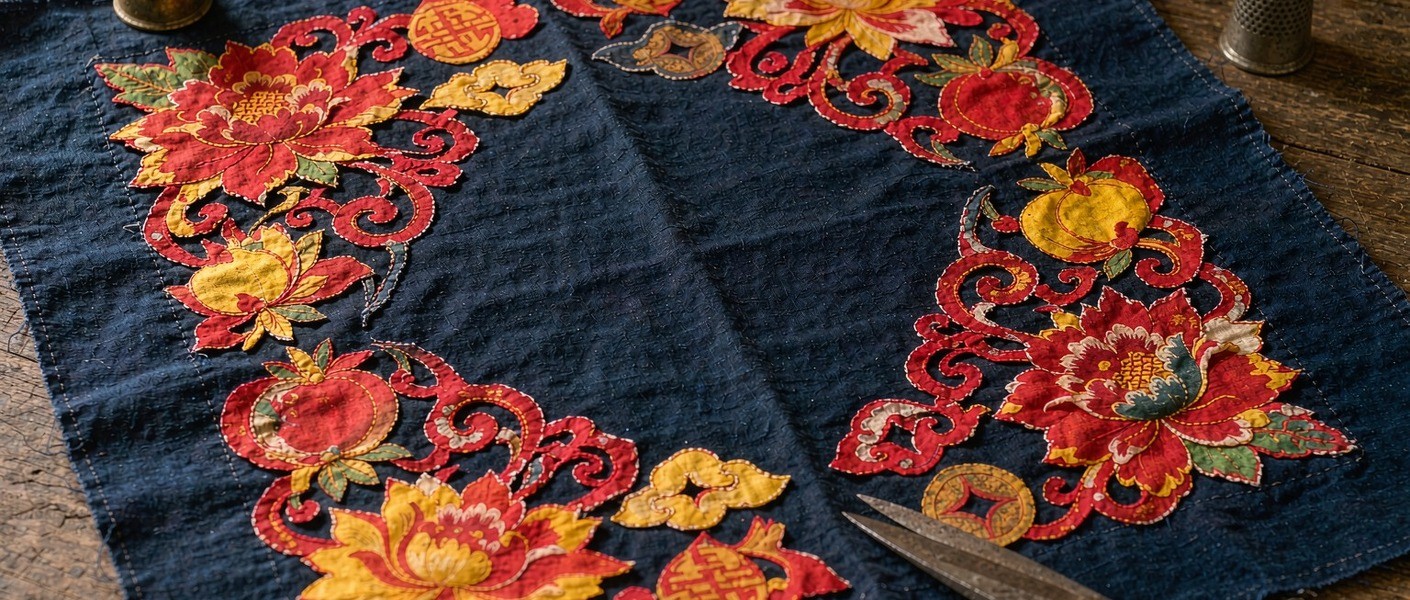
据中国非物质文化遗产网项目页,民间绣活(阳新布贴)于 2008 年列入国家级非物质文化遗产名录(第二批),项目序号 853、编号 Ⅶ-77,类别为传统美术,申报地区为湖北省阳新县,保护单位为阳新县文化馆。这门手艺的欣赏门槛很低,看一眼就能记住:深色的底布上面,贴满鲜亮的花布。
▍一、起源地:从没有文字记载的来历说起
阳新位于湖北省东南部。据中国非物质文化遗产网项目页,阳新布贴的起源和沿革没有文字记载可考,根据其婆媳传承的世系来推断,在当地至少已有两百年的历史;若从图案多为吉祥题材这一点看,其来源当在清代;若从实物所体现的楚文化风格看,渊源显然还要更早。同一页面提到,阳新建县在公元前 201 年,周代属楚地。
没有文字,不等于没有来历。许多民间手艺的谱系留在人和物件身上,而不是书里——这也决定了它们一旦断线,就很难再接回去。
布贴边缘的特写:密实的绕边针脚沿着深蓝底布拐弯,红色贴布的边缘被压在针脚下面
▍二、工艺特色:先贴后绕,最后补几针
据上述项目页,阳新布贴多采用黑色或深蓝色的土布为底布,而以鲜艳亮丽的花布在上面贴花,成品具有黑漆点金般的直观效果,色彩和明度对比极其强烈。
工序上有讲究。据人民网湖北频道 2025 年 7 月 16 日报道中省级代表性传承人胡芳的介绍,制作时先在底布上画样稿,接着剪样、拼贴,再绕边缝制,并辅以刺绣,使作品呈浅浮雕的效果;她还提到,分解图案时要先看清上下关系,压在下面的部分要留缝份,最后用线绕边完成整体缝制。
绕边这一步最见功力。项目页里提到的说法是编织工艺上的"遇折回转"与绕边的细密——转弯的地方针要跟着转,不能硬拐,布才不会起皱。
▍三、文化价值:一件布制品承载的那半句话
据同一项目页,它有近三十个品种,从童装到嫁衣,从日常穿戴到庙观器物,都不乏布贴制品。图案多为传统的吉祥题材,如观音坐莲、状元拜塔、凤戏牡丹、鲤鱼拉莲、喜鹊啄梅,以及长命锁与福禄寿喜等文字符号。
真正让它立住的,是它在生活里的位置。孩子做满月,亲友送的是布贴的围兜、马甲与童枕;姑娘出嫁时,会把做嫁衣剩下的各色布角收进一个"布角包"带到婆家,等有了孩子,再做给小的用。它为贫穷山区的人们提供了"勤俭"与"美"兼得的方法:省下来的边角料,拼成了最艳的一件衣服。
剪刀、线轴与一叠裁好的小色布摊在竹匾里,边上放着一张画了一半的纸样
▍四、传承现状:从口传心授到纹样入库
据中国非物质文化遗产网名录公开信息,阳新布贴的国家级代表性传承人中有蔡月娥;人民网湖北频道前述报道提到,省级代表性传承人有胡芳。
据人民网湖北频道 2025 年 7 月 16 日报道,武汉轻工大学艺术设计学院暑期社会实践团队赴阳新县开展"非遗智传·布贴焕彩"主题活动,围绕技艺特色、传承现状及智能化创新路径调研,并现场采集纹样素材八百八十余张,为建立纹样收集与创新生成式人工智能数据库打基础。
从口传心授到纹样入库,路径变了,难题还在:真正稀缺的不是图案,是那双会在拐角处跟着布转的手。这一点和许多同类手艺的处境一样。
▍问答
问 | 阳新布贴是什么级别的非遗项目
答 | 国家级。据中国非物质文化遗产网项目页,民间绣活(阳新布贴)于 2008 年列入国家级非物质文化遗产名录(第二批),项目序号 853、编号 Ⅶ-77,类别传统美术,申报地区为湖北省阳新县,保护单位为阳新县文化馆。
问 | 阳新布贴是怎么做出来的,和普通拼布有什么不同
答 | 工序是画样稿、剪样、拼贴、绕边缝制,最后辅以刺绣,成品呈浅浮雕效果。它与普通拼布最大的不同在视觉与针工:黑或深蓝的土布为底,鲜艳花布贴花,形成"黑漆点金"般的强对比;绕边讲究"遇折回转",转角处针随布转,这才压得住不皱。
问 | 韵和鸣现在整合了哪些非遗品类
答 | 以平遥推光漆器起家,如今整合的是漆、竹、绣、银、锦、瓷六条线,做的是全国范围的非遗手工品矩阵。阳新布贴这类布艺不在其中,但它同样是值得被看见的手艺——品类可以慢慢扩,收进来的门槛不会变:真非遗、真匠人、核心工序手工完成。
▍说在最后
最艳的那件衣服,往往是碎布拼出来的。匮乏没有让人变朴素,反倒让颜色更放肆。
你家里有没有一件用碎布做出来的东西?留言说说它的来历。
📩 非遗项目 | 匠人举荐 | 跨境出海 | 线下联营
欢迎留言或后台联系,我们与匠人同行。
—— 韵和鸣 · 与匠人同行
〖 遗 〗
相关搜索 | RELATED SEARCHES
阳新布贴 非遗 级别 · 阳新布贴 产地 湖北 · 布贴 和 拼布 区别 · 黑漆点金 布贴 是什么意思 · 阳新布贴 传承人 · 民间绣活 阳新布贴
English
Origin: A Provenance with No Written Record
Yangxin lies in the south-east of Hubei. According to the project page, the origin and history of the craft have no written record to consult; judging by the lineages transmitted between mothers-in-law and daughters-in-law, it has at least two centuries locally; judging from the auspicious subjects, it dates to the Qing; judging from the Chu style of the surviving pieces, its roots run earlier still. The same page notes that Yangxin was established as a county in 201 BC and belonged to Chu in the Zhou.
No writing is not the same as no provenance. The genealogy of much folk craft lives in people and objects rather than books, which means that once the thread breaks it is very hard to join again.
Close-up of a bound edge: dense stitching turns along the deep blue ground with the edge of a red patch held beneath it
The Craft: Paste First, Bind Next, Embroidery Last
According to the same page, black or deep blue homespun provides the ground, with bright printed cloth pasted on top, giving the finished piece a direct effect like gold dotted on black lacquer, with extremely strong contrast in hue and value.
The sequence has its finesse. According to Hu Fang, a provincial-level bearer quoted by People's Daily Online Hubei channel on 16 July 2025, one draws the pattern on the ground, cuts the pieces, pastes them, binds the edges by sewing, and adds embroidery so the work takes on a low relief. She also notes that the layer order matters: lower parts need seam allowance, and the whole is finished with a bound edge.
Binding is where skill shows. The project page mentions double-back stitching at the turns and the density of the binding: the needle must turn with the cloth rather than force the corner, or the fabric puckers.
Cultural Value: Half a Sentence Carried by Cloth
According to the same page, it has close to thirty varieties, with patchwork found on children's clothes, wedding garments, everyday wear and objects for temples. The patterns are mostly traditional auspicious subjects: Guanyin on the lotus, the top scholar bowing at the pagoda, phoenix playing with peony, carp pulling the lotus, magpie pecking plum, together with characters and symbols such as the longevity lock and fortune, rank and long life.
What truly holds it up is its place in life. At a baby's first month, relatives bring patchwork bibs, vests and pillows; a bride carries the leftover scraps of her wedding clothes in a cloth-scrap bundle to her husband's house and later makes things for her children. In a poor mountain region it offered thrift and beauty at once: pieces saved from the cutting table became the brightest garment in the house.
Scissors, spools and a stack of cut coloured cloth lie in a bamboo tray beside a half-drawn paper pattern
Transmission: From Counting Hands to Counting Data
According to the published lists on the China Intangible Cultural Heritage website, Cai Yue'e is among the national-level representative bearers of Yangxin cloth patchwork; Hu Fang was named as a provincial-level bearer in the People's Daily Online report cited above.
According to People's Daily Online Hubei channel on 16 July 2025, a summer practice team from the School of Art and Design at Wuhan Polytechnic University went to Yangxin county for an activity on intelligent transmission of heritage and renewed colour in cloth patchwork, investigating the craft's features, its transmission and paths for intelligent innovation, and collecting more than 880 pattern samples on site as groundwork for a pattern database.
From mouth-to-heart teaching to pattern archives the route has changed, but the difficulty remains: what is scarce is not the pattern but the hand that knows to turn with the cloth at a corner. In this it resembles many other crafts today.
At what level is Yangxin cloth patchwork recognised?
National level. According to the project page, folk needlework (Yangxin cloth patchwork) entered the second national list in 2008 as item 853, code VII-77, in traditional fine arts, submitted by Yangxin county, Hubei, with the county cultural centre as protecting body.
How is Yangxin cloth patchwork made, and how does it differ from ordinary patchwork?
The steps are drawing, cutting, pasting, binding by sewing, then embroidery, giving a low relief. It differs from ordinary patchwork in appearance and needlework: dark homespun beneath bright printed cloth for a gold-on-black contrast, and a binding that doubles back at turns so the cloth does not pucker.
Which heritage categories has YUNHEMING brought together?
Beginning with Pingyao polished lacquerware, the brand now gathers lacquer, bamboo, embroidery, silver, brocade and porcelain into a national matrix of hand-made heritage goods. Cloth crafts such as Yangxin patchwork are not among them, yet they deserve to be seen all the same; the range can widen slowly, but the threshold does not change: genuine heritage, the real maker, core steps done by hand.
The brightest garment is often pieced from scraps. Scarcity did not make people austere; it made the colours more audacious.
Is there anything in your home made from leftover cloth? Leave a comment and tell us where it came from.
ICH Projects · Artisan Referrals · Global Distribution · Salon Partnerships
你可能还感兴趣
苗族银饰锻制技艺:三十多道工序,做一身能走路的银
苗族银饰锻制技艺以三十多道工序,将银料制成头饰、颈饰、胸饰等整套盛装。本文梳理其产区、流变、錾刻与焊接特点,并说明为何用料分量不能替代工艺判断及其传承难题。
韵和鸣 · 2026/10/24 · 90 阅读
一件漆器该有多重,手感不会说谎
严选器物,看纹样、看款识、看证书,都是明面上的事。但有一道标准写不进任何参数表——上手。同一尺寸的两只漆盘,一只压手温润,一只轻飘干瘪,差别从何而来?这次把"分量"这件事拆开讲。说到底,重量是工序的记账本。
韵和鸣 · 2026/10/14 · 52 阅读
漆器能不能装热水?苏绣会不会勾丝?四个常被问到的问题
后台每周都会收到一批重复的问题,大多集中在"买回去怎么用":漆器能不能装热水、能不能进洗碗机,苏绣小饰品日常会不会勾丝,绣品怎么装框才不伤绣面。今天一次答清,另外说说怎么分辨一个品牌是不是"挂名非遗"。说到底,能不能用得久,才是检验的起点。
韵和鸣 · 2026/10/24 · 50 阅读
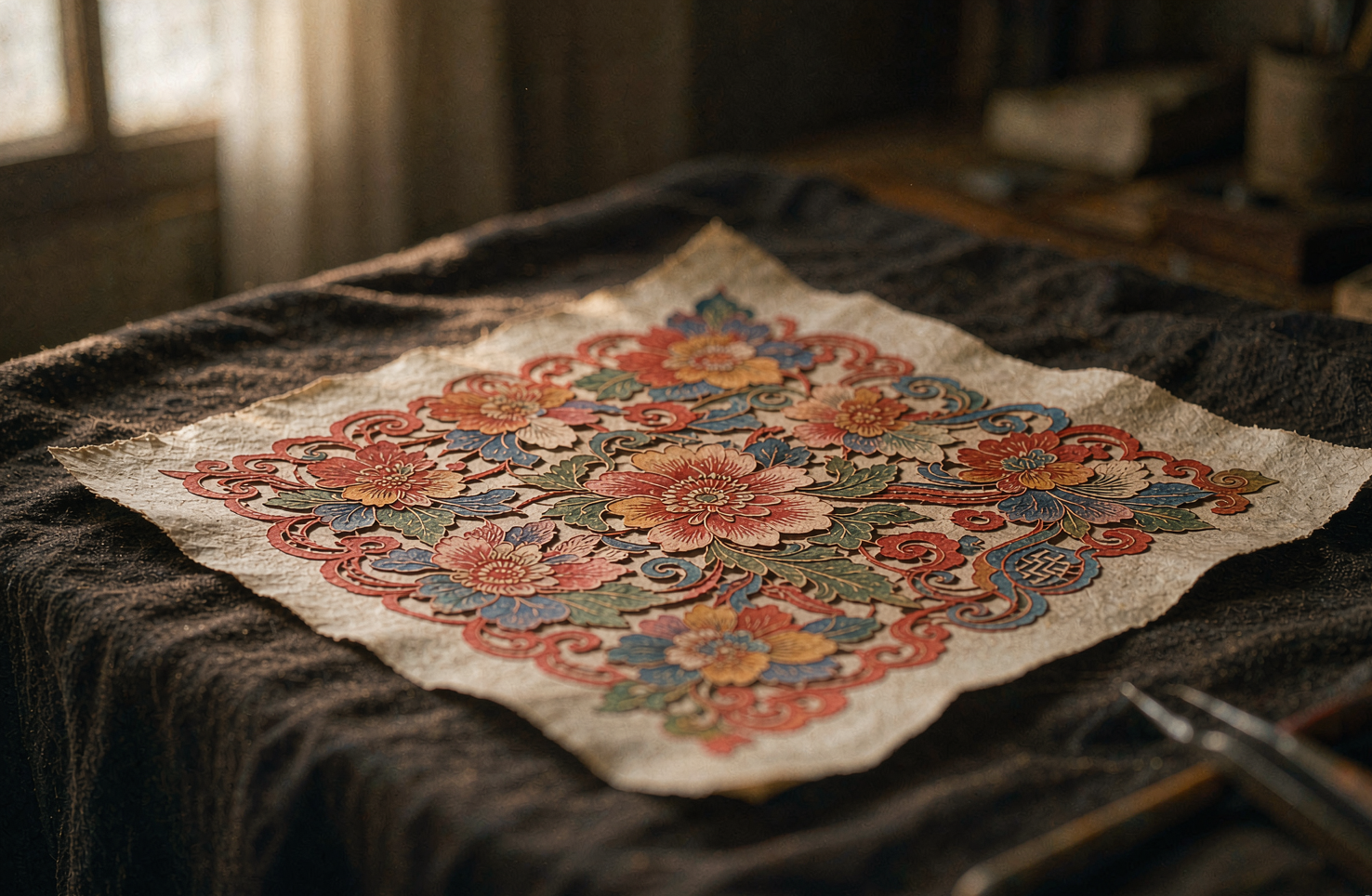
一张蔚县剪纸,彩色的刻刀活
严选录这一期看一张不太一样的剪纸:它不用剪刀,用刻刀;不止红色,还带着点染出来的粉与绿。河北张家口蔚县的剪纸,是剪纸大家族里"反着来"的一支——别处以剪为主、以红为正,蔚县以刻代剪、以点彩上色。说到底,这两个"反着来"的本质,是蔚县人把剪纸从窗前的女红,做成了作坊里的分工手艺:看懂了这一点,才算看懂了这张纸。
韵和鸣 · 2026/10/13 · 48 阅读
一盏博山琉璃:颜色是炉火给的,不是颜料调的
博山琉璃的颜色由矿石、着色配方和炉温共同形成,鸡油黄等色料并非烧成后涂在表面。文章介绍挑料、吹制、塑型、灯工和内画,说明流纹、气泡与壁厚如何反映手工过程,并提供观察颜色、过渡和口沿的选器方法。
韵和鸣 · 2026/10/12 · 46 阅读
大漆和化学漆怎么分?挑漆器前先答这四问
文章从大漆与化学漆的材料和光泽、手工与机器制品的触感和细节、赠礼器形及出口市场四方面回答挑漆器的问题。闻、看、掂、敲可作为综合观察线索,但仍需结合材质说明、制作工序与匠人来路判断。
韵和鸣 · 2026/10/12 · 45 阅读