厦门漆线雕技艺:一条漆线盘出来的立体线条
韵和鸣 · 韵和鸣公众号 · 2026/10/27 12:00:00 · 3 阅读
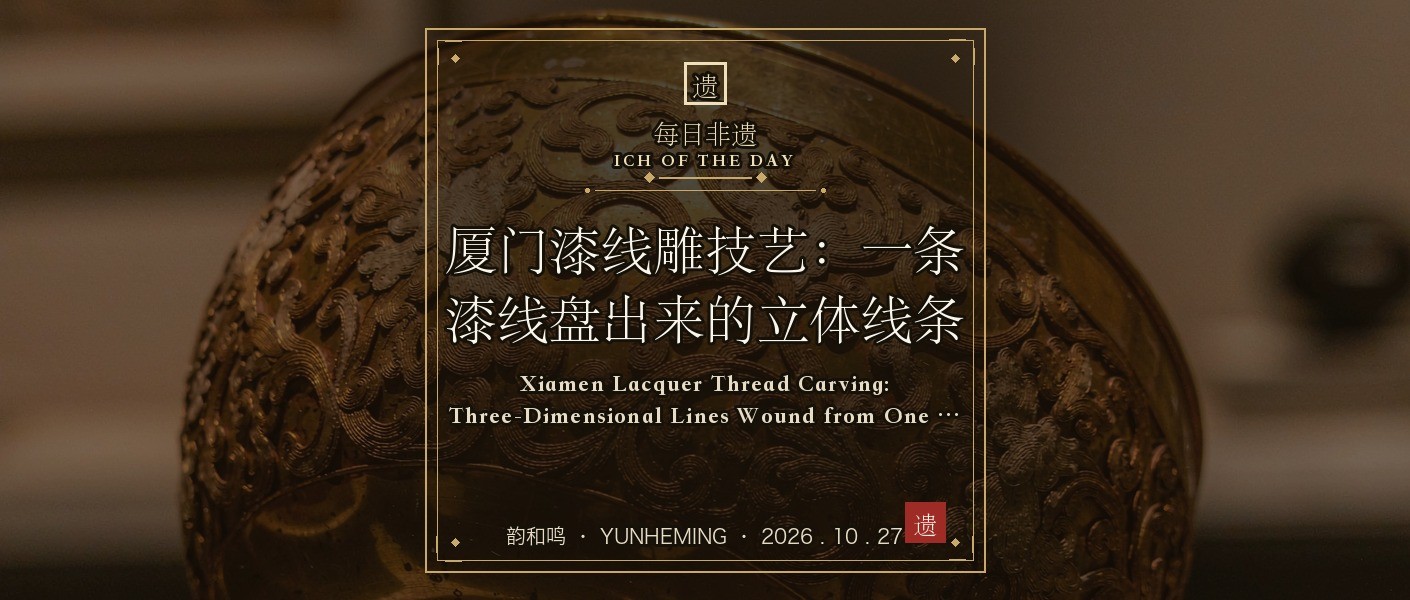
在福建厦门,有一种工艺不用刀雕、不用刀刻,而是用一条比面条还细的漆线,在坯体上一圈圈盘出凸起的纹样,最后贴上金箔。据中国非物质文化遗产网项目介绍,厦门漆线雕技艺在 2006 年公布的国家级非物质文化遗产代表性项目名录之中,项目序号 405,编号 Ⅷ-55,类别为传统技艺,申报地区为福建省厦门市。它的本质在于:把雕塑的体量,压缩进一条线里。所谓漆线雕,指的是以漆线土手工搓成的细线在坯体上盘绕堆塑出浮
▍一、起源地:为什么偏偏长出在厦门
据项目介绍,漆线雕工艺在厦门流传三百余年,最初的制作基地在当时的同安县马巷镇。它的出现和当地两件事有关:一是闽南民间信仰兴盛,神像家家必备;二是宋元以来线雕、沥粉、泥线雕等装饰工艺的长期积累。
靠墙的木架上陈列着几件贴金的装饰小件,背景是素色墙面
▍二、历史背景:从神像身上走到案头上
据项目介绍,这门工艺系古代佛像雕塑艺术的遗脉,受宋元线雕工艺特别是沥粉和泥线雕的启发而产生,形成于明末清初,至晚清逐渐成熟。早期它只是神像衣饰上的装饰,后来逐步独立出来。
一个转折值得记下:项目介绍提到,上世纪七十年代,一位工艺美术大师把漆线雕的图案做成独立的装饰艺术品,此后成为现代漆线雕的主流产品;他的作品《还我河山》《波月洞悟空降妖》被中国工艺美术馆收藏。
▍三、工艺特色:四个词,一条线
传统的漆线雕制作包括雕塑、粉底、漆线装饰、妆金填彩四个方面。真正决定成败的是第三项。
材料朴素:陈年砖粉、大漆、熟桐油等调和在一起,经反复舂打,成为柔软又富于韧性的泥团,行内叫"漆线土"。再手工搓成粗细不同的"漆线",然后在涂有底漆的坯体上一圈一圈盘、结、绕、堆,堆出浮凸的图形。
指间捻起的一条细漆线正沿着坯体上已盘好的纹样推进
因此,漆线雕被形容为"以线条盘结、以浮雕形式展现"——远看是浮雕,近看是线条。线条之间不能有断口,断了一处,整幅的意义就散了。
▍四、文化价值:线条里的一套信仰与审美
漆线雕的价值有两层。实用的一层是它服务的对象——神像、庙宇与祭祀器物;审美的一层则是把线条的表现力推得很远。项目介绍中有一句评价:中国工艺美术中的线条美在这里得到升华。
▍五、传承现状:难在"手上的时间太长"
这门手艺现在的处境不算轻松。据项目介绍,随着市场经济的深入,传统漆线雕工艺受到巨大冲击;工艺复杂、不易掌握,传人不易寻觅,存在后继乏人之虞。同页资料还提到,这门技艺历经蔡氏一门十三代传人,可考的蔡姓艺人上溯到清代嘉庆年间。
难的地方很具体:它不是学会一种手法就能上手的活,搓线的力度、盘的节奏、接头藏在哪里,都要在手上形成记忆。这种记忆没法速成。
▍问答
问 | 厦门漆线雕是国家级非遗吗,编号是多少
答 | 是。项目名称为厦门漆线雕技艺,编号 Ⅷ-55、序号 405,归类在传统技艺,由福建省厦门市申报,2006 年公布(据中国非物质文化遗产网项目介绍)。
问 | 漆线雕的"线"是用什么做的
答 | 不是金属线,也不是普通线材。它是陈年砖粉、大漆、熟桐油等原料调和后反复舂打成的泥团(俗称"漆线土"),再手工搓成粗细不同的线。
问 | 韵和鸣和平遥推光漆器是什么关系
答 | 平遥推光漆器髹饰技艺是韵和鸣动身的地方。但品牌的长相并不由一座城决定:以这门国家级非遗作底,又陆续纳入竹、绣、银、锦、瓷,铺开的是全国手艺的盘子。厦门漆线雕这样的项目,正是这盘棋里值得被更多人看见的一格。
▍说在最后
每一条被盘起来的线,最后都收在一个看不见的地方。手艺人大半的技能,都花在这种"收"上。
你还知道哪些用"线"做出来的手艺?留言告诉我们。
📩 非遗项目 | 匠人举荐 | 跨境出海 | 线下联营
欢迎留言或后台联系,我们与匠人同行。
—— 韵和鸣 · 与匠人同行
〖 遗 〗
相关搜索 | RELATED SEARCHES
厦门 漆线雕 技艺 · 漆线雕 非遗 编号 · 国家级 非遗 传统技艺 名录 · 福建 厦门 传统 手工艺 · 漆线土 怎么 做
English
The introduction notes that the craft has circulated in Xiamen for more than three hundred years, with its earliest production base in Maxiang town, then Tong'an county. Its emergence owes to two local conditions: the strength of folk belief in southern Fujian, where household shrines were universal, and the long accumulation of decorative techniques since the Song and Yuan dynasties, including line carving, raised paste work and clay-thread carving.
Several gilded decorative pieces arranged on shelves against a plain wall
The introduction records it as a descendant of ancient Buddhist sculpture, inspired by Song-Yuan line carving and especially by raised-paste and clay-thread work, taking shape in the late Ming and early Qing and maturing by the late Qing. At first it decorated nothing but divine robes; later it gradually stood on its own.
The introduction notes that in the 1970s a master of arts and crafts turned the patterns into standalone decorative pieces, which went on to become the mainstream form of the craft today; his works Restoring Our Rivers and Mountains and Sun Wukong Subduing the Demon in the Moon-Wave Cave are held by the China National Arts and Crafts Museum.
Traditional production covers four aspects: sculpting, grounding, lacquer thread decoration, and finishing with gold and colour. The third decides whether the piece succeeds.
The materials are plain: aged brick powder, raw lacquer and boiled tung oil blended together and pounded repeatedly into a soft, springy mass the trade calls lacquer-thread clay. This is hand-rolled into threads of varying thickness, then wound, knotted, coiled and piled onto a grounded body until raised forms appear.
A fine lacquer thread held between fingers advancing along a pattern already laid on the body
For this reason the craft is described as winding lines into relief: relief at a distance, lines close up. No break may appear among the lines, for a single break scatters the meaning of the whole piece.
The value runs on two levels. Practically it served religious statues, temples and ritual objects. Aesthetically it carried the expressive power of line a long way; as the project introduction puts it, the beauty of line in Chinese arts and crafts is sublimated here.
The Difficulty Is How Long It Takes to Train a Hand
The position is not easy. According to the project introduction, deeper market reforms have brought severe impact on the craft; the process is complex and hard to master, successors difficult to find and there is concern about who will follow. The same page records thirteen generations of the Cai family carrying the craft, with traceable Cai artisans reaching back to the Jiaqing reign of the Qing dynasty.
The difficulty is concrete. This is not work taken up after learning one method: the pressure for rolling thread, the rhythm of coiling, where to hide a join, must all become memory in the hand. Such memory cannot be rushed.
Is Xiamen lacquer thread carving national-level heritage, and what is its code?
Yes. Under the formal name Xiamen lacquer thread carving, it carries code VIII-55 and item number 405, is classed under traditional craftsmanship, submitted by Xiamen, Fujian, and announced in 2006, according to the China Intangible Cultural Heritage website.
What is the thread in lacquer thread carving made of?
Not metal, not ordinary cord. It is a mass made from aged brick powder, raw lacquer and boiled tung oil, blended and pounded repeatedly — the trade calls it lacquer-thread clay — then hand-rolled into threads of varying thickness.
What is the relationship between YUNHEMING and Pingyao polished lacquerware?
Pingyao polished lacquerware is where YUNHEMING set out. But the brand's face is not decided by one city: grounded in that national-level heritage, it has since taken in bamboo, embroidery, silver, brocade and porcelain, laying out a board of crafts from across the country. A project like Xiamen lacquer thread carving is one square on that board that deserves to be seen.
Every line that gets wound must eventually be closed somewhere invisible. Most of a maker's skill goes into that closing.
ICH Projects · Artisan Referrals · Global Distribution · Salon Partnerships
你可能还感兴趣
苗族银饰锻制技艺:三十多道工序,做一身能走路的银
苗族银饰锻制技艺以三十多道工序,将银料制成头饰、颈饰、胸饰等整套盛装。本文梳理其产区、流变、錾刻与焊接特点,并说明为何用料分量不能替代工艺判断及其传承难题。
韵和鸣 · 2026/10/24 · 90 阅读
一件漆器该有多重,手感不会说谎
严选器物,看纹样、看款识、看证书,都是明面上的事。但有一道标准写不进任何参数表——上手。同一尺寸的两只漆盘,一只压手温润,一只轻飘干瘪,差别从何而来?这次把"分量"这件事拆开讲。说到底,重量是工序的记账本。
韵和鸣 · 2026/10/14 · 52 阅读
漆器能不能装热水?苏绣会不会勾丝?四个常被问到的问题
后台每周都会收到一批重复的问题,大多集中在"买回去怎么用":漆器能不能装热水、能不能进洗碗机,苏绣小饰品日常会不会勾丝,绣品怎么装框才不伤绣面。今天一次答清,另外说说怎么分辨一个品牌是不是"挂名非遗"。说到底,能不能用得久,才是检验的起点。
韵和鸣 · 2026/10/24 · 50 阅读
一张蔚县剪纸,彩色的刻刀活
严选录这一期看一张不太一样的剪纸:它不用剪刀,用刻刀;不止红色,还带着点染出来的粉与绿。河北张家口蔚县的剪纸,是剪纸大家族里"反着来"的一支——别处以剪为主、以红为正,蔚县以刻代剪、以点彩上色。说到底,这两个"反着来"的本质,是蔚县人把剪纸从窗前的女红,做成了作坊里的分工手艺:看懂了这一点,才算看懂了这张纸。
韵和鸣 · 2026/10/13 · 48 阅读
一盏博山琉璃:颜色是炉火给的,不是颜料调的
博山琉璃的颜色由矿石、着色配方和炉温共同形成,鸡油黄等色料并非烧成后涂在表面。文章介绍挑料、吹制、塑型、灯工和内画,说明流纹、气泡与壁厚如何反映手工过程,并提供观察颜色、过渡和口沿的选器方法。
韵和鸣 · 2026/10/12 · 46 阅读
大漆和化学漆怎么分?挑漆器前先答这四问
文章从大漆与化学漆的材料和光泽、手工与机器制品的触感和细节、赠礼器形及出口市场四方面回答挑漆器的问题。闻、看、掂、敲可作为综合观察线索,但仍需结合材质说明、制作工序与匠人来路判断。
韵和鸣 · 2026/10/12 · 45 阅读