汝瓷烧制技艺:一炉火里等出来的雨过天青
韵和鸣 · 韵和鸣公众号 · 2026/10/26 12:00:00 · 3 阅读
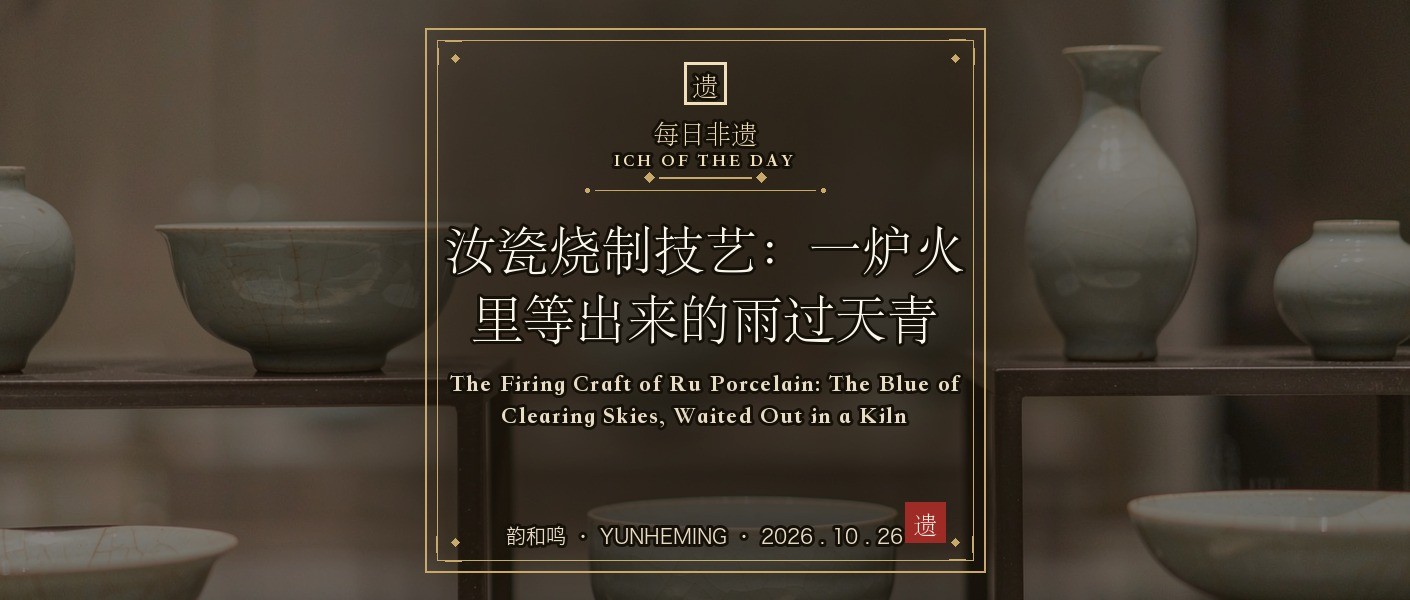
中国陶瓷史上有一个名字,几乎没有争议地被放在高位——汝窑,"宋代五大名瓷"之一,有"汝窑为魁"之说。它产自古汝州一带,釉色清雅素净,烧成极难、成品极少。今天我们讲的就是它背后的那套功夫:汝瓷烧制技艺。
▍一、起源地:古汝州的那片土
汝瓷因产地得名。据河南省文化和旅游厅非遗信息系统介绍,汝瓷为宋代五大名瓷之一,因产于古汝州地区——今河南汝州、宝丰一带——而得名。
决定性的东西在土里。据同一系统介绍,胎料与釉料都必须取自当地一定范围内的高岭土、玛瑙石、黄金土、黑干土等,成分独特,无可替代。一方水土养一方瓷,在汝瓷身上是字面意义上的成立。
木盘里分层摊开的制瓷原料,土色与石料在自然光下显出不同质地
▍二、历史背景:从唐中叶到"近尤难得"
据汝州市人民政府网站介绍,汝瓷从唐代中叶萌芽,至北宋达到鼎盛,成为宋皇宫御用之瓷;后因金兵入侵汝州,技艺隐埋民间,元明清历代均有烧制。
据河南省文化和旅游厅非遗信息系统,宋室南迁后汝瓷隐没,南宋时已有"近尤难得"之叹。中华人民共和国成立后,政府组建研究队伍,走访民间、成立汝瓷生产厂并培养技术人才,这门技艺才逐步恢复。
▍三、工艺特色:八道工序,一钵一器
据《国务院关于公布第三批国家级非物质文化遗产名录的通知》(国务院,2011 年),汝瓷烧制技艺列入第三批国家级非物质文化遗产名录,编号 Ⅷ-189,申报地区为河南省汝州市、宝丰县。
据河南省文化和旅游厅非遗信息系统,汝瓷烧制工序繁杂、难度大,主要有选料、粉碎、练泥、制坯(手拉坯)、素烧、制釉、施釉、烧制等工序,采用一钵一器支钉托烧的叠烧方法。
传统汝瓷烧制用玛瑙入釉,成品率低、精品极少;釉色素静典雅,有"青如天、面如玉、质如乳、声如磬"的典型特征。
真正掌握在人身上的,是火。烧制要把握釉料配方、黏度与流动性,掌控熔融温度、还原气氛与保温渐冷的析晶过程;这些关键没有具体的理化指标,全凭技师眼观手感的经验——用火照观察窑内釉面变化来判断窑温,正是这门技艺的核心之一。
窑前的火照与待烧的坯体并排摆放,釉层尚未出窑
▍四、文化价值:把"南青北白"改了过来
汝瓷的分量不只在好看。据汝州市人民政府网站介绍,汝瓷开青瓷工艺新阶段,改变了"南青北白"的旧论,故有"汝窑为魁"之说;釉色分豆绿、天蓝、天青、月白等品种。
它的审美也很特别:不靠纹饰取胜,靠釉色与器型的克制。经典器型有出戟尊、天青釉洗、盏托等,多为陈设与文房清供,安静放着就很有分量。
▍五、传承现状:列入国家级名录之后
据《国务院关于公布第三批国家级非物质文化遗产名录的通知》,汝瓷烧制技艺于 2011 年 5 月经国务院批准列入第三批国家级非物质文化遗产名录,编号 Ⅷ-189,申报地区为河南省汝州市、宝丰县。
今天的难题与八百年前相似:成品率依然低,能靠眼和手感掌控窑温的人依然要靠年头养。据河南省文化和旅游厅非遗信息系统,关键环节没有量化指标,全凭技师的经验积累。
▍问答
问 | 汝瓷是哪个地方的非遗,属于什么级别
答 | 汝瓷烧制技艺于 2011 年 5 月经国务院批准列入第三批国家级非物质文化遗产名录,编号 Ⅷ-189,申报地区为河南省汝州市、宝丰县——据《国务院关于公布第三批国家级非物质文化遗产名录的通知》。属传统技艺类。
问 | 汝瓷为什么这么难烧
答 | 难在釉与火两头。釉用玛瑙入釉,配方、黏度与流动性都要拿捏;烧成要掌控熔融温度、还原气氛与渐冷析晶过程,这些关键没有理化指标,全凭技师眼观手感的经验,靠火照观察窑内釉面变化来判断。成品率低,精品极少。
问 | 韵和鸣的瓷器品类是怎么选的
答 | 标准只有一条:必须是真的非遗手工品,工序守得住手工完成。品牌整合漆(含大漆髹饰)、竹、绣、银、锦、瓷等多个品类,做的是全国矩阵,而不是某一城市的特产。每件器物都能说清出自哪位匠人之手。
▍说在最后
我们每天记下一项来自全国的非遗,不为评高低,只为让更多角落里的手艺被看见一次。看得多了才知道,还有多少好东西没走出本地。
你的家乡有没有一项还没被多少人知道的老手艺?留言告诉我们,我们去看。
📩 非遗项目 | 匠人举荐 | 跨境出海 | 线下联营
欢迎留言或后台联系,我们与匠人同行。
—— 韵和鸣 · 与匠人同行
〖 遗 〗
相关搜索 | RELATED SEARCHES
汝瓷烧制技艺 是 国家级非遗 吗 · 汝瓷 产地 在 哪里 · 汝窑 为什么 是 五大名瓷 之首 · 汝瓷 天青釉 特点 · 河南 汝州 宝丰 非遗
English
Ru porcelain takes its name from where it is made. According to the intangible heritage information system of the Henan Provincial Department of Culture and Tourism, Ru ware is one of the five great Song wares, named for the old Ruzhou region, today's Ruzhou and Baofeng in Henan.
What decides it lies in the earth. The same source notes that body and glaze materials must come from kaolin, agate, yellow earth and black dry clay found within a certain local range, a composition that cannot be substituted. Local earth makes local porcelain, literally true here.
Porcelain raw materials laid out in layers in a wooden tray, clays and stones showing different textures
Historical Background: From the Mid-Tang to Rare Even Then
According to the Ruzhou municipal government website, Ru porcelain began in the mid-Tang and peaked under the Northern Song as porcelain for the imperial palace; after Jurchen forces entered Ruzhou the skill went underground, with firing continuing through the Yuan, Ming and Qing.
The Henan heritage system records that after the Song court moved south, Ru ware disappeared and by the Southern Song was already lamented as hard to come by. After the founding of the People's Republic, the government assembled research teams, visited communities, set up Ru porcelain works and trained technicians, and only then did the craft gradually return.
The Craft: Eight Stages, One Sagger for One Piece
According to the State Council notice on the third national intangible cultural heritage list, issued by the State Council in 2011, the firing craft of Ru porcelain was inscribed on that list, numbered VIII-189, declared by Ruzhou and Baofeng in Henan.
According to the Henan heritage system, firing Ru porcelain is complex and difficult, running through selecting material, crushing, preparing the body, forming by hand on the wheel, biscuit firing, making the glaze, glazing and firing, with one sagger holding one piece on spur marks.
Traditional Ru porcelain uses agate in the glaze, with a low yield and very few fine pieces; the glaze is quiet and refined, described as blue as the sky, surface like jade, body like milk, sound like a chime.
What rests in a person is the fire. Firing means managing the glaze formula, its viscosity and flow, and controlling melting temperature, reduction atmosphere and the slow cool in which crystals form. None of these have fixed indices; they rest on the technician's eye and hand, and reading the glaze through a trial piece is one of the craft's core skills.
A trial piece and an unglazed-to-be body set side by side before the kiln, the glaze not yet fired
Cultural Value: Rewriting the Old North-South Divide
Ru ware matters for more than beauty. According to the Ruzhou municipal government website, it opened a new stage in celadon technique and overturned the old formula of blue in the south and white in the north, hence the saying that Ru kilns rank first; its glazes include bean green, sky blue, azure and moon white.
Its aesthetic is distinctive too: it wins not through ornament but through restraint in glaze and form. Classic shapes include the flanged vase, the sky-blue washer and cup stands, mostly for display or the desk, objects that carry weight simply by sitting still.
Transmission Today: After Entering the National List
According to the State Council notice on the third national intangible cultural heritage list, Ru porcelain firing was approved in May 2011, numbered VIII-189, declared by Ruzhou and Baofeng in Henan.
The difficulty today resembles that of eight centuries ago: yields remain low, and those who can read a kiln by eye and touch still take years to train. As the Henan heritage system notes, the key links have no quantifiable indices and rest entirely on accumulated experience.
Where is Ru porcelain a heritage item, and at what level?
The firing craft of Ru porcelain was approved by the State Council in May 2011 for the third batch of the national intangible cultural heritage list, numbered VIII-189, declared by Ruzhou and Baofeng in Henan, according to the State Council notice on that third batch. It falls under traditional craftsmanship.
Why is Ru porcelain so hard to fire?
The difficulty sits in both glaze and fire. The glaze uses agate, and its formula, viscosity and flow must all be judged; firing requires controlling melting temperature, reduction atmosphere and the slow cool in which crystals form, none of which have fixed indices, so the technician relies on eye and touch, reading the glaze through trial pieces. Yields are low and fine pieces few.
How does YUNHEMING choose its porcelain pieces?
One standard only: it must be a genuine handmade heritage work whose process holds to hand finishing. The brand brings together lacquer, including raw-lacquer decoration, bamboo, embroidery, silver, silk and porcelain, building a national matrix rather than the speciality of one city. Every piece can state whose hands made it.
We record one heritage item from somewhere in China each day, not to rank them but so that crafts in more corners get seen once. See enough and you realise how much good work has never left its own locality.
ICH Projects · Artisan Referrals · Global Distribution · Salon Partnerships
你可能还感兴趣
苗族银饰锻制技艺:三十多道工序,做一身能走路的银
苗族银饰锻制技艺以三十多道工序,将银料制成头饰、颈饰、胸饰等整套盛装。本文梳理其产区、流变、錾刻与焊接特点,并说明为何用料分量不能替代工艺判断及其传承难题。
韵和鸣 · 2026/10/24 · 90 阅读
一件漆器该有多重,手感不会说谎
严选器物,看纹样、看款识、看证书,都是明面上的事。但有一道标准写不进任何参数表——上手。同一尺寸的两只漆盘,一只压手温润,一只轻飘干瘪,差别从何而来?这次把"分量"这件事拆开讲。说到底,重量是工序的记账本。
韵和鸣 · 2026/10/14 · 52 阅读
漆器能不能装热水?苏绣会不会勾丝?四个常被问到的问题
后台每周都会收到一批重复的问题,大多集中在"买回去怎么用":漆器能不能装热水、能不能进洗碗机,苏绣小饰品日常会不会勾丝,绣品怎么装框才不伤绣面。今天一次答清,另外说说怎么分辨一个品牌是不是"挂名非遗"。说到底,能不能用得久,才是检验的起点。
韵和鸣 · 2026/10/24 · 50 阅读
一张蔚县剪纸,彩色的刻刀活
严选录这一期看一张不太一样的剪纸:它不用剪刀,用刻刀;不止红色,还带着点染出来的粉与绿。河北张家口蔚县的剪纸,是剪纸大家族里"反着来"的一支——别处以剪为主、以红为正,蔚县以刻代剪、以点彩上色。说到底,这两个"反着来"的本质,是蔚县人把剪纸从窗前的女红,做成了作坊里的分工手艺:看懂了这一点,才算看懂了这张纸。
韵和鸣 · 2026/10/13 · 48 阅读
一盏博山琉璃:颜色是炉火给的,不是颜料调的
博山琉璃的颜色由矿石、着色配方和炉温共同形成,鸡油黄等色料并非烧成后涂在表面。文章介绍挑料、吹制、塑型、灯工和内画,说明流纹、气泡与壁厚如何反映手工过程,并提供观察颜色、过渡和口沿的选器方法。
韵和鸣 · 2026/10/12 · 46 阅读
大漆和化学漆怎么分?挑漆器前先答这四问
文章从大漆与化学漆的材料和光泽、手工与机器制品的触感和细节、赠礼器形及出口市场四方面回答挑漆器的问题。闻、看、掂、敲可作为综合观察线索,但仍需结合材质说明、制作工序与匠人来路判断。
韵和鸣 · 2026/10/12 · 45 阅读