十车枯枝立起七米大圣,头一版被他全拆了
韵和鸣 · 韵和鸣公众号 · 2026/11/11 12:00:00 · 4 阅读
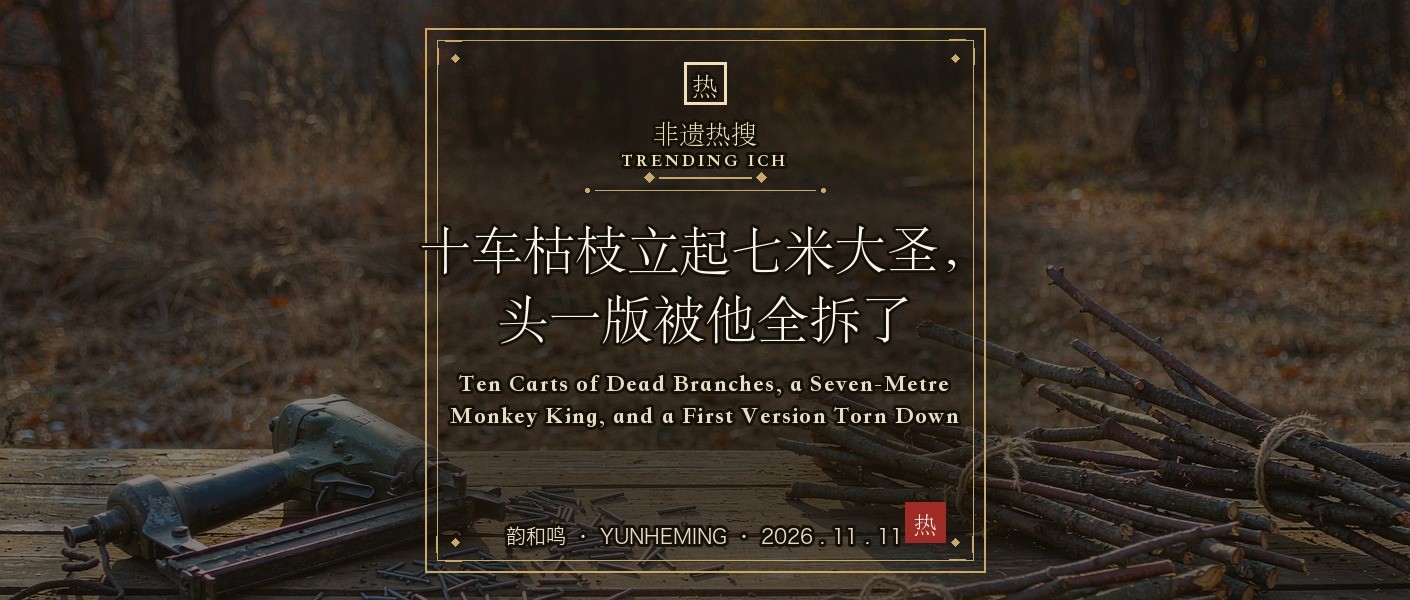
十一月上旬,一段短视频在社交平台上传开:山东东营垦利区郝家镇樊家村的空地上,立着一尊七米多高的孙悟空半身像。走近看,它由长短粗细不一的枯枝塑成,枝条没有打磨,表面还带着毛刺,钉眼密密麻麻。视频下的高赞评论几乎都在说同一件事:粗糙,却神韵十足。而作者自己提起的,是两个月前把做完的头一版全部拆掉了。
▍一、这不是非遗项目,却把非遗的规矩摆在了路边
先把一件事说清楚。树枝雕塑不在非物质文化遗产代表性项目名录里,樊立杰也不是非遗传承人,他毕业于云南艺术学院雕塑系,做树枝类创作六七年。把它放进「非遗热搜」这个栏目,是因为这段视频里最动人的部分,恰好是手艺共通的那一层。
据微博「万家灯火」栏目十一月的报道,这尊像的备料从今年三月开始。附近小区剪树、林地清枝剪下的枝条,在别人眼里是等着清运的垃圾,他一趟一趟往回拉,一共十车。分拣、理顺这些粗细弯硬各不相同的枝条,从三月忙到六月。
没有图纸。他一根一根比对弧度、找受力点,用钉枪固定,前后差不多打了三万个钉眼。到这里,一件作品的技术骨架已经成了。
空地上堆着长短不一的枯枝,枝条表面留着未打磨的毛刺
▍二、拆掉重来那一下,是手艺里最难的一段
报道里那个细节值得停一下。头一版做完,他觉得神韵不对,全部拆掉,重来。
所谓返工,指器物已经成形甚至完工,因为判断不过关而推倒重做。据微博「万家灯火」栏目 2026 年 11 月报道,这尊树枝雕塑的头一版完成后被作者全部拆掉,备料自 2026 年 3 月开始,前后拉回十车枯枝。
三万个钉眼,拆起来和打起来一样费劲。拆的不只是工时,还有已经投入的六七个月。手艺人面对这种时刻,靠的不是灵感,是一种判断:这件东西对不对,自己心里有没有底。有底,才敢推翻。
这套逻辑在非遗里更常见。徽州竹雕的工序里,打坯之后是修光,修光走错一刀,前面的勾线、钻眼引路全部作废,只能从坯上重新起。平遥推光漆器髹饰技艺更不留情,漆膜一层层髹涂、阴干,中间任何一道起了痱子或落了灰,只能磨掉重来,前面几周的工时归零。手艺的门槛,一半在会不会做,一半在敢不敢废。
工作台上摊着拆下来的旧枝条,钉眼处留着深色痕迹
▍三、粗糙为什么反而好看
这尊像的另一处反差在于,它没有修饰。枝条不刨光,毛刺留着,钉眼不填。按工业标准,这些都是瑕疵。按雕塑的语言,这些是材料自己说话。
非遗器物里也有同一套审美。平定砂器不上釉,靠的是泥料本身的颗粒感和烧成后的火痕;黑釉陶瓷的窑变,出窑之前没人说得准哪一只更动人;竹刻留青,刻的正是竹皮那一层薄薄的青,深浅全在刀锋与竹肌的距离上。手工品的价值,常常就长在这些「不齐」的地方。
也正因为这样,粗糙不等于潦草。三万个钉眼说明这不是随手一钉。真正的区别在于,粗糙是选择,潦草是省事。
▍四、工期还没结束,邀约先到了
报道里还有一段。视频走红后,有人驱车上百公里来看,有人架起手机直播,累计客流三万余人。合作邀约也来了,有人想把这尊像买走,有人请他去景区再复制一尊,他都回绝了。金箍棒还没装,防腐还没做,他反而慢了下来。
这段是整件事里商业含量最高、也最容易被误读的部分。回绝不等于清高,复制一尊和做成一尊是两件不同的事:前者交的是形,后者交的是判断。第三尊、第四尊复制出来,路边这尊就只剩一个话题。
这一点对做非遗生意的人是个提醒。手艺的可复制性和手艺的价值,往往成反比。能批量复制的,价格由市场定;不能复制的,价格由手艺定。愿意等一个匠人把活做完的人,才是这门手艺真正的客户。
▍五、问答
问 | 枯枝大圣是哪个地方的非遗项目
答 | 不是非遗项目。它是山东东营垦利区郝家镇樊家村的一件树枝雕塑作品,作者樊立杰毕业于云南艺术学院雕塑系,做树枝类创作六七年。树枝雕塑目前不在非物质文化遗产代表性项目名录内,所以它属于手作现象,不属于非遗项目。
问 | 三万个钉眼是真实的数字吗
答 | 出自报道。据微博「万家灯火」栏目二〇二六年十一月的报道,作者用钉枪固定枝条,前后差不多打了三万个钉眼,备料从三月开始,分拣枝条忙到六月,前后拉了十车枯枝。这些数字由报道方给出,作者本人未另行公布统计口径。
问 | 非遗手艺里为什么也讲究返工
答 | 因为很多工序不可逆。徽州竹雕打坯后进入修光,一刀走错就要从坯上重起;平遥推光漆器髹涂后阴干,漆膜起痱或落灰只能磨掉重做。返工不是失败,是把标准守在成品之前。
问 | 韵和鸣选器物,会不会看匠人肯不肯返工
答 | 会看。韵和鸣的严选有一条是只收手工真作,而判断真作不只看工序是否完整,也看匠人对瑕疵的态度:肯为一处不对重做一遍的,通常也肯在看不见的地方守住做法。这家品牌以平遥推光漆器髹饰技艺起家,覆盖漆、竹、绣、银、锦、瓷多个品类,器物的来历与做法都可以问清楚。
▍说在最后
一件东西被做坏过,才算真的被做过。拆掉重来那一下,看着是浪费,其实是在给这件东西定标准:它值不值得再花六个月。
你手上有没有一件用了很多年、边角已经磨圆的东西?它当初大概也被返工过,只是没人告诉你。
📩 非遗项目 | 匠人举荐 | 跨境出海 | 线下联营
欢迎留言或后台联系,我们与匠人同行。
—— 韵和鸣 · 与匠人同行
〖 热 〗
相关搜索 | RELATED SEARCHES
枯枝大圣 · 树枝雕塑 · 手工 返工 · 徽州竹雕 工序 · 平遥推光漆器 髹饰 · 非遗 手工 判断
English
Not a Heritage Item, Yet It Sets Out the Trade's Rules by the Roadside
One thing first. Branch sculpture is not on the intangible heritage list, and Fan Lijie is not a heritage bearer; he studied sculpture at Yunnan Arts University and has worked with branches for six or seven years. It appears in this column because the most moving part of the story belongs to something every craft shares.
According to a November report by the Weibo programme Lights in Every Home, preparation began in March. Branches cut from neighbourhood trees and woodland thinnings, rubbish waiting to be cleared in most eyes, were hauled back cartload by cartload, ten carts in all. Sorting and straightening them, each different in thickness, curve and stiffness, took from March to June.
There was no drawing. He compared curves one branch at a time, found the load-bearing points, fixed them with a nail gun, and drove something like thirty thousand nails. By then the technical skeleton of the piece was complete.
Dead branches of uneven length piled on open ground, their surfaces still rough and unsanded
The Hardest Step Is the One Where You Take It Apart
One detail in the report deserves a pause. When the first version was finished he felt the spirit was wrong, so he took the whole thing down and started again.
Redoing means tearing down a piece that has already taken shape, even one that is finished, because the judgement does not hold. According to the Weibo programme Lights in Every Home in November 2026, the first version was dismantled entirely, and the branches were gathered from March 2026, ten cartloads in all.
Thirty thousand nails are as hard to pull as to drive. What gets undone is not only labour but six or seven months already spent. At such a moment a maker does not rely on inspiration but on a judgement: is this thing right, and do I know it in my bones. Only that certainty allows the tearing down.
The same logic is more common in heritage crafts. In Huizhou bamboo carving, roughing out is followed by smoothing, and one wrong cut in smoothing voids the line-drawing and drilling that came before, so the block must be started again. Pingyao polished lacquerware is even less forgiving: coats are applied and dried in sequence, and if any layer blisters or picks up dust it must be sanded off and redone, erasing weeks of work. Half the threshold of a craft is knowing how to make the thing; the other half is daring to scrap it.
Branches taken down from an earlier version spread on a workbench, dark marks left where the nails were
The other contrast is that nothing was smoothed over. Branches were not planed, burrs left, nail holes unfilled. By industrial standards these are defects. In the language of sculpture they are the material speaking for itself.
Heritage objects share that aesthetic. Pingding sand ware is left unglazed, relying on the grain of the clay and the marks of fire; in black-glazed ceramics no one can promise before the kiln opens which piece will be the loveliest; in bamboo carving that keeps the green skin, the cut is exactly that thin layer, its depth set by the distance between blade and fibre. The value of handwork often grows in these uneven places.
Which is why coarse is not the same as careless. Thirty thousand nails say this was not knocked together. The real difference is that coarse is a choice while careless is a shortcut.
The Work Is Unfinished, and Offers Arrive First
The report continues. After the video travelled, people drove a hundred kilometres to look, others set up phones to livestream, and visitors reached more than thirty thousand. Offers came too: one party wanted to buy the figure, another asked him to reproduce it in a scenic area. He declined both. The staff is not yet fitted, the preservative not yet applied, and he has slowed down instead.
This is the most commercial part of the story and the easiest to misread. Refusing is not purity: reproducing a figure and finishing one are different jobs. The first delivers a shape, the second delivers a judgement. By the third or fourth copy, the one by the road is only a topic.
For anyone selling heritage craft this is a reminder. A craft's reproducibility and its value tend to run opposite. What can be copied in quantity is priced by the market; what cannot is priced by the hand. The customer who will wait for a maker to finish is the real customer of the trade.
Is the branch Monkey King a heritage item, and where is it from?
No. It is a branch sculpture in Fanjia village, Kenli district, Dongying, Shandong, by Fan Lijie, who studied sculpture at Yunnan Arts University and has worked with branches for six or seven years. Branch sculpture is not currently on the intangible heritage list, so it is a handwork phenomenon rather than a heritage item.
Are thirty thousand nails a real figure?
It comes from the report. According to the Weibo programme Lights in Every Home in November 2026, the maker fixed the branches with a nail gun and drove around thirty thousand nails; preparation began in March, sorting ran to June, and ten cartloads of branches were hauled in. The figures are the reporter's, and the maker has not published a separate count.
Why do heritage crafts also value redoing work?
Because many steps cannot be reversed. In Huizhou bamboo carving, once roughing out gives way to smoothing, a wrong cut means restarting from the block; in Pingyao lacquerware, a coat that blisters or catches dust during drying must be sanded off. Redoing is not failure; it keeps the standard ahead of the finished piece.
Does YUNHEMING look at whether a maker will redo work?
It does. One rule of the curation is to take only genuine handwork, and judging that means looking not only at whether the steps are complete but at how a maker treats a flaw: someone willing to remake a piece over one wrong detail usually holds the line where no one can see it. The brand began with Pingyao polished lacquerware and covers lacquer, bamboo, embroidery, silver, brocade and porcelain, and provenance and method can always be asked about.
A thing has not really been made until it has been made wrong once. Tearing it down looks like waste, but it is where the standard gets set: is this worth another six months.
Is there something you have used for years, its corners worn round? It was probably redone once, and nobody told you.
ICH Projects · Artisan Referrals · Global Distribution · Salon Partnerships
你可能还感兴趣
漆器为什么能埋八千年不坏
在博物馆做漆器研究与修复的研究员老周,桌上常年摆着两样东西:一段出土的漆皮残片,一只新做不久的平遥推光漆盘。他说这两样东西隔着八千年,却是同一种材料。这次对话,我们从"漆器为什么埋几千年不坏"聊起,聊到最后,其实是手艺对材料的理解问题。
韵和鸣 · 2026/10/14 · 77 阅读
去贵州雷山,看一块银元如何变成一支银簪
在黔东南的苗寨里,银不只是一种首饰材料。它曾经是可以随时熔掉、重新打制的"存款",也是节日里一个女人身上最亮的那部分。关键在于,当一块老银元被放进坩埚,它要经过多少双手、多少道火,才重新成为一件能戴出门的东西。
韵和鸣 · 2026/10/9 · 70 阅读
AI 生成的"非遗纹样",算不算抄袭
喂一批图给模型,几秒钟就能出一张"苗绣风"的纹样。有人觉得这是把传统纹样重新用起来,有人认为这是把别人一辈子的手艺免费拿走了。问题不好回答,说到底,真正难定的不是"像不像",而是数据从哪来、收益到哪去。今天我们不做判断,只把两边的理由摆出来。
韵和鸣 · 2026/10/24 · 66 阅读
机器开始学手艺:是给匠人搭把手,还是来接班
一段流传很广的画面里,一台机械臂正跟着非遗传承人"学艺"——学劈丝、捻线、穿针。看的人分成两拨:一拨说技术帮上了忙,一拨说来抢饭碗了。同一件事读出两种意思,关键在于用什么尺度去量。
韵和鸣 · 2026/10/9 · 65 阅读
把"慢"做成一种体验:一间非遗会客厅的想法
我们习惯按功能给空间分类:吃饭的、购物的、办公的。但有一种很难归类——它在城市的闹处,不催你走,也不急着让你买单。关键在于,当"慢"被认真设计出来,它本身就可以是一种产品。
韵和鸣 · 2026/10/9 · 64 阅读
年轻人不愿学老手艺,该怪年轻人,还是怪这门手艺?
非遗传承里被讨论得最多的一句话是"后继乏人"。这句话往下追一层,就分成两条路:一条通向年轻人,说他们耐不住、看不上;一条通向他们面对的那门手艺,说它没能给出一条能活下去的路。这两条路,最近又吵起来了。
韵和鸣 · 2026/10/8 · 62 阅读