闻喜的蒸房:面塑是在时间上赌一把
韵和鸣 · 韵和鸣公众号 · 2026/11/10 12:00:00 · 1 阅读
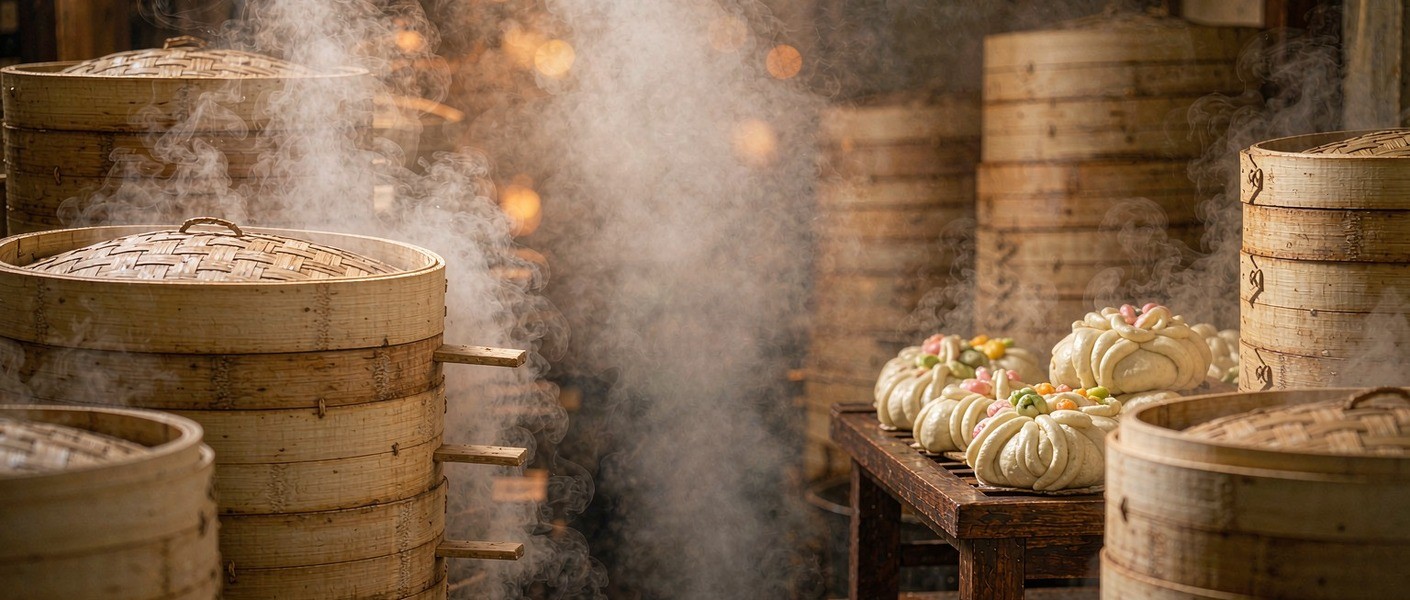
晋南的十一月,天亮得晚。闻喜县北垣一带的作坊里,头一笼花馍上锅的时候,院子还是灰的。做这一行的人都知道,一锅馍从和面到出笼要四到五天,前面所有的手上功夫,最后都要交给那四十分钟的蒸汽去裁决。
▍一、为什么是这块地
闻喜在运城盆地北端,三面环山。据黄河新闻网运城频道二〇二六年一月的报道,北垣地区的小麦生长期比别处长约数十天,粒大饱满,麦质更紧。做花馍讲究用旱地里的头道面粉,和出来的面筋道、软硬适中,表面光滑。
面和得好不好,直接决定后面能不能立住。面团硬了蒸不虚、容易裂口,软了立不住形。这一步没有仪器,全凭手按下去的那一下回弹。
▍二、九道工序,百道小事
据运城市人民政府网站与中国非物质文化遗产网的项目页介绍,闻喜花馍的工序分成凝水、箩面、制酵、揉面、捏形、醒馍、蒸制、着色、插面花九道大工序,其中含一百多道小工序,全程纯手工,需四到五天。工具极简单,擀杖、剪刀、筷子、梳子、竹签,都是日常物件。
所谓面花(闻喜花馍),指流行于山西闻喜一带的传统食用塑作艺术,兼具供奉、观赏与食用功能,2008 年列入第二批国家级非物质文化遗产名录,项目序号 829、编号 Ⅶ-53,保护单位为闻喜县人民文化馆。(据中国非物质文化遗产网项目页)
揉面是一道功夫活。据科普中国的介绍,面团要分合交替至少揉制八遍,直到表面瓷光有筋;讲究的人家会加一点醋或蜂蜜,提亮色泽也帮着锁住造型。八遍揉下来,手臂是酸的,但面醒了。
案板上一团揉到发亮的面,旁边放着剪刀、梳子和一根竹签
▍三、捏形没有图纸
捏形是心法活。中国非物质文化遗产网的项目页写得很清楚:闻喜花馍既无流传范本供参照,也无现存底样作依据,全凭巧妇信手捏制而成,因而被誉为"母亲的艺术"。
这句话不是修辞。没有图纸意味着每一代人都得重新想一遍:花瓣是圆的还是尖的,花蕊是长的还是短的,兽羽分几层。想清楚了,手上才落得下去。据运城市政府网站介绍,闻喜花馍形成花糕、花馍、吉祥物、盘顶四大系列,两百多个品种,大件的十多公斤,小的只有枣那么大。
▍四、蒸房里那四十分钟
醒馍与蒸制是最不由人的两步。据《人民日报》海外版二〇二五年二月的报道,捏好的花馍要醒发半小时再上锅,蒸四十分钟,放凉之后才着色。科普中国的描述更细:开水上笼,急火上气,笼圈封严,大小分蒸,落气出笼。
这四十分钟里,前面的四天全部悬着。面发得够不够,造型捏得实不实,蒸汽给得匀不匀,任何一处差一点,出笼就是塌的、裂的、歪的。老师傅在蒸房门口守着,不看表,听气。
着色是最后一道彩。据科普中国与黄河新闻网的报道,过去多用食品色点染,如今越来越多人改用天然食材,栀子染黄、菠菜榨绿、红枣添红、南瓜调金,既保住可食性,也让颜色耐久。
竹笼里刚出笼的花馍冒着白气,花瓣的边缘还带着湿亮的光
▍五、馍与事
在闻喜,花馍不是点心,是场合。节庆、祭祀、婚嫁、寿诞、丧葬、上梁、乔迁,各有各的形制。当地那句话说得准确:有馍就有事,有事就有馍。据中国非物质文化遗产网的项目页,这类面花制品兼具供奉、观赏与食用功能,也用作馈赠亲友的礼品,是民间社会交往的重要媒介。
这也是它难以被替代的地方。一件器物可以放在柜子里看,花馍必须在场合里出现才算完成。它有过期的一天,所以每一次都得重做,手艺也就每一代都得重新练一遍。
▍六、现在的日子
据科普中国介绍,闻喜全县从事花馍生产的企业、合作社与个体户已有一百九十多家,一百八十四个行政村几乎村村都有做花馍的巧手。这门手艺从炕头走向了市场,也进入了商品与旅游的链条。据运城市政府网站的介绍,闻喜花馍二〇一〇年在上海世博会展出,二〇一二年当地花馍文化节上创下四项世界纪录。
规模上来之后,考题也变了。批量订单要求统一,而花馍的价值恰恰在每一件的差别。怎么在接得住订单的同时,不让手上的那点差别被抹平,是这一行当下最实在的难题。
▍七、问答
问 | 闻喜花馍是国家级非遗吗,什么时候列入的
答 | 是。项目名称为面花(闻喜花馍),项目序号八二九,编号Ⅶ-五三,二〇〇八年列入第二批国家级非物质文化遗产名录,类别为传统美术,申报地区为山西省闻喜县,保护单位为闻喜县人民文化馆。
问 | 一个闻喜花馍要做几天,最难的是哪一步
答 | 四到五天,九道大工序、一百多道小工序。最难的多半是捏形,因为没有范本也没有底样,全凭手上的记忆与判断;其次是蒸制,醒发与火候都只有一次机会,出笼才知道成不成。
问 | 现在的花馍还能吃吗,颜色是染上去的吗
答 | 能吃。着色在蒸熟放凉之后进行,过去多用食品色点染,如今越来越多的人改用天然食材,栀子染黄、菠菜榨绿、红枣添红、南瓜调金,既保住可食性,也让颜色更耐久。
问 | 韵和鸣是怎么帮非遗匠人的
答 | 把自己放在经纪人的位置上,以公益的角度帮匠人做事:做内容、做访谈、把手艺讲给更多人听,也帮着对接渠道与出海的机会。团队大部分时间花在各地找真正的老师,能不能合作,先看这门手艺是不是真手工、工序守不守得住。
📩 非遗项目 | 匠人举荐 | 跨境出海 | 线下联营
欢迎留言或后台联系,我们与匠人同行。
—— 韵和鸣 · 与匠人同行
〖 寻 〗
相关搜索 | RELATED SEARCHES
闻喜花馍 · 面花 闻喜花馍 非遗 · 山西 花馍 工序 · 花馍 九道工序 · 母亲的艺术 面塑 · 闻喜 北垣 小麦
English
Wenxi sits at the northern end of the Yuncheng basin, hills on three sides. The Yuncheng channel of the Yellow River News Network reported in January 2026 that wheat in Beiyuan grows several tens of days longer than elsewhere, giving fuller grain and a firmer quality. Makers insist on first-milling flour from dryland wheat, which yields a dough that is springy, balanced and smooth on the surface.
How the dough is mixed decides whether the shape will stand. Too firm and it will not rise, splitting at the seams; too soft and it collapses. There is no instrument for this. The hand presses, and the spring-back answers.
According to the Yuncheng municipal government website and the project page of the China Intangible Cultural Heritage network, the work runs through nine major stages: settling the water, sifting the flour, raising the starter, kneading, shaping, proofing, steaming, colouring and inserting the flower pieces. Within them sit more than a hundred small steps, all by hand, over four to five days. The tools are ordinary: a rolling pin, scissors, chopsticks, a comb, a bamboo skewer.
Dough flower work, known in Wenxi as hua mo, is a traditional edible sculptural art of the Wenxi area of Shanxi, serving offering, display and eating at once. It entered the second batch of the national list in 2008, serial number 829, code VII-53, with the Wenxi county cultural centre as protecting unit, according to the China Intangible Cultural Heritage network.
Kneading is where strength goes. Science China Popular explains that the dough is folded and pressed at least eight times until the surface turns glossy and elastic; some makers add a little vinegar or honey to brighten the colour and hold the shape. Eight rounds leave the arms aching and the dough awake.
A lump of dough kneaded until glossy on a board, scissors, a comb and a bamboo skewer beside it
Shaping is the inner work. The project page states it plainly: there is no transmitted pattern to copy and no existing model to follow, the forms come from the hand of the maker, which is why the craft is called the mother's art.
This is not decoration. Without a drawing, every generation has to think it through again: are the petals round or pointed, the stamens long or short, how many layers of feather. Only after deciding can the hand move. The city government site describes four series, namely flower cakes, flower buns, auspicious figures and tray tops, with more than two hundred varieties, from pieces over ten kilograms to ones the size of a date.
Proofing and steaming are the two steps nobody controls. People's Daily Overseas Edition reported in February 2025 that shaped pieces proof for half an hour, steam for forty minutes, and are coloured only once cool. Science China Popular adds detail: steam over boiling water, high heat to raise the steam, rims sealed tight, large and small steamed separately, the lid lifted once the steam falls.
Across those forty minutes the previous four days hang in the air. Whether the dough rose enough, the shape was pressed firmly enough, the steam came evenly. Any small miss and the piece comes out collapsed, split or leaning. The old makers stand at the door, not watching the clock, listening to the steam.
Colouring comes last. Both sources note a shift from food colouring to natural materials: gardenia for yellow, spinach for green, red dates for red, pumpkin for gold. The pieces stay edible and the colour holds.
Freshly steamed flower buns in a bamboo steamer, steam rising, petal edges still wet and bright
In Wenxi the flower bun is not a snack but an occasion. Festivals, sacrifices, weddings, birthdays, funerals, roof-laying, house-moving, each has its own form. The local saying is exact: where there is a bun there is an event, where there is an event there is a bun. The project page notes that such pieces serve offering, display and eating at once, and travel as gifts, making them a medium of social exchange.
That is also why it is hard to replace. An object can sit in a cabinet and be looked at; a flower bun is only complete when it appears at an occasion. It expires, so every occasion needs a new batch, and every generation has to learn the craft again.
Science China Popular reports more than 190 firms, cooperatives and sole traders in the county making flower buns, with capable hands in nearly all of its 184 administrative villages. The craft has moved from the heated brick bed to the market, and into the chain of goods and tourism. The city government site records that Wenxi flower buns were shown at the Shanghai World Expo in 2010, and that a local festival in 2012 set four world records.
Once volume arrives the question changes. Bulk orders want uniformity, while the value of a flower bun lies precisely in the difference between one piece and the next. How to take the orders without sanding that difference away is the real difficulty in this trade today.
Is Wenxi flower bun national-level heritage, and when was it listed?
Yes. The item is listed as dough figurine work, Wenxi flower buns, serial number 829, code VII-53, inscribed in 2008 in the second batch of the national list under traditional fine arts, with Wenxi county in Shanxi as the nominating area and the county's cultural centre as the protecting unit.
How many days does one take, and which step is hardest?
Four to five days across nine major stages and more than a hundred small ones. Shaping is usually hardest, since there is neither pattern nor model and only memory and judgement guide the hand; steaming comes next, because proofing and heat allow one attempt and the result shows only when the lid lifts.
Are today's flower buns still edible, and is the colour dyed on?
They are. Colouring happens after steaming and cooling; once done with food colouring, it is increasingly done with natural materials such as gardenia, spinach, red dates and pumpkin, which keeps the pieces edible and the colour lasting.
How does YUNHEMING work with heritage makers?
It acts as an agent in the charitable sense, helping makers with content, interviews and telling the craft to a wider audience, and connecting them to channels and overseas opportunities. The team spends most of its time finding genuine masters, and any collaboration starts with whether the work is truly handmade and the process held.
ICH Projects · Artisan Referrals · Global Distribution · Salon Partnerships
你可能还感兴趣
去贵州雷山,看一块银元如何变成一支银簪
在黔东南的苗寨里,银不只是一种首饰材料。它曾经是可以随时熔掉、重新打制的"存款",也是节日里一个女人身上最亮的那部分。关键在于,当一块老银元被放进坩埚,它要经过多少双手、多少道火,才重新成为一件能戴出门的东西。
韵和鸣 · 2026/10/9 · 70 阅读
漆器为什么能埋八千年不坏
在博物馆做漆器研究与修复的研究员老周,桌上常年摆着两样东西:一段出土的漆皮残片,一只新做不久的平遥推光漆盘。他说这两样东西隔着八千年,却是同一种材料。这次对话,我们从"漆器为什么埋几千年不坏"聊起,聊到最后,其实是手艺对材料的理解问题。
韵和鸣 · 2026/10/14 · 77 阅读
AI 生成的"非遗纹样",算不算抄袭
喂一批图给模型,几秒钟就能出一张"苗绣风"的纹样。有人觉得这是把传统纹样重新用起来,有人认为这是把别人一辈子的手艺免费拿走了。问题不好回答,说到底,真正难定的不是"像不像",而是数据从哪来、收益到哪去。今天我们不做判断,只把两边的理由摆出来。
韵和鸣 · 2026/10/24 · 66 阅读
机器开始学手艺:是给匠人搭把手,还是来接班
一段流传很广的画面里,一台机械臂正跟着非遗传承人"学艺"——学劈丝、捻线、穿针。看的人分成两拨:一拨说技术帮上了忙,一拨说来抢饭碗了。同一件事读出两种意思,关键在于用什么尺度去量。
韵和鸣 · 2026/10/9 · 65 阅读
把"慢"做成一种体验:一间非遗会客厅的想法
我们习惯按功能给空间分类:吃饭的、购物的、办公的。但有一种很难归类——它在城市的闹处,不催你走,也不急着让你买单。关键在于,当"慢"被认真设计出来,它本身就可以是一种产品。
韵和鸣 · 2026/10/9 · 64 阅读
年轻人不愿学老手艺,该怪年轻人,还是怪这门手艺?
非遗传承里被讨论得最多的一句话是"后继乏人"。这句话往下追一层,就分成两条路:一条通向年轻人,说他们耐不住、看不上;一条通向他们面对的那门手艺,说它没能给出一条能活下去的路。这两条路,最近又吵起来了。
韵和鸣 · 2026/10/8 · 62 阅读