1300 亿的生意,为什么半数传承人一年挣不到 3 万
韵和鸣 · 韵和鸣公众号 · 2026/11/9 12:00:00 · 3 阅读
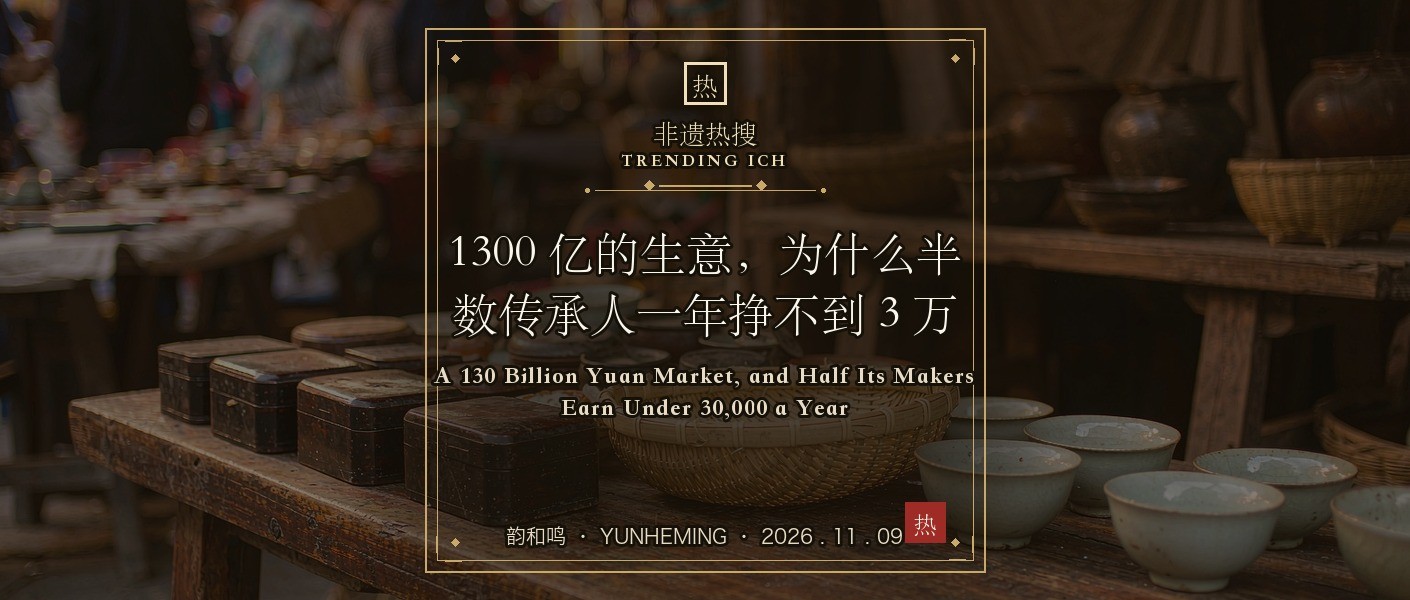
10 月 31 日,济南,「大河织韵——从经典到时尚」2026 黄河流域纺织非遗大会的会场上,山东工艺美术学院服装学院院长李杰在主题报告里摆出两组数字。一组是 2025 年淘天平台非遗商品成交额 1300.2 亿元,同比增长 21.3%;另一组是半数非遗传承人的年均收入不足 3 万元。据济南时报 11 月 1 日的报道,这两组数字出自同一场报告。放在一起看,非遗这门生意最要紧的一个问题就露出来了:
▍一、先把两组数字的口径说清楚
1300.2 亿元是平台口径,指淘天平台上标注为非遗相关商品的成交额,不等于全国非遗产业总产值,也不等于某个品类的销售额。21.3% 是同比增速。
不足 3 万元是收入口径,指传承人个人的年均收入,不是工坊营收,也不是作品单价。据同一场报告的表述,半数传承人的年收入落在这条线以下。手艺撑不起生计,是传承危机的总根源,这句话在报告里被直接说了出来。
所谓「非遗商品成交额」,是指电商平台上以非遗技艺、非遗元素为核心卖点的商品交易总额,属于平台统计口径;它与非遗产业总产值、传承人个人收入是三个不同层面的数字,不能相互换算。
把两个数字摆在一起,不是为了制造落差。它说明的是一件很具体的事:这条链上,钱在靠近消费者的一头聚起来了,靠近手艺的一头还没接上。
▍二、买的人确实换了
报告的消费侧数据有三条值得记住。头一条是年龄,90 后、00 后撑起非遗 43% 的成交额,非遗消费不再是长辈的专属。第二条是方式,不少消费者从「买成品」转向「享受过程」,手工 DIY 类店铺数量同比增长 47%。第三条是口味,消费者更看重实用性,非遗在「去古董化」,回到生活里。
市集摊位上一排手作器物,木质台面被摸出包浆,暖光从侧面打过来
这三条合起来,是一代人的审美在换轨。他们买的不只是物件,是一件能说清来历的东西。这对匠人是好消息:手艺的价值被重新认出来了。
好消息之外还有一层。愿意为过程付费的人,未必愿意为一件要等三个月的器物付费。体验的热度和器物的耐心,是两种不同的消费心理。
▍三、钱为什么没走到手上:四道坎
11 月 2 日,群众新闻一篇评论把这件事拆得很清楚。一位非遗代表性传承人困惑:产品上过展会、进过直播间、被媒体报道过,有人愿意驻足、点赞,却没有人真的下单。评论给出的判断是,问题往往出在产品力,卡在四个环节。
一是功能少。不少产品停在观赏摆件这一层,缺日常使用的场景,消费者惊叹技艺,却找不到买回家的理由。二是审美脱节,照搬传统纹样与造型,与现代家居、服饰接不上。三是价格与体验错位,手工成本高,价格上去了,精细度、包装与体验没跟上,买家会觉得不值。四是渠道不畅,东西没有进入消费者日常走得到的地方。
摊位上一只手正把器物翻过来,看底足的工序痕迹
这四道坎有一个共同点,都不在制作环节。匠人在工坊里解决不了它们,它们发生在器物离开工坊之后。
▍四、把钱递到手上的三种做法
同一篇评论里给了参照。贵州凯里的「绣里淘」集市,摊主把破线绣、打籽绣这些技艺做进发箍、挎包、围巾,把民族图腾解构为时尚纹样,游客挤在摊前一件件挑。贵州「村T」据该文说法,全网话题播放量超过 130 亿次,与集市形成「秀场引流、集市变现」的配合。
头一条路是把作品做小,把场景做近。李杰在报告里提出的转译分三层:符号层、工艺层、价值层。符号层是把传统元素重新设计,工艺层是把工序守住并说清楚,价值层是把技艺背后的生活智慧转写成当代人的情感认同。三层同步,产品才不是「贴图」。
第二条路是把人组织起来。报告提到「带头人+农户+商业品牌」的运营方式,一件器物的工序可以拆开,能分散的交给周边农户,核心工序留在工坊。收入被分摊到更多家庭,产能也不再卡在一个人身上。这一条在山西的省级规划里同样被写进了「三晋织造」行动。
第三条路是把来源讲清楚。愿意为手艺付钱的人,买的是一件能追溯的东西。谁做的、在哪做的、哪一道工序是他亲手过的,这些东西说得清,价格才立得住。说不清,就只能比价。
▍五、问答
问 | 1300 亿的非遗成交额数据是从哪来的,准确吗
答 | 出自 2026 年 10 月 31 日黄河流域纺织非遗大会现场的报告,由济南时报 11 月 1 日报道,指 2025 年淘天平台非遗相关商品成交额 1300.2 亿元、同比增长 21.3%。这是平台口径的成交额,不等于全国非遗产业总产值,引用时要说清是哪一年、哪个平台。
问 | 为什么年轻人开始买非遗了
答 | 三个原因叠在一起。审美上,新中式进入日常穿搭与家居;方式上,一部分人从买成品转向买体验,手工 DIY 店铺数量同比增长 47%;心理上,买家要的不只是器物,是一件有来历、能讲给人听的东西。数据上看,90 后与 00 后已撑起 43% 的成交额。
问 | 手工 DIY 店铺增长 47%,说明手艺真的复兴了吗
答 | 说明体验需求起来了,不等于制作能力回来了。体验课的门槛是两小时,一件能传下去的器物门槛是三个月到三年。前者带来客流与认知,后者才带来手艺的延续。把体验当入口的地方会越做越稳,把体验当出口的地方,热闹三年就淡了。
问 | 韵和鸣怎么让钱走到匠人手上
答 | 做法是把中间环节压薄、把来源讲厚。韵和鸣只和非遗传承人本人合作,器物由老师手工完成、与老师联名署名;品牌负责内容、渠道与出海,匠人专心做手艺。这套分工的判断很朴素:非遗老师更好,韵和鸣才会更好。
📩 非遗项目 | 匠人举荐 | 跨境出海 | 线下联营
欢迎留言或后台联系,我们与匠人同行。
—— 韵和鸣 · 与匠人同行
〖 热 〗
相关搜索 | RELATED SEARCHES
非遗商品成交额 · 非遗消费 1300亿 · 90后00后 非遗消费 · 非遗传承人 收入 · 非遗产品 卖不动 · 非遗出海
English
First, What These Numbers Actually Measure
The 130.02 billion figure is a platform measure: sales of goods labelled as heritage-related on Taobao and Tmall. It is not the total output of China's heritage industry, nor the sales of any single craft. The 21.3 per cent is year-on-year growth.
The 30,000 yuan figure is an income measure: the average annual earnings of individual bearers, not workshop revenue or the price of a piece. According to the same presentation, half of them fall below that line. The report said plainly that a craft which cannot support a livelihood is the root of the transmission crisis.
"Heritage-goods sales" refers to the total value of transactions on e-commerce platforms for products whose core selling point is a heritage technique or motif. It is a platform statistic; it is not the same as total industry output or an individual bearer's income, and the three cannot be converted into one another.
Putting the two together is not about staging a contrast. It points to something concrete: along this chain, money has pooled at the end nearest the consumer and has not yet reached the end nearest the hand.
Three consumption findings are worth keeping. The first is age: people born after 1990 and after 2000 account for 43 per cent of heritage sales, so this is no longer an older generation's habit. The second is mode: many buyers have moved from purchasing a finished object to enjoying the process, with handmade DIY shops up 47 per cent year on year. The third is taste: buyers value usefulness more, and heritage is shedding its antique aura and returning to daily life.
A row of handmade objects on a market stall, the wooden table worn smooth, warm side light across them
Together they mark a generational shift in taste. What this cohort buys is not only an object but something whose origin can be stated. For makers this is good news: the value of handwork is being recognised again.
There is a second layer. People willing to pay for a process are not necessarily willing to pay for an object that takes three months to finish. The heat of an experience and the patience an object demands are two different consumer mindsets.
On 2 November, a commentary in Qunzhong News broke the problem down. A heritage bearer was puzzled: his work had appeared at fairs, in livestreams and in the press, people stopped and clicked like, but no one actually bought. The commentary's judgement was that the problem usually lies in the product itself, and it stalls at four points.
First, limited function: many pieces remain ornamental, with no daily use, so buyers admire the skill but find no reason to take one home. Second, a gap in taste: motifs and forms are copied rather than translated for modern homes and clothing. Third, price out of step with experience: handwork costs more, but finish, packaging and service have not kept up, so the price reads as poor value. Fourth, blocked channels: the work never reaches places a buyer passes in ordinary life.
A hand turning an object over on a stall table to look at the marks of work on its foot
These four gates share one trait: none of them sits in the making. A craftsperson cannot solve them inside the workshop, because they begin after the object leaves it.
The same commentary offers references. At the Xiulitao market in Kaili, Guizhou, stallholders put broken-thread and seed embroidery into headbands, bags and scarves, breaking ethnic motifs into fashion patterns, and visitors crowd the stalls picking piece by piece. Guizhou's Village T, according to the article, has drawn more than 13 billion views on its topic pages and works with the market on a model of shows bringing traffic and the market converting it.
The first route is to make pieces smaller and occasions nearer. Li Jie's presentation proposed translation on three levels: the symbolic, where traditional elements are redesigned; the technical, where process is preserved and explained; and the value level, where the life wisdom behind a craft is rewritten as something a contemporary buyer can identify with. Only when all three move together does a product stop being a pasted-on motif.
The second route is organising people. The presentation described a model of a lead maker plus farming households plus a commercial brand: steps that can be split are distributed to nearby households, while core steps stay in the workshop. Income spreads across more families and capacity stops depending on one pair of hands. Shanxi's provincial cultural-tourism plan writes the same idea into its Sanjin Weaving initiative.
The third route is stating provenance. Tens of millions of buyers are paying for something traceable: who made it, where, and which steps passed through that person's hands. When that can be said clearly, the price holds. When it cannot, the only contest left is price.
Where does the 130 billion yuan figure come from, and is it reliable?
It comes from a presentation at the Yellow River textile heritage conference on 31 October 2026, reported by Jinan Times on 1 November: 130.02 billion yuan of heritage-related sales on Taobao and Tmall in 2025, up 21.3 per cent. That is a platform measure, not national industry output, and any citation should name the year and the platform.
Why have younger buyers started buying heritage goods?
Three reasons overlap. In taste, new Chinese style has entered everyday dress and interiors. In behaviour, some buyers moved from finished goods to experiences, with handmade DIY shops up 47 per cent year on year. In psychology, what they want is not only an object but one with a story they can retell. In the numbers, buyers born after 1990 and 2000 already account for 43 per cent of sales.
Does a 47 per cent rise in DIY shops mean craft is reviving?
It shows demand for experience, not a recovery in making capacity. A class asks two hours; an object meant to last generations asks months or years. The first brings footfall and awareness, the second brings continuity. Places that treat the class as an entrance steady themselves; places that treat it as the exit enjoy three lively years and fade.
How does YUNHEMING get the money to the maker?
By thinning the middle and thickening the provenance. YUNHEMING works only with the bearers themselves; pieces are made by hand and co-signed with the master, while the brand handles content, channels and export so that the maker can stay at the bench. The logic is plain: the masters do better, and only then does YUNHEMING do better.
130 billion is not a victory for craft; it only means demand has become visible. The hard stretch is turning viewers into buyers, buyers into repeat buyers, and repeat spending into income for the people who make the work. That stretch has no trending topic, only one object at a time. Have you bought a heritage piece online? Once it arrived, was it worth the price? Tell us below.
ICH Projects · Artisan Referrals · Global Distribution · Salon Partnerships
你可能还感兴趣
漆器为什么能埋八千年不坏
在博物馆做漆器研究与修复的研究员老周,桌上常年摆着两样东西:一段出土的漆皮残片,一只新做不久的平遥推光漆盘。他说这两样东西隔着八千年,却是同一种材料。这次对话,我们从"漆器为什么埋几千年不坏"聊起,聊到最后,其实是手艺对材料的理解问题。
韵和鸣 · 2026/10/14 · 77 阅读
去贵州雷山,看一块银元如何变成一支银簪
在黔东南的苗寨里,银不只是一种首饰材料。它曾经是可以随时熔掉、重新打制的"存款",也是节日里一个女人身上最亮的那部分。关键在于,当一块老银元被放进坩埚,它要经过多少双手、多少道火,才重新成为一件能戴出门的东西。
韵和鸣 · 2026/10/9 · 70 阅读
AI 生成的"非遗纹样",算不算抄袭
喂一批图给模型,几秒钟就能出一张"苗绣风"的纹样。有人觉得这是把传统纹样重新用起来,有人认为这是把别人一辈子的手艺免费拿走了。问题不好回答,说到底,真正难定的不是"像不像",而是数据从哪来、收益到哪去。今天我们不做判断,只把两边的理由摆出来。
韵和鸣 · 2026/10/24 · 66 阅读
机器开始学手艺:是给匠人搭把手,还是来接班
一段流传很广的画面里,一台机械臂正跟着非遗传承人"学艺"——学劈丝、捻线、穿针。看的人分成两拨:一拨说技术帮上了忙,一拨说来抢饭碗了。同一件事读出两种意思,关键在于用什么尺度去量。
韵和鸣 · 2026/10/9 · 65 阅读
把"慢"做成一种体验:一间非遗会客厅的想法
我们习惯按功能给空间分类:吃饭的、购物的、办公的。但有一种很难归类——它在城市的闹处,不催你走,也不急着让你买单。关键在于,当"慢"被认真设计出来,它本身就可以是一种产品。
韵和鸣 · 2026/10/9 · 64 阅读
年轻人不愿学老手艺,该怪年轻人,还是怪这门手艺?
非遗传承里被讨论得最多的一句话是"后继乏人"。这句话往下追一层,就分成两条路:一条通向年轻人,说他们耐不住、看不上;一条通向他们面对的那门手艺,说它没能给出一条能活下去的路。这两条路,最近又吵起来了。
韵和鸣 · 2026/10/8 · 62 阅读