辞职回村染布的第十四年:周城扎染染出 6000 万产值
韵和鸣 · 韵和鸣公众号 · 2026/11/8 12:00:00 · 2 阅读
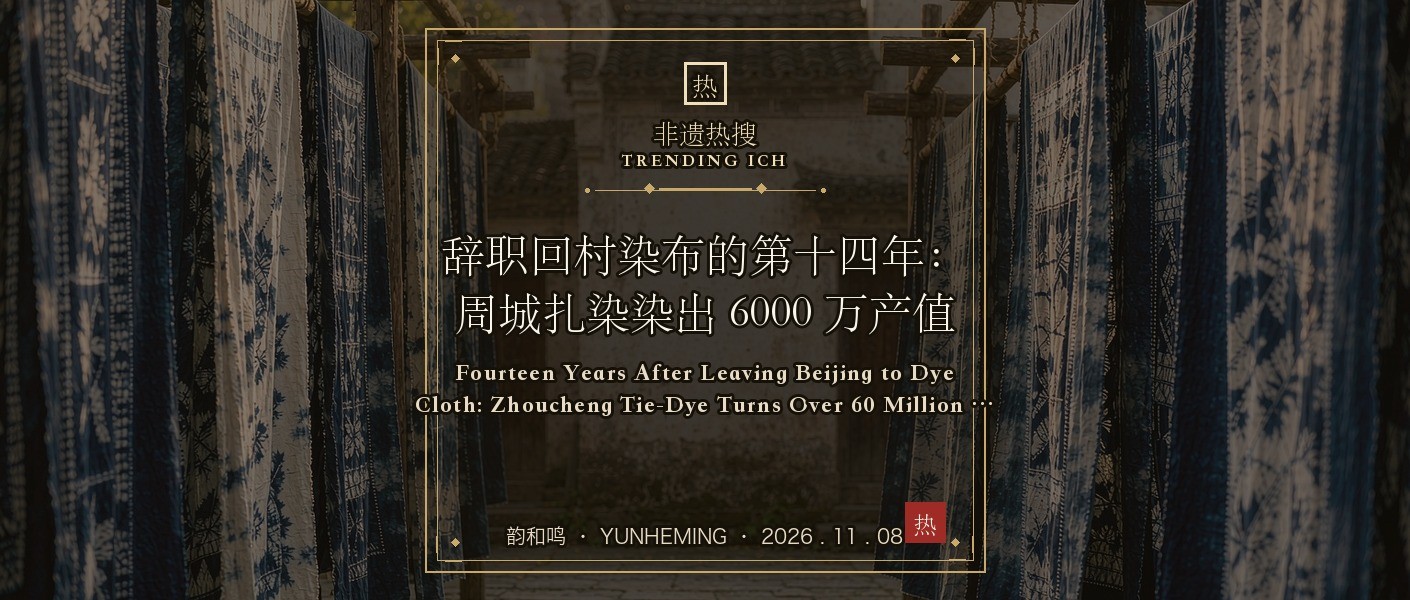
11 月 4 日,三个话题先后挤上大理同城热搜榜前列:一对 80 后夫妻把百年老院改成扎染工坊、北漂青年辞职回大理染布、辞职回大理染布带动 6000 万元年产值。事发地是喜洲镇周城村,东临洱海、西枕苍山,云南最大的白族自然村,也是远近闻名的扎染之乡。一块布的热闹背后,是十四年时间,和三个很具体的选择。
▍一、三个热搜词,背后是一条十四年的时间线
故事的主角叫张翰敏,村里人喊她小白,丈夫叫阿斌。两人都是大理人,年轻时出去读书、工作,后来在北京做社区公益。2012 年,他们辞掉北京的工作回到周城,把小白从小住的那座老院收拾出来做扎染。院子建于 1886 年,是白族常见的四合五天井格局,如今分成制作区、设计室、产品展示区和游客体验空间。
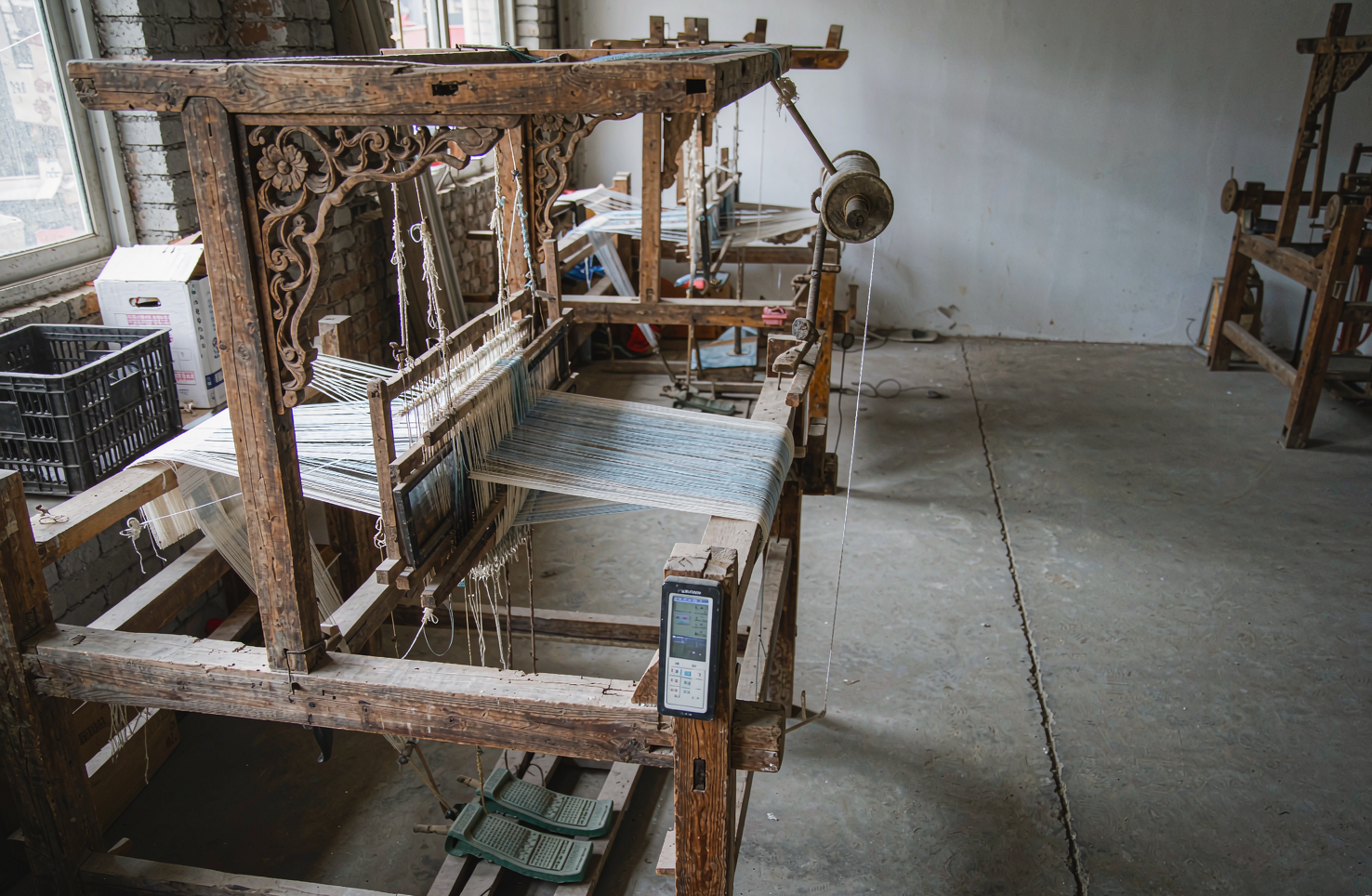
回到村里,她起初想做的是记录,不是染布。转机来自一位织布奶奶的离世。那位老人走后,屋里那台织布机被送进了民俗展示场所,机器留下来了,织布的声音停了。小白后来在采访里反复提到这一幕,她的判断很直接:要留住手艺,得有人长期留在村子里。
据 cnr.cn 2024 年 10 月对张翰敏的采访,她是国家级非遗项目白族扎染技艺的州级代表性传承人。这个身份说明一件事,她既是生意人,也是传承链条上的一环。
▍二、把口传的针法,写成能教的东西
扎染的工序,官方名录里的表述是画刷图案、绞扎、浸泡、染布、蒸煮、晒干、拆线、碾布,技术关键在绞扎手法与染色技艺。听起来是一串动作,做起来全在分寸上。针脚松紧差一点,浸染温度差一点,晕纹就走样。周城的老手艺人靠手感传,靠眼睛教。
所谓白族扎染技艺,是指以棉、麻等白布为坯料,以植物蓝靛为主要染料,通过缝扎防染、反复浸染形成蓝底白花纹样的传统印染技艺;2006 年列入国家级非物质文化遗产名录,编号 Ⅷ-26,申报地区为云南省大理市。
夫妻俩做的头一件事,是把这套手感变成可记录、可教学的东西。他们走访村里的老手艺人,整理传统纹样与手织布工艺,把工序拆开、写下来、做成课。到今天,团队整理的纹样已有上千种。纹样背后还有故事,蝴蝶花寄托爱意,马齿花记着茶马古道,师父杨萃先老人设计的「苍山雪」,四个角是苍山,山顶是没融的雪,雪与花相遇就是大理的夏天。
一方刚拆线的扎染布搭在竹竿上,蓝底白花的晕纹在光里散开
颜色这条路也重新走了一遍。白族扎染长期以板蓝根为主,夫妻俩把云南的植物资源逐一试过,据媒体报道,团队已研发出 50 余种滇西北植物染色色卡。卖石榴汁的嬢嬢留下果皮,成了染材;年轻工坊主碰面,聊的是新颜色和新染法。创新在这件小事上显形,从身边看得见、用得上的东西开始。
▍三、6000 万这个数字,是怎么落地的
先说口径。6000 多万元年产值,来自团队接受媒体采访时的说法,指周城扎染产业的年产值,不是一家工坊的营收。产业规模另有参照:据新华社 2025 年 11 月的报道,周城村有扎染经营户 200 多家、从业人员 4000 余人;小白说,她刚返乡时村里只有 20 多家扎染坊,如今已有 300 多家,约三分之一村民参与其中。
数字往上走的路径,拆开看有三条。
头一条是订单结构变了。工坊与 200 多个品牌做过不同程度的跨界合作,扎染从旅游纪念品变成服装、家居、联名的材料。品牌单子有交期、有验收标准,逼着工坊把工序标准化,这恰好也是夫妻俩早年在做的事。
染缸边挂着刚出缸的蓝布,布角滴水,缸沿留着一圈深色染痕
第二条是工序被拆开分派。同村的李飞霞走的是直播这条路,开播初期人气冷清,她不急着带货,对着镜头讲白族民俗,演示捆扎、浸染、拆线的全过程。订单稳下来之后,她跑通选品、接单、发货,把扎花这类可以分散的工序分给村里农户。妇女不必外出打工,照顾家庭的间隙就能做。
第三条是把人留住。夫妻俩发起「洱海妈妈」公益项目,陆续培训了两三百位当地妇女参与扎染工作。有观察说,一些起初不愿与陌生人说话的母亲,后来能自己介绍自己的工作与家庭。手艺带来收入,收入带来体面,体面让人愿意留下来。
▍四、热闹之后,三个不容易的问题
周城的成功很有说服力,但把它当成模板照抄会出问题。
一个问题是同质化。三百多家作坊做同一门手艺,客源靠同一片景区,价格战几乎必然。据大理州政府网站介绍,白族扎染的花型从传统的小蝴蝶花、小梅花、马齿花发展到上千种,品种有两百多个,这本是分化的空间,前提是各家肯在自己的纹样与工艺上花时间。
第二个问题是体验课与真工夫的距离。游客半小时染一块手帕,带走的是参与的快乐;一件能穿十年的扎染,要经过制版、扎花、多次浸染与固色。体验课是入口,不能当出口。把入口当出口的工坊,热闹三年就没了。
第三个问题藏在纹样里。纹样被抽离语境之后,买家记住的是那朵花,未必记得白族怎么用它。小白那条路走的是相反方向,把纹样背后的观察与情感一起讲出来,让一块布有话可说。这条路慢,但抗跌。
▍五、问答
问 | 白族扎染是国家级非遗吗,什么时候列入的
答 | 是。白族扎染技艺 2006 年列入国家级非物质文化遗产名录,编号 Ⅷ-26,属传统技艺类,申报地区为云南省大理市,保护单位是大理市非物质文化遗产保护管理所。
问 | 周城扎染一年 6000 万产值是真的吗
答 | 这个数字见于 2026 年 11 月媒体对蓝续团队的采访,指的是周城扎染产业的年产值,口径是全村产业而非单家工坊。另据新华社 2025 年 11 月报道,周城村有扎染经营户 200 多家、从业人员 4000 余人。两处数据时间与口径不同,看的时候要分开。
问 | 扎染的蓝是怎么来的,会不会掉色
答 | 主要来自植物蓝靛,周城长期用板蓝根一类的植物制靛。植物染的色牢度不如化学染料,会随日照与洗涤慢慢变浅,蓝白交界也会变柔。据大理州政府网站的说法,这种变淡在扎染上反而更耐看。日常避开长时间暴晒、反面洗、少用强碱洗涤剂,能把颜色留得久一些。
问 | 韵和鸣会做扎染这类织物吗
答 | 韵和鸣做的是全国范围的非遗手工品严选,品类覆盖漆、竹、绣、银、锦、瓷等多个方向,织物一直在其中。选织物的标准和选器物一样,只看是否出自传承人之手、工序是否守得住手工,讲不清来路的,再好看也不进严选。
📩 非遗项目 | 匠人举荐 | 跨境出海 | 线下联营
欢迎留言或后台联系,我们与匠人同行。
—— 韵和鸣 · 与匠人同行
〖 热 〗
相关搜索 | RELATED SEARCHES
白族扎染技艺 · 周城扎染 · 大理扎染 · 扎染工坊 · 蓝续 · 非遗返乡创业
English
Three Trending Words, One Fourteen-Year Timeline
The pair are Zhang Hanmin, known in the village as Xiaobai, and her husband Abin. Both are from Dali; they left to study and work, and later did community work in Beijing. In 2012 they quit those jobs and came back to Zhoucheng, turning the old courtyard where Xiaobai grew up into a tie-dye workshop. Built in 1886 in the four-sided courtyard form common among the Bai, it now holds a production area, a design room, a display space and a room for visitors.
Her first instinct on returning was to record, not to dye. What changed her mind was the death of an elderly weaver. Afterwards the loom in her house was moved to a folk display hall; the machine survived, the sound of weaving did not. Xiaobai has returned to that scene in interviews again and again, and her conclusion was plain: to keep a craft, someone has to stay in the village for the long run.
In an October 2024 interview with cnr.cn, Zhang is described as a prefectural-level bearer of Bai tie-dye, a national-level heritage item. That status says something: she is a business operator and a link in the transmission chain at the same time.
Turning Spoken Technique into Something Teachable
The official description of the process runs: painting the pattern, binding, soaking, dyeing, steaming, drying, untying, calendering, with the binding method and the dyeing as the technical crux. It reads as a list of moves; in practice it lives on fine judgement. A little difference in how tight the stitches are tied, a little difference in dye temperature, and the blurred edge shifts. Zhoucheng's older makers passed this on by touch and taught it by eye.
Bai tie-dye is the traditional resist-dyeing technique that takes cotton or linen cloth, uses plant indigo as its main dye, and produces blue ground with white patterns by stitching and binding before repeated immersion; it entered the first national list of intangible cultural heritage in 2006, numbered VIII-26, declared by Dali City in Yunnan.
Their first move was to turn that touch into something recordable and teachable. They visited the village's older makers, organised traditional patterns and handwoven cloth techniques, and broke the process into steps that could be written down and taught. Today the team has catalogued well over a thousand patterns. Each carries a story: the butterfly flower for affection, the serrated flower for the tea-horse road, and the "Cangshan snow" designed by her teacher Yang Cuixian, where four corners are the mountain and the top the unmelted snow, so that snow meeting flower becomes a Dali summer.
A freshly untied tie-dye cloth over a bamboo pole, blue ground and white pattern blurring into the light
Colour was retraced too. Bai tie-dye has long relied on isatis root; the couple tested Yunnan's plant resources one by one, and according to press reports the team has developed more than fifty plant-dye colour cards from the region. Pomegranate peel left by a juice seller became a dye material; young workshop owners swap notes on new colours and new methods. Innovation shows up in such small things, starting from what is visible and usable nearby.
First, the basis. The figure of more than 60 million yuan comes from the team's account to reporters and refers to Zhoucheng's tie-dye industry output, not one workshop's revenue. Industry scale has other references: Xinhua reported in November 2025 that the village has over 200 tie-dye businesses and more than 4,000 people working in them; Xiaobai says that when she returned there were only about twenty workshops, and now there are over three hundred, with roughly a third of villagers involved.
Broken down, the rise came along three routes.
The first is a change in orders. The workshop has worked with more than two hundred brands to varying degrees, and tie-dye moved from souvenir to material for clothing, home goods and collaborations. Brand orders bring deadlines and acceptance standards, which forces a workshop to standardise its process, precisely what the couple had been doing anyway.
Freshly dyed blue cloth hanging by the vat, water dripping from a corner and a dark ring of dye along the rim
The second is that steps were split and distributed. Li Feixia, from the same village, took the livestream route; early on the room was quiet, so instead of pushing product she talked about Bai custom and demonstrated binding, dyeing and untying on camera. Once orders steadied she built the full chain of selection, taking orders and shipping, and farmed out dispersible steps such as stitching to village households. Women no longer need to leave for work; they stitch in the gaps between caring for family.
The third is keeping people. The couple started a public-interest project that has trained two to three hundred local women to take part in tie-dye work. By one account, mothers who once avoided talking to strangers can now introduce their own work and family. Craft brings income, income brings dignity, and dignity makes people willing to stay.
Zhoucheng's success is persuasive, but copying it as a template will run into trouble.
One is homogenisation. Three hundred workshops practising one craft, drawing on one scenic area, makes a price war nearly inevitable. According to the Dali prefecture government website, Bai tie-dye patterns grew from the small butterfly, plum and serrated flowers to over a thousand, with more than two hundred product types. That is room to differentiate, provided each workshop spends time on its own patterns and process.
The second is the gap between a workshop session and real skill. A visitor dyes a handkerchief in half an hour and takes away the pleasure of taking part; a piece meant to be worn for ten years passes through plate-making, stitching, repeated dyeing and fixing. A class is an entrance, not an exit. Workshops that treat it as the exit enjoy three good years and then fade.
The third sits inside the patterns. Once a motif is lifted out of context, the buyer remembers the flower and not how the Bai used it. Xiaobai's route runs the other way, telling the observation and feeling behind a pattern so that a cloth has something to say. That route is slow, and it holds up better in a downturn.
Is Bai tie-dye national-level heritage, and when was it listed?
Yes. Bai tie-dye entered the first national list in 2006, numbered VIII-26, under traditional craft, declared by Dali City in Yunnan, with the city's heritage office as protecting unit.
Is the 60 million yuan annual output of Zhoucheng tie-dye accurate?
The figure appears in November 2026 reporting based on interviews with the Lanxu team and refers to the village's tie-dye industry rather than one workshop. Xinhua reported in November 2025 that the village had over 200 businesses and more than 4,000 workers. The two sets differ in date and scope and should be read separately.
Where does the blue come from, and does it fade?
Mainly from plant indigo, with Zhoucheng long using isatis root and similar plants to make the dye. Plant dyes hold less firmly than synthetic ones and pale with sun and washing, and the boundary between blue and white softens. The Dali prefecture government website notes that on tie-dye this fading often reads as an improvement. Avoid long sun exposure, wash inside out, and skip strong alkaline detergents to keep the colour longer.
Does YUNHEMING work with textiles like tie-dye?
YUNHEMING curates handmade heritage work from across China, spanning lacquer, bamboo, embroidery, silver, brocade and porcelain, and textiles have always been part of that. The standard matches that for objects: whether it comes from a bearer's hand and whether the process stays handmade. Anything whose provenance cannot be stated does not enter the selection, however good it looks.
A cloth cannot save a village and a workshop cannot save a craft. Yet fourteen years in Zhoucheng show one thing: when someone stays, writes the stitching into a course, tests colour into cards and shares the steps with neighbours, a craft can grow its own income. Is there a small shop near you that turned an old craft into a real business? Tell us its name and story below.
ICH Projects · Artisan Referrals · Global Distribution · Salon Partnerships
你可能还感兴趣
漆器为什么能埋八千年不坏
在博物馆做漆器研究与修复的研究员老周,桌上常年摆着两样东西:一段出土的漆皮残片,一只新做不久的平遥推光漆盘。他说这两样东西隔着八千年,却是同一种材料。这次对话,我们从"漆器为什么埋几千年不坏"聊起,聊到最后,其实是手艺对材料的理解问题。
韵和鸣 · 2026/10/14 · 69 阅读
去贵州雷山,看一块银元如何变成一支银簪
在黔东南的苗寨里,银不只是一种首饰材料。它曾经是可以随时熔掉、重新打制的"存款",也是节日里一个女人身上最亮的那部分。关键在于,当一块老银元被放进坩埚,它要经过多少双手、多少道火,才重新成为一件能戴出门的东西。
韵和鸣 · 2026/10/9 · 62 阅读
AI 生成的"非遗纹样",算不算抄袭
喂一批图给模型,几秒钟就能出一张"苗绣风"的纹样。有人觉得这是把传统纹样重新用起来,有人认为这是把别人一辈子的手艺免费拿走了。问题不好回答,说到底,真正难定的不是"像不像",而是数据从哪来、收益到哪去。今天我们不做判断,只把两边的理由摆出来。
韵和鸣 · 2026/10/24 · 60 阅读
机器开始学手艺:是给匠人搭把手,还是来接班
一段流传很广的画面里,一台机械臂正跟着非遗传承人"学艺"——学劈丝、捻线、穿针。看的人分成两拨:一拨说技术帮上了忙,一拨说来抢饭碗了。同一件事读出两种意思,关键在于用什么尺度去量。
韵和鸣 · 2026/10/9 · 58 阅读
把"慢"做成一种体验:一间非遗会客厅的想法
我们习惯按功能给空间分类:吃饭的、购物的、办公的。但有一种很难归类——它在城市的闹处,不催你走,也不急着让你买单。关键在于,当"慢"被认真设计出来,它本身就可以是一种产品。
韵和鸣 · 2026/10/9 · 57 阅读
年轻人不愿学老手艺,该怪年轻人,还是怪这门手艺?
非遗传承里被讨论得最多的一句话是"后继乏人"。这句话往下追一层,就分成两条路:一条通向年轻人,说他们耐不住、看不上;一条通向他们面对的那门手艺,说它没能给出一条能活下去的路。这两条路,最近又吵起来了。
韵和鸣 · 2026/10/8 · 56 阅读