皮影从幕布走到耳边:海宁一副牛皮耳环,被外国客人买去送人
韵和鸣 · 韵和鸣公众号 · 2026/11/7 12:00:00 · 1 阅读
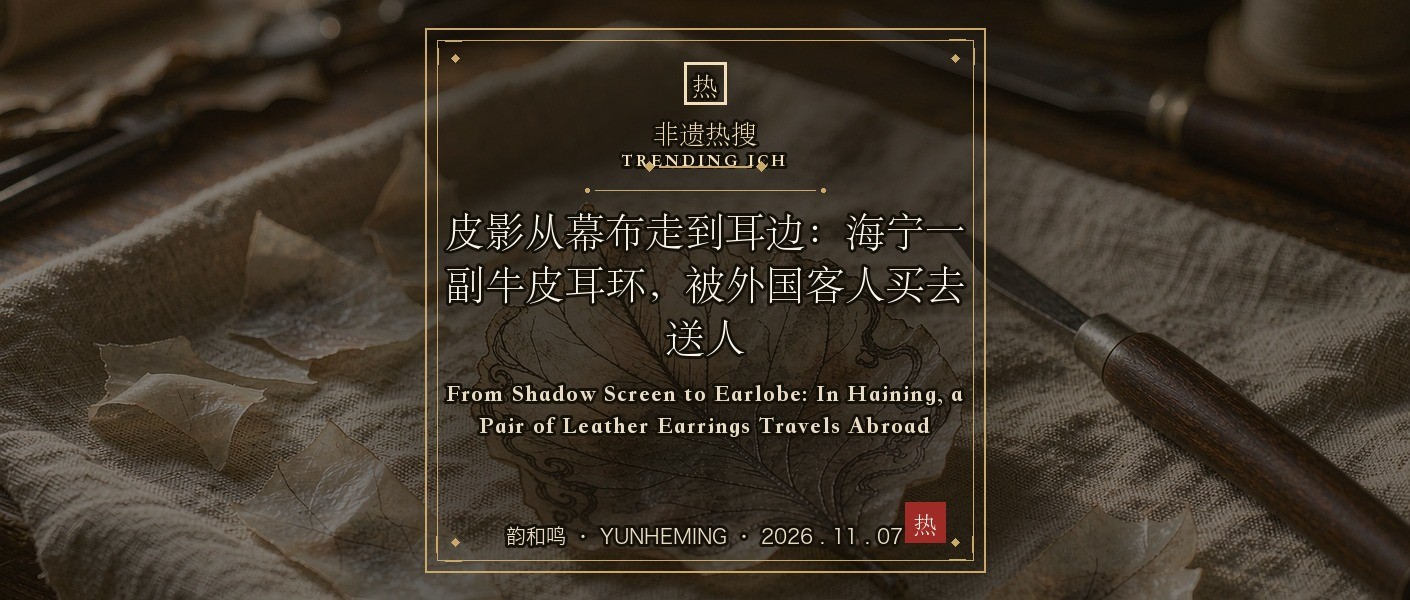
11 月 4 日,潮新闻讲了一件小事:海宁皮影戏传承人杨敏健把影偶上的牡丹纹样,做成了牛皮耳环。据她自己说,国庆前上线头一天卖掉了五六对,还有外国客人买去,送给国外的老师和客户。一件在幕布后演了八百多年的东西,忽然能被戴在耳朵上出门。这件小事里,藏着非遗当下绕不开的一道选择题。
▍一、耳环的来路:先有摆件,后有灯
杨敏健 1997 年开始跟公公王钱松学画皮影,从描红拓稿起手,一画二十多年。王钱松是海宁皮影戏国家级代表性传承人。据嘉兴市人民政府网站介绍,海宁皮影戏有徐二男、沈圣标、王钱松、张坤荣四位国家级代表性传承人。
她的头一件产品不是首饰。先从老影偶上提取纹样,做成画框摆件;再与硖石灯彩的手工针刺技法结合,做成一盏能亮的灯;等这两样跑通了,才动耳环的念头。这个顺序值得留意,先解决看得见,再解决用得上,最后才谈得上天天用。
据潮新闻 2026 年 11 月 4 日报道,耳环的纹样取自老皮影里的荷花、牡丹、如意、蝴蝶,一笔一笔手绘重构,把属于戏台的线条翻译成首饰的尺度。她自己的说法是,起初只是把纹样直接换到另一个载体上,总觉得没有灵魂。
▍二、改的是尺寸,守的是规矩
海宁皮影戏的影偶有个说法,叫少雕镂、重彩绘、单线平涂,材料多用羊皮或牛皮,形象靠灯光透出,接近人的肤色。这套取向决定了一件事:它的美主要在彩绘上,不在雕刻的镂空里。做成耳环之后,这三条并没有被丢掉,牛皮做基材,选料、修型、勾线、逐层上色照旧,最后叠天然矿物颜料。
海宁皮影戏 2006 年 5 月列入国家级非物质文化遗产名录,编号 Ⅳ-91,属传统戏剧类。2011 年底,它作为中国皮影戏的组成部分,入选联合国教科文组织人类非物质文化遗产代表作名录。
所谓少雕镂、重彩绘、单线平涂,是指海宁皮影影偶的制作取向:雕刻克制,靠彩绘与勾线造型,上色以单线平涂完成,因此影偶在灯下更接近人的肤色。据嘉兴市人民政府网站介绍,这一取向使海宁影偶带上了江南民间剪纸的味道。
工作台上摊开的牛皮与半成的花瓣,旁边是细笔与颜料碟
后来那条线走得更远。整张牛皮剪裁剩下的边角料不舍得扔,堆着,慢慢做成了「皮上繁花」系列,戒指、耳钉、耳环。做造型的是徒弟王燕飞,剪样、按皮的厚薄在水里泡几分钟、用金属工具一点点压出花型与褶皱、塑形、上色、上油、装配件。
▍三、小件化,是活路也有代价
把大件做小,是这几年非遗商业化里最常见的一条路。好处很直接,单价降下来,使用场景变多,年轻人愿意先花一笔小钱试一次。这副耳环还多做了一件事,包装一物两用,摘下来,盒子是一幅会发光的小画。买的人觉得值,卖的人有了现金流,手艺有了继续做的理由。
代价也在。首饰是配饰,配饰的更换周期短,潮流一转就压箱底。纹样被抽离戏台之后,观众记住的是那朵花,未必记得那出戏。更要紧的一层是,如果小件赚得比大件快,工坊的时间会往小件上挪,做大件的心气会慢慢散掉。
国外那条线也值得一提。据这家团队说,买耳环的外国客人不少是买去送老师和客户。跨文化送礼讲究的是含蓄与体面,一件体积小、有来历、讲得出工艺的东西,比大件更容易被接受。手艺出海的入口,往往就是这类不起眼的小物。
杨敏健给这条线画过边界。她说做作品才是撑住这门手艺的东西,做出一幅来,前面再辛苦都忘掉了。她还叮嘱记者别把非遗说得太苦,越说苦越没人来做。这两句话放在一起看,比任何口号都实在,一门手艺要有人愿意进来,靠的是做成的快乐,不是悲情的讲述。
一对牛皮耳环挂在素色布面上,透光处能看见皮的纹理
▍四、问答
问 | 海宁皮影戏是什么时候列入国家级非遗的
答 | 2006 年 5 月,皮影戏(海宁皮影戏)列入国家级非物质文化遗产名录,编号 Ⅳ-91,归在传统戏剧类;2011 年底它作为中国皮影戏的组成部分,入选联合国教科文组织人类非物质文化遗产代表作名录。
问 | 皮影耳环用什么材料,颜色能保持多久
答 | 基材是牛皮,沿用选料、修型、勾线、逐层上色的做法,颜料用天然矿物颜料。制作人的判断是矿物颜料色彩沉着、比普通颜料耐久;日常佩戴仍要避开长期暴晒与浸水,这是皮革类器物的通则。
问 | 皮影除了看戏,还能做成什么
答 | 影偶的纹样可以转成多种日用品。海宁这条线上已经出现画框摆件、与硖石灯彩结合的小灯,以及耳环、戒指、耳钉,共同点是纹样与技法仍出自同一套皮影工艺。
问 | 韵和鸣怎么看把非遗做成小件
答 | 小件是入口,不是终点。韵和鸣做的是把真正的非遗手工品严选出来、送到海外市场,器物要出自传承人之手、讲得清来路与工序;小件能让人头一次碰上这门手艺,能不能留住人,还要看工序守不守得住。
📩 非遗项目 | 匠人举荐 | 跨境出海 | 线下联营
欢迎留言或后台联系,我们与匠人同行。
—— 韵和鸣 · 与匠人同行
〖 热 〗
相关搜索 | RELATED SEARCHES
海宁皮影戏 · 皮影耳环 · 非遗首饰 · 皮上繁花 · 牛皮耳环 · 非遗文创
English
The Route to an Earring: First a Frame, Then a Lamp
Yang began learning to paint shadow figures in 1997 under her father-in-law Wang Qiansong, starting from tracing and inking templates, and has painted for more than twenty years. Wang is a national-level bearer of Haining shadow puppetry. According to the Jiaxing municipal government website, the form counts four national-level bearers: Xu Ernan, Shen Shengbiao, Wang Qiansong and Zhang Kunrong.
Her first product was not jewellery. She began by lifting patterns from old puppets into framed panels, then combined them with the hand-pricked technique of Xiashi lanterns to make a lamp that lights up. Only after both worked did she consider earrings. The sequence matters: make it visible, then make it usable, and only then make it something worn daily.
Chaosheng News reported on 4 November that the earrings draw on lotus, peony, ruyi and butterfly motifs from old puppets, redrawn stroke by stroke, translating stage-scale lines into a size that sits on an ear. Her own account is that simply moving a pattern onto another carrier felt soulless at first.
Haining shadow puppets follow a formula usually put as little carving, heavy colouring, flat single-line painting, cut mostly from sheep or cow hide and lit from behind so the figure takes on something close to human skin. That orientation settles one thing: the beauty lives in the painting, not in pierced carving. Made into earrings, the three rules survive. Cowhide is the base, and the old sequence of selecting, shaping, inking and layering colour holds, finished with natural mineral pigments.
Haining shadow puppetry entered the first national list of intangible cultural heritage in May 2006, numbered IV-91, under traditional theatre. At the end of 2011, as part of Chinese shadow puppetry, it was inscribed on UNESCO's Representative List of the Intangible Cultural Heritage of Humanity.
Little carving, heavy colouring and flat single-line painting describe how Haining puppets are made: restrained cutting, form carried by painting and outline, colour laid in flat single lines, so that under lamplight a figure comes close to human skin. The Jiaxing municipal government website notes that this gives Haining puppets something of the feel of Jiangnan papercut.
Cowhide and a half-finished petal spread on a workbench, fine brushes and a dish of pigment beside them
The line later went further. Offcuts from whole hides were too good to throw away, so they piled up until they became a series of rings, studs and earrings called Blossoms on Leather. The shaping is done by her apprentice Wang Yanfei: cut the pattern, soak it a few minutes according to the hide's thickness, press the petal forms and folds with metal tools, shape, colour, oil, assemble.
Making It Small: A Way Through, and a Price
Shrinking large objects is the most trodden path in heritage commerce these years. The benefits are plain: lower unit price, more occasions to use it, and young buyers willing to risk a small sum for a first try. These earrings add one more move, a box that serves twice, so that once the earrings come off, the case is a small glowing picture. Buyers feel the price is fair, makers gain cash flow, and the craft gains a reason to continue.
The price is there too. Jewellery is accessory, and accessories turn over fast; when taste shifts, they go into the drawer. Once a pattern is lifted off the stage, what people remember is the flower, not the play. More important: if small pieces earn faster than large ones, workshop hours drift toward the small, and the appetite for the large quietly disperses.
The overseas line deserves a note. By the team's account, many foreign buyers take the earrings as gifts for teachers and clients. Cross-cultural gifting values restraint and grace, and a small object with provenance and an explainable process is easier to accept than something large. The doorway for a craft going abroad is often an unassuming piece like this.
Yang has drawn a boundary around this path. Making the work itself, she says, is what holds the craft up; finish one piece and the hardship before it is forgotten. She also asked the reporter not to paint heritage as bitter, since the more bitter it sounds, the fewer people come. Read together, the two remarks are more solid than any slogan: a craft draws people in through the joy of finishing, not through a tale of suffering.
A pair of cowhide earrings hung against plain cloth, the grain of the leather showing where light passes
When did Haining shadow puppetry enter the national heritage list?
In May 2006, shadow puppetry as practised in Haining entered the first national list, numbered IV-91, under traditional theatre. At the end of 2011, as part of Chinese shadow puppetry, it joined UNESCO's Representative List.
What are the earrings made of, and how long does the colour hold?
The base is cowhide, worked through selecting, shaping, inking and layered colour, with natural mineral pigments. The maker's judgement is that mineral pigments stay deep and outlast ordinary ones; daily wear should still avoid long sun exposure and soaking, the general rule for leather.
Beyond performance, what else can shadow figures become?
Patterns from the figures can move into many objects. In Haining the line already includes framed panels, small lamps made with Xiashi lantern technique, and earrings, rings and studs, all drawing on the same body of craft.
How does YUNHEMING see heritage made small?
Small pieces are an entrance, not a destination. YUNHEMING curates genuine handmade heritage work and carries it to overseas markets, and every piece must come from a bearer's hand with provenance and process told clearly. A small piece gives someone a first encounter; whether they stay depends on whether the process holds.
A pair of earrings will not save a theatre form. It does show another possibility: the craft is worn first, and the question of where it came from follows. Do you own something small with a craft's story behind it? Tell us below.
ICH Projects · Artisan Referrals · Global Distribution · Salon Partnerships
你可能还感兴趣
漆器为什么能埋八千年不坏
在博物馆做漆器研究与修复的研究员老周,桌上常年摆着两样东西:一段出土的漆皮残片,一只新做不久的平遥推光漆盘。他说这两样东西隔着八千年,却是同一种材料。这次对话,我们从"漆器为什么埋几千年不坏"聊起,聊到最后,其实是手艺对材料的理解问题。
韵和鸣 · 2026/10/14 · 69 阅读
去贵州雷山,看一块银元如何变成一支银簪
在黔东南的苗寨里,银不只是一种首饰材料。它曾经是可以随时熔掉、重新打制的"存款",也是节日里一个女人身上最亮的那部分。关键在于,当一块老银元被放进坩埚,它要经过多少双手、多少道火,才重新成为一件能戴出门的东西。
韵和鸣 · 2026/10/9 · 62 阅读
AI 生成的"非遗纹样",算不算抄袭
喂一批图给模型,几秒钟就能出一张"苗绣风"的纹样。有人觉得这是把传统纹样重新用起来,有人认为这是把别人一辈子的手艺免费拿走了。问题不好回答,说到底,真正难定的不是"像不像",而是数据从哪来、收益到哪去。今天我们不做判断,只把两边的理由摆出来。
韵和鸣 · 2026/10/24 · 60 阅读
机器开始学手艺:是给匠人搭把手,还是来接班
一段流传很广的画面里,一台机械臂正跟着非遗传承人"学艺"——学劈丝、捻线、穿针。看的人分成两拨:一拨说技术帮上了忙,一拨说来抢饭碗了。同一件事读出两种意思,关键在于用什么尺度去量。
韵和鸣 · 2026/10/9 · 58 阅读
把"慢"做成一种体验:一间非遗会客厅的想法
我们习惯按功能给空间分类:吃饭的、购物的、办公的。但有一种很难归类——它在城市的闹处,不催你走,也不急着让你买单。关键在于,当"慢"被认真设计出来,它本身就可以是一种产品。
韵和鸣 · 2026/10/9 · 57 阅读
年轻人不愿学老手艺,该怪年轻人,还是怪这门手艺?
非遗传承里被讨论得最多的一句话是"后继乏人"。这句话往下追一层,就分成两条路:一条通向年轻人,说他们耐不住、看不上;一条通向他们面对的那门手艺,说它没能给出一条能活下去的路。这两条路,最近又吵起来了。
韵和鸣 · 2026/10/8 · 56 阅读