一只青花盖碗的弧度,为什么手一握就知道
韵和鸣 · 韵和鸣公众号 · 2026/11/5 12:00:00 · 1 阅读
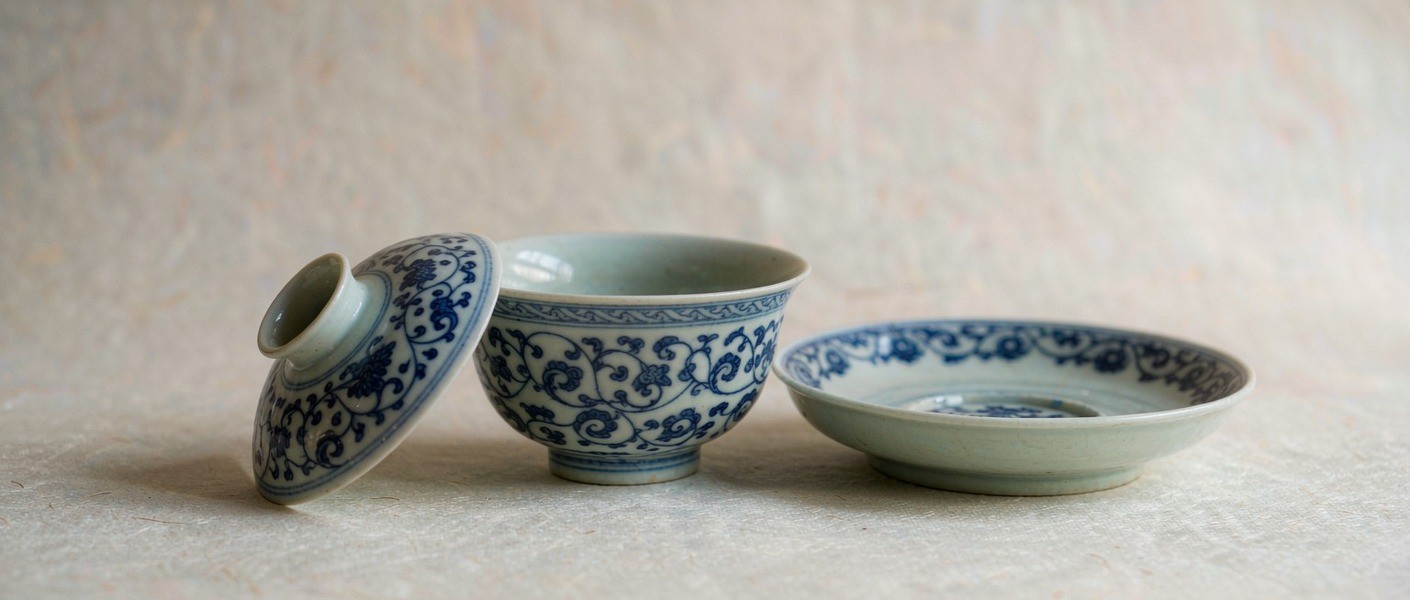
盖碗是茶器里结构最省、要求最严的一件。三件东西,盖、碗、托,各自承担一个功能:盖留香、碗盛汤、托隔热。做得好不好,不用仪器,手一握、水一冲,答案就出来了。这一篇只讲三个地方:口沿、器身、青花。
▍一、三件合一:每一件都有明确的分工
盖的作用是聚香。盖子扣上,茶香在碗内积累,揭盖那一刻集中释放,闻香这件事才成立。盖钮的高度也有讲究:太矮,揭盖时手指贴近碗口,容易烫;太高,重心偏上,扣不严。
碗是主体,负责盛汤与出汤。出汤靠盖沿与碗口之间留出的那道缝,缝宽了汤冲得急,缝窄了出得慢。这个动作看着随意,实际考验碗口的弧度与盖沿的贴合度。
托是隔热层,也是承托。手托着托,指腹不直接接触碗身,热汤的温度才不至于穿透。托的圈口要与碗的圈足对得上,浅了会滑,深了会卡。
一只青花盖碗分作盖、碗、托三件,摆在素色布面上
▍二、口沿的弧度,决定烫不烫手
盖碗最容易出事的地方是口沿。撇口的角度大一些,热气散得快,唇感也顺;角度小,口沿聚热,端起来烫手。
厚薄同样关键。口沿太厚,唇感发钝,出汤时汤汁容易顺着外壁流;太薄,遇到骤冷骤热容易惊裂。手拉坯的碗,口沿会有一圈自然的收束,这一圈是修坯时用手指抹出来的,机器压不出同样的过渡。
▍三、青花在釉下,所以能天天用
青花是釉下彩。钴料画在素胎上,罩一层透明釉,再进窑高温一次烧成。图案被封在釉层之下,摸上去是平的,不会脱落,也不直接接触食物。
这一点对日用很实际。釉上彩的图案浮在釉面,长期摩擦或遇酸碱可能磨损;釉下彩把这层风险去掉了。价格差往往也出在这里:画工在素胎上,一笔下去不能改,画坏了整只碗回炉也救不回来。
素胎上一支细笔正在勾线,旁边是盛着钴料的小碟
景德镇手工制瓷技艺已列入国家级非物质文化遗产名录,拉坯、利坯、画坯、施釉、烧窑各是一道专门的行当。一只盖碗从泥到器,要过好几个人的手。
所谓釉下彩,是指在素胎上彩绘、再罩透明釉、经高温一次烧成的装饰方式,图案被封在釉层之下。青花的发色取决于钴料、釉层厚度与烧成气氛;同一批器物,窑位不同,蓝的深浅会有差别,这属于手工烧成的正常范围。景德镇手工制瓷技艺 2006 年列入国家级非物质文化遗产名录,见《国家级非物质文化遗产代表性项目名录》。
▍四、手一握就知道:器型是给手做的
器型好不好,最终要回到手上。碗身直径偏大,手指张不开,出汤时手腕要用力;偏小,容量不够,一泡茶分不了两杯。圈足的高度决定手指能不能塞进去托住,太矮端不稳,太高显得悬。
这些判断没有公式。同一个器型,手大的人觉得趁手,手小的人觉得吃力。所以挑盖碗的方法很土:装上七分水,端起来走两步,再出一次汤。走得稳、出得顺,就是合适。
▍五、问答
问 | 青花盖碗怎么分辨是手绘还是贴花
答 | 看笔触与层次。手绘的青花有浓淡过渡,同一片叶子上能看到笔锋提起落下的深浅变化,线条偶有粗细不匀;贴花的图案边缘齐整、深浅一致,凑近看能发现网点或薄膜痕迹。再一个方法是看内壁与底部,手绘往往留有笔意。
问 | 盖碗泡茶烫手,是碗不好还是手法不对
答 | 两者都可能。撇口角度小、口沿厚的器物确实更聚热;手法上,注水过满、出汤时手指压住盖钮正中,也会加剧烫感。可行的调整是注水七分、拇指与中指扣住碗沿两侧、食指压盖钮,出汤时手腕先动。
问 | 手工盖碗有轻微不圆,算瑕疵吗
答 | 一般不算。手拉坯的器型存在合理误差,口沿的椭圆度、釉面的细微色差都在手工范围之内;需要留意的是开裂、渗漏、釉面剥落与明显的变形,这些属于质量问题。
问 | 韵和鸣的瓷器是景德镇的吗
答 | 按品类选产区,不按一个地方包打。韵和鸣的「瓷」这一支里,青花类多取景德镇的手工制瓷脉络,其他品类按各自源流选,器物与非遗老师联名,来源和工序都能说清。选哪一处,看的是这门手艺在哪最扎实。
📩 非遗项目 | 匠人举荐 | 跨境出海 | 线下联营
欢迎留言或后台联系,我们与匠人同行。
—— 韵和鸣 · 与匠人同行
〖 器 〗
相关搜索 | RELATED SEARCHES
青花盖碗 怎么挑 · 手绘 贴花 区别 · 盖碗 烫手 怎么办 · 景德镇 手工制瓷 · 盖碗 三才碗
English
The lid gathers aroma. Closed, it lets fragrance build inside the bowl and release in one breath when lifted, which is what makes smelling the tea possible. The knob's height matters too: too low and fingers come close to the hot rim; too high and the centre of gravity rises, so the lid sits poorly.
The bowl holds and pours. Pouring relies on the gap left between lid edge and rim: too wide and the liquor rushes, too narrow and it crawls. The gesture looks casual, yet it tests the rim's curve and how the lid seats against it.
A blue-and-white lidded bowl in three parts on a plain cloth
The saucer insulates and supports. Holding the saucer keeps fingertips off the bowl so heat does not travel through. Its ring must match the bowl's foot: too shallow and the bowl slides, too deep and it jams.
The rim is where a lidded bowl most often fails. A wider flare lets heat escape and feels easier on the lip; a narrower one traps heat and burns the hand.
Thickness matters as much. Too thick and the lip feels dull, with tea running down the outside during pouring; too thin and a sudden change of temperature can crack it. A hand-thrown bowl carries a natural tightening at the rim, wiped by finger during trimming, a transition no press reproduces.
Blue under Glaze, So It Can Be Used Daily
Blue-and-white is an underglaze decoration. Cobalt is painted on the bisque, a clear glaze covers it, and the piece fires once at high temperature. The pattern sits sealed beneath the glaze, flat to the touch, unable to flake and out of direct contact with food.
A fine brush outlining on a bisque body, a small dish of cobalt beside it
This matters for daily use. Overglaze decoration sits on the surface and can wear under friction or acid; underglaze removes that risk. Much of the price gap starts here: painting on bisque allows no correction, and one bad stroke sends the bowl back to the kiln unsalvageable.
The handcraft of Jingdezhen porcelain is on the national heritage list, with throwing, trimming, painting, glazing and firing each a separate trade. A lidded bowl passes through several pairs of hands between clay and vessel.
Underglaze decoration means painting on the bisque, covering it with clear glaze and firing once at high temperature, so the pattern is sealed beneath the glaze. Tone depends on cobalt, glaze thickness and kiln atmosphere; within one batch, kiln position shifts the depth of blue, which sits inside the normal range for hand-fired work. Jingdezhen's handcraft of porcelain making entered the national list in 2006, as recorded in the national list of representative intangible heritage items.
The Hand Knows: Form Is Made for the Hand
Form comes back to the hand. A wide body forces the fingers open and strains the wrist when pouring; a narrow one holds too little to fill two cups. Foot height decides whether fingers can slip underneath: too low and the grip is unstable, too high and the bowl seems to float.
There is no formula. The same form suits a large hand and strains a small one. So the test is crude: fill it seven-tenths, carry it a few steps, pour once. Steady in the walk and clean in the pour means it fits.
How can I tell a hand-painted blue-and-white bowl from a transfer print?
Look at brushwork and gradation. Hand-painted blue shows transitions, with the depth changing as the brush lifts and lands on a single leaf, and lines of uneven weight; transfers have even edges and uniform depth, and close up reveal dot screens or film edges. Check the interior and base too, where hand painting usually leaves traces of the brush.
If a lidded bowl burns my hand, is the bowl at fault or my technique?
Both can be. A narrow flare and a thick rim do trap heat; filling too full and pressing the knob dead centre also worsens it. Adjust by filling to seven-tenths, gripping the rim between thumb and middle finger with the index finger on the knob, and leading with the wrist when pouring.
Is a slightly out-of-round handmade bowl a defect?
Usually not. Hand-thrown forms carry reasonable tolerance, and slight ovality at the rim or minor colour variation in the glaze sit within the handmade range. What deserves attention is cracking, seepage, flaking glaze and marked distortion, which are quality problems.
Is YUNHEMING's porcelain from Jingdezhen?
Regions are chosen by category rather than fixed to one place. Within the porcelain line, blue-and-white follows Jingdezhen's handcraft lineage, while other categories follow their own sources; works are co-signed with the masters and both provenance and process can be explained. The choice follows where the craft is strongest.
Whether a bowl is worth it is often settled by walking a few steps with it rather than reading a label. What has kept the bowl in your hand for years?
ICH Projects · Artisan Referrals · Global Distribution · Salon Partnerships
你可能还感兴趣
一件漆器该有多重,手感不会说谎
严选器物,看纹样、看款识、看证书,都是明面上的事。但有一道标准写不进任何参数表——上手。同一尺寸的两只漆盘,一只压手温润,一只轻飘干瘪,差别从何而来?这次把"分量"这件事拆开讲。说到底,重量是工序的记账本。
韵和鸣 · 2026/10/14 · 54 阅读
一盏博山琉璃:颜色是炉火给的,不是颜料调的
博山琉璃的颜色由矿石、着色配方和炉温共同形成,鸡油黄等色料并非烧成后涂在表面。文章介绍挑料、吹制、塑型、灯工和内画,说明流纹、气泡与壁厚如何反映手工过程,并提供观察颜色、过渡和口沿的选器方法。
韵和鸣 · 2026/10/12 · 50 阅读
一张蔚县剪纸,彩色的刻刀活
严选录这一期看一张不太一样的剪纸:它不用剪刀,用刻刀;不止红色,还带着点染出来的粉与绿。河北张家口蔚县的剪纸,是剪纸大家族里"反着来"的一支——别处以剪为主、以红为正,蔚县以刻代剪、以点彩上色。说到底,这两个"反着来"的本质,是蔚县人把剪纸从窗前的女红,做成了作坊里的分工手艺:看懂了这一点,才算看懂了这张纸。
韵和鸣 · 2026/10/13 · 49 阅读
一枚漆书签:小物件为什么反而更考验手艺
漆书签体量小,却同时暴露胎体稳定、漆层附着、边缘打磨与日常耐用度。挑选时先看薄厚与侧面,再摸边缘和转角,比只看纹样更能判断小件工序是否扎实,也值得问清售后修复。
韵和鸣 · 2026/10/24 · 47 阅读
平金开黑:金与黑,为什么这么耐看
平金开黑以黑漆为底、金线为饰,关键在于黑底的推光质量、金线的稳定和留白的分寸。文章介绍相关工具与工序,并从线条、光泽、使用和来源等方面说明如何观察描金漆器,避免只用金的多少判断价值。
韵和鸣 · 2026/10/10 · 46 阅读
竹编漆艺茶席:两种非遗,如何在同一张桌上共生
一张茶席上,常常同时摆着竹编的垫、漆艺的托。它们来自两门毫不相干的手艺,却在同一片茶汤边安静相处。共生这件事,比"混搭"难得多。
韵和鸣 · 2026/10/2 · 45 阅读