一只竹篮好不好,先看这三处
韵和鸣 · 韵和鸣公众号 · 2026/11/4 12:00:00 · 1 阅读
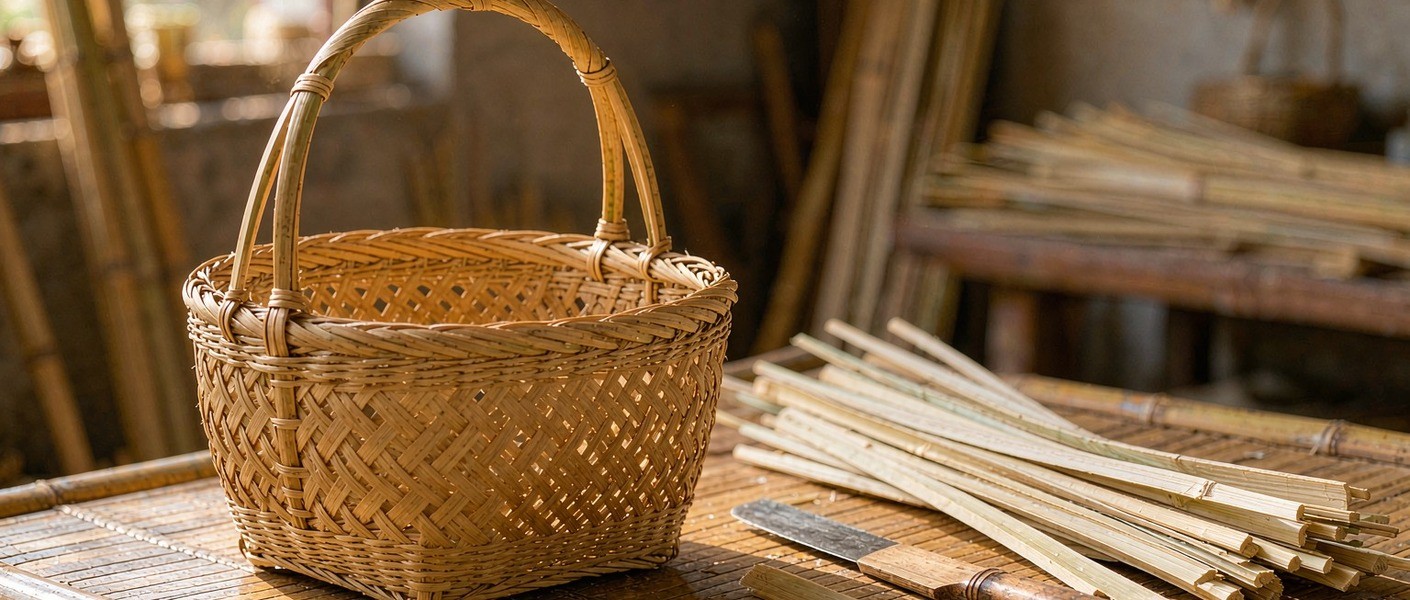
竹编提篮这几年重新回到日常,装水果、装面包、装换季的衣物,也有人拎着去野餐。买的人多了,问题也跟着来:市面上的提篮,看着都是竹篾编的,价格从几十到上千。差别在哪里,多数人说不清。判断一只竹篮,其实有三处可以摸得到:骨架、经纬、收头。
▍一、先看骨架:底要平,口要正
竹编是指用竹片与篾条编织器物的手工技艺,在南方竹产区分布极广。据中国非物质文化遗产网项目页,竹编的项目序号为 350,项目编号 Ⅶ-51,类别为传统美术;其中嵊州竹编(浙江嵊州)2006 年列入国家级非物质文化遗产名录,青神竹编(四川青神)2008 年列入扩展项目,道明竹编(四川崇州)、安溪竹藤编(福建安溪)、东阳竹编(浙江东阳)等同属该项目。
产区不同,器物的脾气也不同。嵊州的细篾能做到极细,青神的竹丝细到可以编字画,闽北与川西的器物更偏日用。我们在山西平遥的会客厅里陈列竹器时,常把一只细篾提篮与一只粗编果盘放在一起,让客人先摸手感,再谈价钱。
一只篮子立不立得住,看底。起底是竹编的头一道,也是最能看出功夫的一道。好的起底,篾条从中心向外放射,间距均匀,编到底圈时收得紧,放在桌上不晃。差的起底,中心容易鼓,或者外圈松,装重物时底会往下坠。
口沿是第二处。口沿要正,圆篮看圆不圆,方篮看四角有没有塌。多数手工提篮会在口沿加一道加固,用较厚的篾片或藤条包边,把整圈锁住。这一道看着是装饰,实际是结构:口沿一软,篮子装满了就会变形,提手受力也传不下去。
一只竹编提篮的俯视图,篾条从篮底中心向外均匀排开
▍二、再看经纬:篾条的宽窄与厚薄
竹编的基本结构是经纬交错,一上一下。看编织,先看篾条本身:宽窄是否一致,厚薄是否均匀。手工劈出来的篾,一条与一条之间总有微小的差别,这是正常的;但如果同一只篮子上,有的篾薄得透光、有的厚得压手,那就是选料没做细。
劈篾之前要刮青,把竹表皮那一层青刮掉,留下纤维紧密的部分。竹材的行内经验是选三到四年的毛竹:年份不足的竹纤维嫩,编出来容易脆断;年份过老的竹发硬,劈薄了会裂。同一根竹子,靠外的部分韧,靠内的部分软,怎么搭配,看编的是什么部位。
再看松紧。手工编织的松紧很难完全一致,但应该均匀:手指按上去,整片的手感是同一个力度。松的地方一眼能看出来,篾条之间露缝,久了会积灰、会松垮。紧过头也不好,篾条被挤压变形,用两年就开始起毛。
细者能在一寸长度内编进 150 根竹丝,精巧细腻,薄如羽翼。
(中国非物质文化遗产网 · 嵊州竹编项目页)
▍三、最后看收头:藏得住,摸不扎
收头是竹编里最见耐心的部分,也是买家最容易忽略的地方。一只篮子的篾条有几十上百个断头,好的做法是把断头藏进编织层里,或者回折压在相邻的篾条下,从外面看不到,手伸进去摸,也不扎手。
差的收头有几种典型:断头翘在外面,一摸就扎;用胶粘住,看着齐整,一沾水就开;还有直接剪断不处理的,用不了多久就抽丝,一根篾松了,旁边的跟着松。
收头做得好不好,其实反映的是工序有没有走完。一只篮子的工时,很大一部分压在收尾上,这部分看不见,也最容易被省。
收头处篾条回折压进邻条之下
▍四、用起来:颜色会变,形不会散
竹子的颜色会变。新编的提篮偏青黄,用上一年半载,慢慢转成蜜色,光线好的时候泛出一点红。这是竹材自然的氧化,不是质量问题。真正要留意的是形:好的提篮用久了,颜色深了,形状还在;差的用半年,口沿开始歪,提手处松动。
养护上不必复杂。避开长期潮湿与暴晒,梅雨天之后拿出来通通风,沾了水擦干立着放。竹器怕的是闷,闷久了会生霉,霉斑渗进纤维就擦不掉了。
▍问答
问 | 手工竹编提篮怎么分辨是手工还是机器编的
答 | 看三处。一看篾条,手工劈的篾宽窄与厚薄有细微差别,机器的每一根几乎一样;二看松紧,手工的整片手感均匀但有呼吸感,机器的往往通体死紧;三看收头,手工的断头藏在编织层里,机器的多为热压或胶粘封边。这三处都能上手摸,不必只看照片。
问 | 竹编器物会不会长霉、生虫
答 | 会,关键在使用环境。竹材含糖与淀粉,潮湿闷热时容易生霉;未经处理的竹器也可能被蛀。日常做法是保持通风干燥,梅雨季后勤晾,避免长期贴墙贴地存放。选购时可以问清竹材年份与是否做过防霉防蛀处理,处理过的竹器在同样环境下更耐久。
问 | 一只竹篮卖几百块,贵在哪
答 | 贵在工序与工时。一只提篮要经过选竹、刮青、劈篾、启篾、起底、编织、收头、打磨等多道工序,篾条越细,工时越长,收头越费耐心。机器可以批量冲出形状,但编不出手工的松紧与手感。价格差的那部分,买的是被省掉的那几道工序有没有做。
问 | 韵和鸣的竹编器物是怎么选进来的
答 | 三条标准,都在器物上看得到。看工艺是否完整,起底、编织、收头有没有省;看来源是否清楚,出自哪位老师、哪个产区;看是否联名,匠人的名字与手艺写在作品上。竹、木、藤这类器物还要多看一项:材料处理是否到位,这决定了它能不能用久。
📩 非遗项目 | 匠人举荐 | 跨境出海 | 线下联营
欢迎留言或后台联系,我们与匠人同行。
—— 韵和鸣 · 与匠人同行
〖 器 〗
相关搜索 | RELATED SEARCHES
手工竹编 怎么分辨 · 竹编提篮 挑选 · 竹器 防霉 防蛀 · 竹编 用几年 · 非遗竹编 产地
English
Start with the Frame: a Flat Base and a True Rim
Bamboo weaving is the hand craft of building vessels from split bamboo, widespread across the bamboo regions of southern China. According to the project page of the China Intangible Cultural Heritage website, the item carries serial number 350 and project code Ⅶ-51 in the traditional fine arts category; Shengzhou bamboo weaving in Zhejiang was listed nationally in 2006, Qingchen bamboo weaving in Sichuan followed as an expanded item in 2008, and Daoming in Chongzhou, Anxi bamboo and rattan weaving in Fujian and Dongyang bamboo weaving in Zhejiang belong to the same entry.
Regions give objects different tempers. Shengzhou splits strips extremely fine, Qingchen splits bamboo to a hair so that calligraphy can be woven, while work from northern Fujian and western Sichuan leans to daily use. When we display bamboo in the Pingyao Salon in Shanxi, a fine basket usually sits beside a coarsely woven tray, so visitors feel the difference before hearing a price.
Whether a basket stands depends on its base. Setting the base is the first step in bamboo weaving and the one that shows skill most clearly. In good work the strips radiate from the centre at even intervals, tighten as they reach the rim of the base, and the basket sits steady on a table. In poor work the centre bulges or the outer ring stays loose, and under weight the base sags.
The rim is the second place. It should be true, round in a round basket, firm at the corners in a square one. Most hand-woven baskets reinforce the rim, binding it with a thicker strip or rattan to lock the circle. It looks decorative and is structural: a soft rim deforms under a full load and cannot carry the pull of the handle.
A basket seen from above, strips radiating evenly from the centre of the base
Then the Weave: Width and Thickness of the Strips
Bamboo weaving is a plain interlacing of warp and weft, one over one under. Look first at the strips themselves: how consistent in width, how even in thickness. Hand-split strips always differ slightly from one another, which is normal; but if on one basket some strips are thin enough to show light and others heavy in the hand, the sorting was careless.
Before splitting, the green outer skin is scraped away, leaving the dense fibrous layer. Workshop experience favours moso bamboo of three to four years: younger fibre is tender and snaps, older bamboo hardens and cracks when split thin. Within one culm the outer part is tough and the inner soft, and how they are paired depends on which part of the basket they will form.
E> The finest work fits a hundred and fifty bamboo threads into one cun, delicate and thin as a wing.
Then the tightness. Hand weaving cannot be perfectly uniform, but it should be even: press with a finger and the whole panel answers with the same resistance. Slack is easy to spot, gaps open between strips, dust collects and the weave loosens. Too tight is also a fault, the strips deform under pressure and begin to fray within two years.
Finally the Finish: Hidden Ends, No Prickle
Finishing is where patience shows most and where buyers look least. A basket has dozens or hundreds of strip ends. Good practice hides them inside the weave or folds them back under a neighbouring strip, invisible from outside and smooth to a hand reaching in.
Poor finishing has familiar forms: ends left standing out to prick the hand; ends glued flat, neat until water reaches them; ends simply cut and left, which soon unravel, one loose strip loosening its neighbours.
How the ends are finished reveals whether the process was completed. A large share of the labour sits in the closing stage, which is invisible and the easiest to cut.
Strip ends folded back under neighbouring strips at the finish
Bamboo changes colour. A new basket leans green-yellow and turns honey over a year or so, warming towards red in good light. This is natural oxidation, not a defect. What matters is shape: a good basket darkens and keeps its form, a poor one leans at the rim within six months and loosens where the handle joins.
Care need not be elaborate. Keep it from prolonged damp and direct sun, air it after the rainy season, wipe it dry and stand it up if it gets wet. What bamboo fears is stagnation, which brings mould, and mould that seeps into the fibre will not come out.
How can hand-woven bamboo baskets be told from machine-made ones?
Three places. The strips: hand-split ones vary slightly in width and thickness, while machine strips are near identical. The tightness: hand weaving feels even yet alive, machine weaving is uniformly rigid. The finish: hand work hides ends inside the weave, machine work usually heat-seals or glues the edge. All three can be checked by hand rather than from a photograph.
Do bamboo items grow mould or harbour insects?
They can, and the environment decides. Bamboo holds sugars and starch, so damp warmth brings mould, and untreated pieces may be attacked by insects. Keep them aired and dry, air them after the wet season, and avoid storing them flat against walls or floors. When buying, ask the age of the bamboo and whether it was treated against mould and insects, since treated pieces last longer under the same conditions.
Why does a bamboo basket cost several hundred yuan?
In process and hours. A basket passes through choosing culms, scraping the skin, splitting, refining strips, setting the base, weaving, finishing and sanding; the finer the strips, the longer the work, and the more patience the finishing takes. Machines can stamp out shapes in batches but cannot produce the give and feel of hand weaving. The price gap pays for the steps that were or were not skipped.
How does YUNHEMING select bamboo work?
Three standards, all visible on the object. Whether the process is complete, base, weave and finish all done; whether the source is clear, which maker and which region; and whether it is co-signed, with the maker's name and craft on the work. For bamboo, wood and rattan, one more matters: whether the material was properly treated, which decides how long it will last.
ICH Projects · Artisan Referrals · Global Distribution · Salon Partnerships
你可能还感兴趣
一件漆器该有多重,手感不会说谎
严选器物,看纹样、看款识、看证书,都是明面上的事。但有一道标准写不进任何参数表——上手。同一尺寸的两只漆盘,一只压手温润,一只轻飘干瘪,差别从何而来?这次把"分量"这件事拆开讲。说到底,重量是工序的记账本。
韵和鸣 · 2026/10/14 · 54 阅读
一盏博山琉璃:颜色是炉火给的,不是颜料调的
博山琉璃的颜色由矿石、着色配方和炉温共同形成,鸡油黄等色料并非烧成后涂在表面。文章介绍挑料、吹制、塑型、灯工和内画,说明流纹、气泡与壁厚如何反映手工过程,并提供观察颜色、过渡和口沿的选器方法。
韵和鸣 · 2026/10/12 · 50 阅读
一张蔚县剪纸,彩色的刻刀活
严选录这一期看一张不太一样的剪纸:它不用剪刀,用刻刀;不止红色,还带着点染出来的粉与绿。河北张家口蔚县的剪纸,是剪纸大家族里"反着来"的一支——别处以剪为主、以红为正,蔚县以刻代剪、以点彩上色。说到底,这两个"反着来"的本质,是蔚县人把剪纸从窗前的女红,做成了作坊里的分工手艺:看懂了这一点,才算看懂了这张纸。
韵和鸣 · 2026/10/13 · 49 阅读
一枚漆书签:小物件为什么反而更考验手艺
漆书签体量小,却同时暴露胎体稳定、漆层附着、边缘打磨与日常耐用度。挑选时先看薄厚与侧面,再摸边缘和转角,比只看纹样更能判断小件工序是否扎实,也值得问清售后修复。
韵和鸣 · 2026/10/24 · 47 阅读
平金开黑:金与黑,为什么这么耐看
平金开黑以黑漆为底、金线为饰,关键在于黑底的推光质量、金线的稳定和留白的分寸。文章介绍相关工具与工序,并从线条、光泽、使用和来源等方面说明如何观察描金漆器,避免只用金的多少判断价值。
韵和鸣 · 2026/10/10 · 46 阅读
竹编漆艺茶席:两种非遗,如何在同一张桌上共生
一张茶席上,常常同时摆着竹编的垫、漆艺的托。它们来自两门毫不相干的手艺,却在同一片茶汤边安静相处。共生这件事,比"混搭"难得多。
韵和鸣 · 2026/10/2 · 45 阅读