一块蓝布上的裂纹,为什么成了丹寨蜡染的防伪标记
韵和鸣 · 韵和鸣公众号 · 2026/11/4 12:00:00 · 1 阅读
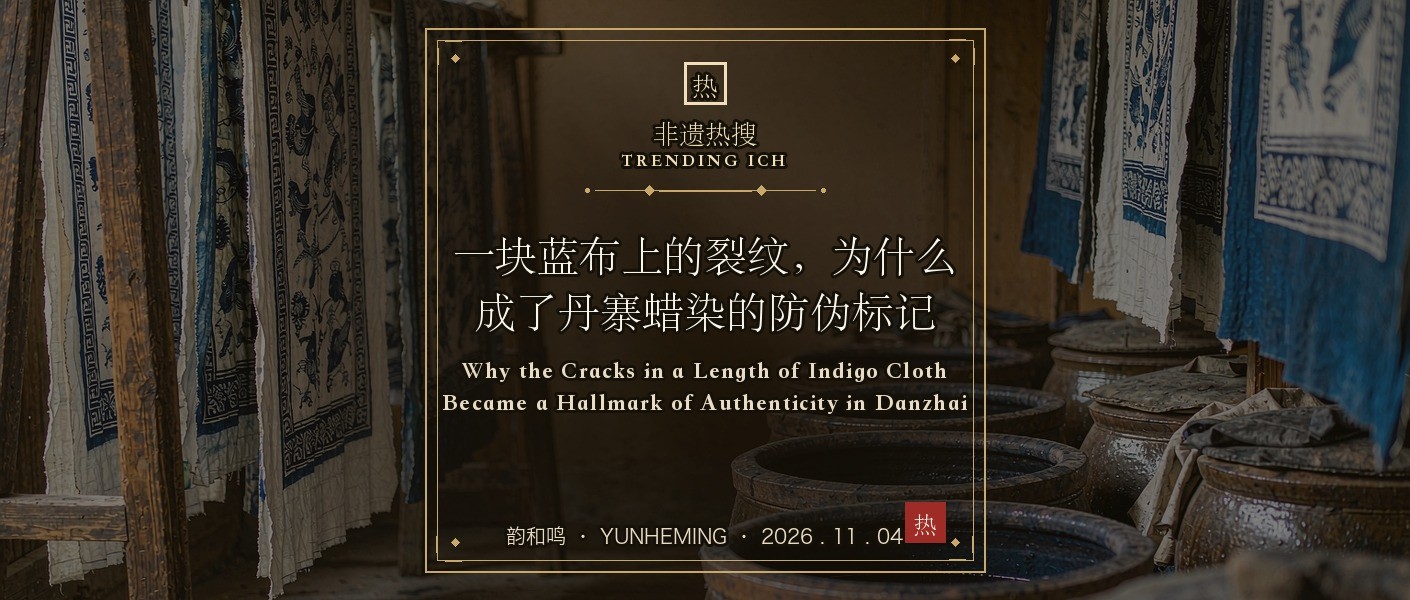
据《光明日报》2026 年 11 月 1 日报道,贵州丹寨的蜡染作坊里,传承人张义苹一边点蜡一边讲了一句很实在的话:真蜡染有裂纹,染进去不规则;假蜡染均匀得一点裂纹都没有。这句话把一门手艺的辨识方法,压缩成了两个字的差别:匀,与不匀。裂纹在这里的意思,是手工留下的证据。
▍一、裂纹是蜡自己裂的
蜡染的做法,说起来不复杂:用蜡在布上画出纹样,再把布放进蓝靛染缸里浸染,有蜡的地方染不上色,没蜡的地方吃色。问题出在中间那一步。蜡是脆的,布是要揉、要折、要下缸的,蜡层在过程中会裂开细缝,蓝靛顺着这些缝渗进去,染完脱蜡,布面上就留下了一道道细如发丝的深色纹路。
据中国非物质文化遗产网项目页,苗族蜡染技艺 2006 年列入国家级非物质文化遗产名录,项目序号 375,项目编号 Ⅷ-25,申报地区为贵州省丹寨县,保护单位为丹寨县非物质文化遗产保护中心。同一页面对工序的记录很细:先用草木灰滤水浸泡土布,脱去纤维里的脂质,让布容易点蜡上色;黄蜡放在小瓷碗里,碗置于热木灰上化开,再用铜刀往布上点画;点好的布温水浸湿,入蓝靛染缸反复浸泡,再到河边漂洗去浮色;最后下锅水煮,黄蜡熔化浮起,回收留作下次使用。
那道裂纹在行内有个名字,叫冰纹。它不受人控制,位置、走向、疏密都由蜡的厚薄、天气的干湿、下缸的次数决定。同一双手,也画不出两块纹路相同的布。
浸染后的蓝布在清水里漂洗,深色纹路沿蜡裂的走向散开
▍二、匀,是机器的长处
反过来看,一件纹样均匀、边缘齐整、块块一样的「蜡染」,多半不是这么做出来的。常见的方式是印花:把纹样做成版,用染料直接印在布上;也有用化学染料的,颜色一次到位,不必反复浸染。这类产品远看与蜡染相似,近看差别明显,纹样边缘没有染液渗开的毛边,布面上找不到冰纹。
这里有一个常被忽略的细节:蓝靛是反复浸染出来的颜色,深浅靠次数攒。一次染到位,颜色是平的;染十几次,蓝色里就有层次,光下会动。丹寨的蜡染在脱蜡之后还要拼涂红黄,据前述项目页记录,红色多用茜草根,黄色取自栀子,且一般要等布制成之后才着色,为的是避免褪色。
▍三、报道里那句话,说的是辨真的方法
张义苹在报道里还提到,手艺不好的会糊,形状不清晰。这句话补上了另一半:裂纹是手工的痕迹,糊与不糊是手艺的高下。两道判断叠在一起,才构成一个完整的标准,既排除了机器货,也分出了熟练与生涩。
这套标准对买家有用,对匠人也有用。市场上「蜡染风」的面料很多,价格从几十到几百,买家如果没有一把尺子,只能按价格猜;匠人如果拿不出可辨认的差别,就只能跟着价格往下走。
真蜡染有裂纹,染进去不规则;假蜡染均匀得一点裂纹都没有。
(引自《光明日报》2026 年 11 月 1 日《点蜡成画 蜡去现花》,受访者为贵州丹寨蜡染传承人张义苹)
▍四、布上的蓝,正在变成一种可以带走的体验
同一篇报道提到,丹寨县相继开设蜡染体验课堂,面向学生与游客开展沉浸式体验,每年接待大量研学团队,「非遗+研学」的业态正在兴起;越来越多返乡青年与 00 后加入蜡染创作队伍。报道还写到,张义苹把传统蜡染与国画的形式结合,用多层次上蜡、多层次染色、反复浸染的办法做出山水意境,深蓝浅蓝层层过渡。
体验课是好事,一个人亲手点过一次蜡,再看布上的裂纹,眼睛就不一样了。但体验课也带来一个新的问题:当「蜡染」变成一个可以上课、可以拍照、可以带走的活动名词,它和那块布本身的关系,会不会越来越松。
铜刀蘸着熔化的黄蜡,在土布上描出弧线纹样
▍五、把裂纹讲清楚,是一门手艺的定价权
我们这些年走访工坊,见过一种反复出现的情形:手艺人对自己的工序讲得极细,对「怎么让别人认出来」却讲得很少。买家问一句「这跟印花的有什么不一样」,答不上来,价格就只能交给对方判断。
裂纹这件事的意义就在这里。它不玄,也不需要专业知识,一块布摊在光下,看纹路有没有渗开、有没有冰纹、颜色有没有层次,三分钟就能判断个大概。把这种判断方法公开,短期看是给同行也递了把尺子,长期看是把整类产品的价格锚点抬回工艺本身。
▍问答
问 | 丹寨苗族蜡染怎么分辨是手工还是印花
答 | 看三处。一看裂纹,手工蜡染的蜡层会裂,靛蓝渗进去形成细密冰纹,印花布上没有;二看边缘,手工的纹样边缘有染液渗开的毛边,印花的边缘齐整发硬;三看颜色层次,蓝靛靠反复浸染攒色,深浅有过渡,一次染到位的颜色是平的。据中国非物质文化遗产网项目页,苗族蜡染技艺 2006 年列入国家级非物质文化遗产名录,编号 Ⅷ-25,申报地区为贵州省丹寨县。
问 | 蜡染布会不会掉色,能不能洗
答 | 会褪一些,属于正常。蓝靛是植物发酵染的色,头几次下水会有浮色出来,之后趋于稳定。洗的时候用冷水和中性洗涤剂,单独洗,不要长时间浸泡,也不要暴晒,阴干就好。深浅拼色的作品头几次宜分开洗,避免串色。
问 | 一件手工蜡染的衣服,为什么比印花的贵好几倍
答 | 贵在次数与不可复制。一件蜡染要经过点蜡、浸染、漂洗、脱蜡等步骤,颜色深浅靠反复下缸累积,同一块布上的冰纹由蜡的裂法决定,做不出两件一样的。印花是版与染料的效率,蜡染是时间与手的消耗,两者的成本结构不同,价格自然不在一个区间。
问 | 韵和鸣做蜡染这类织染品类吗,选品看什么
答 | 做。韵和鸣以国家级非遗平遥推光漆器髹饰技艺起家,如今整合漆、竹、绣、银、锦、瓷几个门类,织染类也在其中,蜡染、扎染这类植物染的作品同样在范围内。选品只看三条:是不是真正的非遗手工品,是不是与传承人本人合作,核心工序是不是手工完成。产地不设门槛,标准不因产地而变。
📩 非遗项目 | 匠人举荐 | 跨境出海 | 线下联营
欢迎留言或后台联系,我们与匠人同行。
—— 韵和鸣 · 与匠人同行
〖 热 〗
相关搜索 | RELATED SEARCHES
丹寨蜡染 怎么分辨真假 · 苗族蜡染技艺 国家级非遗 · 蜡染 冰纹 是什么 · 蜡染 会掉色吗 · 贵州丹寨 蜡染 体验
English
The method of batik is not complicated to describe: draw a pattern on cloth with wax, then steep the cloth in an indigo vat. Where there is wax the dye cannot take; where there is none, it does. The trouble sits in the middle step. Wax is brittle, and cloth must be folded and pressed and dipped, so the wax layer opens into fine fissures. Indigo seeps along them, and once the wax is boiled off, the cloth carries hair-thin dark lines.
According to the project page of the China Intangible Cultural Heritage website, the Miao batik technique was inscribed on the national list in 2006, serial number 375, project code Ⅷ-25, with Danzhai County in Guizhou as the declaring area and the county's intangible heritage protection centre as the protecting body. The same page records the steps closely: raw cloth is soaked in water filtered through plant ash to strip oils from the fibres so wax and dye can take; yellow wax is melted in a small porcelain bowl set on warm ash and drawn onto the cloth with a copper knife; the waxed cloth is dampened, steeped repeatedly in an indigo vat, rinsed in the river to remove loose colour, then boiled so the wax melts and floats, to be skimmed off and used again.
Those cracks have a name in the trade: ice veins. They are not controlled by the maker. Position, direction and density all depend on how thick the wax is, how damp the weather, how many dips the cloth takes. The same pair of hands cannot produce two identical pieces.
Indigo cloth being rinsed in clear water, dark lines spreading along the paths where the wax cracked
Turn it around: a piece of "batik" whose patterns are uniform, whose edges are crisp, whose repeats are identical is most likely not made this way. The common alternative is printing, where the pattern is made into a screen or block and dye is applied directly, or chemical dyeing, where colour arrives in one pass without repeated steeping. From a distance such goods look like batik; up close the difference shows. There is no feathering where dye bled past the pattern edge, and no ice veins anywhere on the cloth.
One detail is often missed: indigo colour is built by repeated dipping, its depth accumulated by count. Dye it once and the colour is flat; dye it a dozen times and the blue has layers that move in the light. Danzhai batik, after the wax is removed, also adds red and yellow, and according to the same project page the red usually comes from madder root and the yellow from gardenia, applied generally after the cloth is finished to keep the colours from fading.
What That Sentence in the Report Really Says
In the report Zhang Yiping adds that poor work smears and the shapes lose their clarity. That supplies the other half: cracks are the trace of the hand, and smearing or not is the measure of skill. The two judgements stack into one complete standard, which rules out machine goods and at the same time separates fluency from inexperience.
This standard is useful to buyers and to makers alike. There is plenty of "batik-style" fabric on the market, priced from tens to hundreds, and a buyer without a ruler can only guess by price; a maker who cannot point to a recognisable difference can only follow the price downward.
E> Real batik has cracks, and the dye seeps in unevenly; fake batik is so even that it has no cracks at all.
The Blue on the Cloth Is Becoming Something Visitors Can Carry Away
The same report notes that Danzhai has opened batik experience classes for students and visitors, receiving many study groups each year, with a "heritage plus study travel" trade taking shape, and that growing numbers of returning young people and those born after 2000 are joining the craft. It also describes how Zhang Yiping blends batik with the forms of Chinese painting, building landscapes through repeated waxing and repeated dyeing, so that deep and pale blues shade into one another.
Experience classes are a good thing. Once a person has drawn wax by hand, the eye reading those cracks is never the same. But they raise a new question: as "batik" becomes the name of an activity that can be attended, photographed and taken home, does its link to the cloth itself grow looser.
A copper knife carrying melted wax traces curved patterns on homespun cloth
Explaining the Cracks Is Part of a Craft's Pricing Power
In the workshops we have visited over the years, one situation repeats: makers describe their own steps in great detail and say very little about how others should recognise them. When a buyer asks what separates this from a print, and there is no answer, the price is left to the other side to decide.
This is where the cracks matter. There is nothing mystical about them and no expertise required: spread the cloth in the light, look at whether the lines bled, whether ice veins appear, whether the colour has depth, and a rough judgement takes three minutes. Publishing that method hands a ruler to competitors in the short run; in the long run it pulls the price anchor of the whole category back toward the craft.
How can you tell hand-made Danzhai batik from a print?
Look at three things. First the cracks: wax in hand-made batik splits and indigo seeps in to form fine ice veins, which printed cloth lacks. Second the edges: hand-drawn patterns feather where dye bled, printed edges stay crisp and hard. Third the depth of colour: indigo is built by repeated dipping so tones grade into one another, while one-pass dyeing stays flat. According to the China Intangible Cultural Heritage project page, the Miao batik technique was listed nationally in 2006 under code Ⅷ-25, declared by Danzhai County, Guizhou.
Does batik cloth fade, and can it be washed?
It will lose some colour, and that is normal. Indigo is a plant vat dye, so the first few washes release loose colour before it settles. Wash in cold water with a mild detergent, separately, without long soaking, and dry in the shade rather than in direct sun. Pieces combining deep and pale colours are best washed apart at first to avoid transfer.
Why does a hand-made batik garment cost several times a printed one?
The difference lies in repetition and in the impossibility of duplication. A piece passes through waxing, steeping, rinsing and dewaxing, its depth accumulated dip by dip, and the ice veins on it are decided by how the wax cracked, so no two are alike. Printing is the efficiency of screens and dye; batik is the consumption of time and hand. Different cost structures put them in different price ranges.
Does YUNHEMING work with batik and other dyed textiles, and what does its selection look at?
Yes. YUNHEMING began with Pingyao polished lacquerware, a national-level item, and now brings together lacquer, bamboo, embroidery, silver, brocade and porcelain, dyed and woven textiles among them, including plant-dyed work such as batik and tie-dye. Selection rests on three points: genuine handmade heritage work, collaboration with the bearers themselves, and core steps completed by hand. Origin is not a threshold, and the standard does not change with origin.
ICH Projects · Artisan Referrals · Global Distribution · Salon Partnerships
你可能还感兴趣
漆器为什么能埋八千年不坏
在博物馆做漆器研究与修复的研究员老周,桌上常年摆着两样东西:一段出土的漆皮残片,一只新做不久的平遥推光漆盘。他说这两样东西隔着八千年,却是同一种材料。这次对话,我们从"漆器为什么埋几千年不坏"聊起,聊到最后,其实是手艺对材料的理解问题。
韵和鸣 · 2026/10/14 · 68 阅读
去贵州雷山,看一块银元如何变成一支银簪
在黔东南的苗寨里,银不只是一种首饰材料。它曾经是可以随时熔掉、重新打制的"存款",也是节日里一个女人身上最亮的那部分。关键在于,当一块老银元被放进坩埚,它要经过多少双手、多少道火,才重新成为一件能戴出门的东西。
韵和鸣 · 2026/10/9 · 61 阅读
AI 生成的"非遗纹样",算不算抄袭
喂一批图给模型,几秒钟就能出一张"苗绣风"的纹样。有人觉得这是把传统纹样重新用起来,有人认为这是把别人一辈子的手艺免费拿走了。问题不好回答,说到底,真正难定的不是"像不像",而是数据从哪来、收益到哪去。今天我们不做判断,只把两边的理由摆出来。
韵和鸣 · 2026/10/24 · 59 阅读
把"慢"做成一种体验:一间非遗会客厅的想法
我们习惯按功能给空间分类:吃饭的、购物的、办公的。但有一种很难归类——它在城市的闹处,不催你走,也不急着让你买单。关键在于,当"慢"被认真设计出来,它本身就可以是一种产品。
韵和鸣 · 2026/10/9 · 56 阅读
机器开始学手艺:是给匠人搭把手,还是来接班
一段流传很广的画面里,一台机械臂正跟着非遗传承人"学艺"——学劈丝、捻线、穿针。看的人分成两拨:一拨说技术帮上了忙,一拨说来抢饭碗了。同一件事读出两种意思,关键在于用什么尺度去量。
韵和鸣 · 2026/10/9 · 56 阅读
年轻人不愿学老手艺,该怪年轻人,还是怪这门手艺?
非遗传承里被讨论得最多的一句话是"后继乏人"。这句话往下追一层,就分成两条路:一条通向年轻人,说他们耐不住、看不上;一条通向他们面对的那门手艺,说它没能给出一条能活下去的路。这两条路,最近又吵起来了。
韵和鸣 · 2026/10/8 · 55 阅读