38 道工序的夜光杯,为什么卖不过一百块
韵和鸣 · 韵和鸣公众号 · 2026/11/3 12:00:00 · 1 阅读
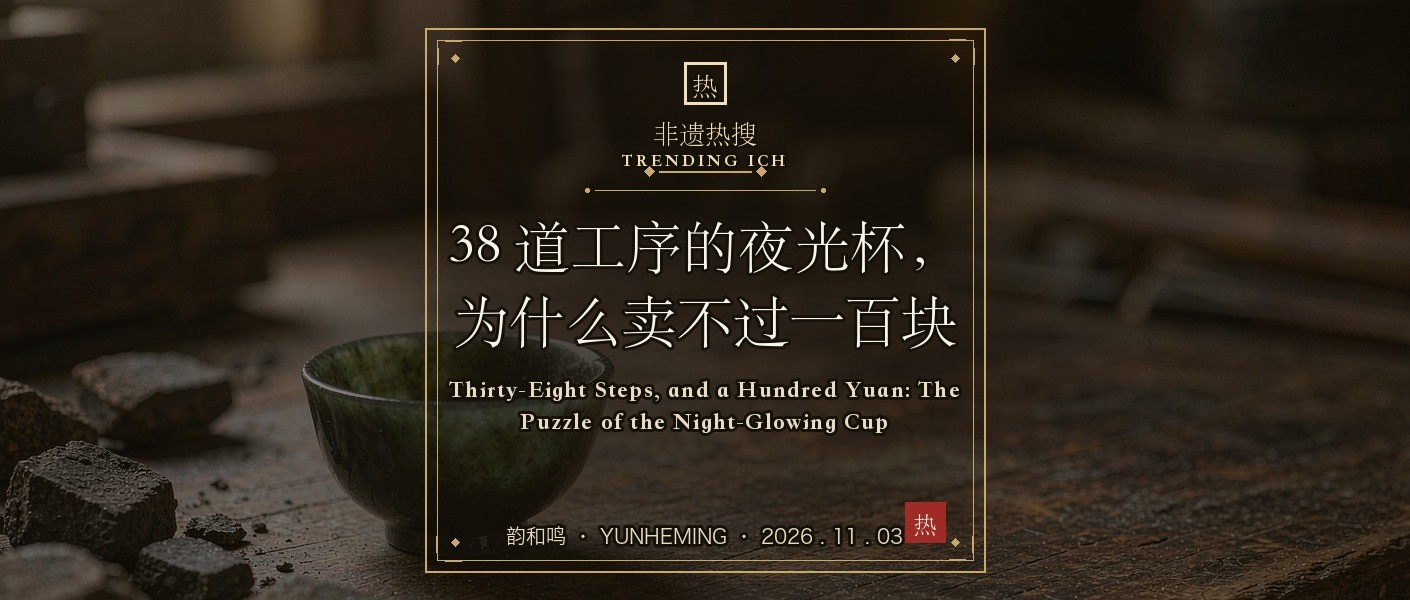
一个杯子要过三十八道手,卖价却上不去。这不是故事里的情节,是兰州夜光杯代表性传承人车万霞在长沙说出的一句实在话。据腾讯新闻转载长沙晚报 2026 年 10 月 31 日报道,当天下午,「香橙妈妈守艺计划」2026 年非遗焕新创变营线下营在湖南圆点美术馆收官,来自全国十六个省市的十八位「守艺妈妈」,把十八项非遗手艺带到了同一个场地。手艺齐了,问题也摆在了台面上:东西好,为什么卖不动。
▍一、一只杯子的账:薄到零点五毫米,卖百把块钱
夜光杯这三个字,多数人是从唐诗里认得的。真东西摆在面前,反而常被问两个问题:它会发光吗,为什么这么贵。车万霞每次都要解释一遍:叫「夜光」,是因为胎薄透光,不是杯子自己会亮。
真正的门槛在工艺上。一只杯子要过三十八道工序,最薄的薄胎只有零点五毫米,匠人每天泡在凉水里一点点打磨,稍一分神磨透就废了。她父亲做了三十年,年纪大了舍不得丢;她原是口腔科护士,辞职回家女承父业。即便如此,一对小杯只卖百把块钱。
薄胎玉杯在窗前透光,杯壁映出手指的影子
价格这道坎,卡住的从来不是手艺本身。卡住它的是三件看起来与手艺无关的事:谁来讲这门手艺,谁来把它摆到对的地方,谁愿意为它付一次钱。
▍二、同场的还有皮绣、侗绣和鱼皮画:难的从来不是手艺
这场营里,处境相似的不是一个两个。湟源皮绣在皮料上一针一线绣出河湟风光,唐卡、湘绣、掐丝珐琅、侗绣、赫哲族鱼皮贴画同场陈列。贵州从江的侗绣传人石吉芝说,2023 年县里办非遗展演,全村竟然凑不出十二件侗绣云肩,她和姐妹干脆自己动手,办起绣坊。
把这几件事放在一起看,会发现它们的困难长得很像:手艺是完整的,链条是断的。有人会做,没人会讲;有人会讲,没人会卖;好不容易卖出去一次,回头没有第二次。
绣绷上的半成品,线与针停在花样的一角
所以这次活动把五十余家品牌和投资方请到了展台前,手里拿的是「心动牌」。这一步的意义不在于当场成交多少,而在于让做手艺的人和做市场的人第一次坐在同一张桌子旁。
That is why the event brought more than fifty brands and investors to the stands, each holding a "心动牌" card. The point was not how much was signed on the spot, but that makers and market people sat at the same table for once.
▍三、另一头,广交会把非遗摆到了海外买家面前
几乎同一时间,另一条消息给出了这个问题的另一个半边答案。据中新社 2026 年 10 月 31 日报道,第 140 届广交会第三期在广州举行,多家中国企业把非遗技艺与东方美学做进箱包、服装和手袋,产品从比拼价格转向比拼品质与时尚价值。
报道里提到两类做法:一类是与代表性传承人合作,把宋锦、广绣、苏绣的纹样做进箱包,主攻中东与欧洲市场;另一类是联合科研机构推动植物染技艺标准化,用现代纺织技术解决传统柿染长期存在的色牢度与批次稳定性问题。
从比拼价格,转向比拼品质和时尚价值。
(引自中新社 2026 年 10 月 31 日关于第 140 届广交会第三期的报道)
这两条路指向同一件事:手艺要走出去,靠的不只是手艺。它还需要把工艺讲成对方听得懂的话,需要一条能稳定履约的链,需要一件在海外日常里用得上的器物。
▍四、从展品到爆品,中间隔着四道坎
把两场活动放在一起,可以大致画出这道坎的形状。
头一道是叙事。夜光杯被反复问「会不会发光」,说明它的名字和它的好处之间没有搭上。手艺的名字越美,越需要一句朴素的话把它翻译过来。
第二道是场景。摆进展柜的器物, buyer 看到的是工艺品;摆进日常用品货架的器物,买的人看到的是能用的东西。唐卡进了挂画、香牌进了车载,走的都是这一步。
第三道是标准。植物染遇到的色牢度与批次稳定性,是所有天然材料工艺共同的难题。不做标准化,就只能在小圈子里流通;做了标准化,才谈得上批量与复购。
工作台上的打磨工具与待修的器物,水痕还留在台面
第四道是分账。谁的手艺在前、谁的名字在前、卖出去的钱怎么分,这三件事谈不清楚,合作通常停在第二次。
▍五、热闹散了之后,留下什么
一场营能带来几天的关注,一届广交会能带来一季的订单。这些都实在,也都不够。手艺的延续需要的是一条稳定的链:有人做,有人讲,有人卖,还有人愿意一次次回来买。
这也是我们做内容时反复遇到的事。在山西平遥的漆坊里,推光漆器的价值靠一遍遍髹涂与推光才说得清;不讲,它就只是一个「黑亮的盒子」。看见手艺的开头,是一件成本很低、效果很慢的事,但链条上少这一环,后面几环都接不上。
▍问答
问 | 兰州夜光杯是什么级别的非遗,为什么叫「夜光」
答 | 据腾讯新闻转载长沙晚报 2026 年 10 月 31 日报道,兰州夜光杯是国家级非物质文化遗产代表性项目。叫「夜光」是因为胎薄透光,并非杯子自身发光;薄胎处最薄约零点五毫米,全程三十八道工序。
问 | 非遗产品为什么常常「好看但卖不动」
答 | 因为缺的不是手艺,是链条。常见断点有四处:手艺的名称没有被翻译成能听懂的好处;器物只进展柜、没有进入日常场景;天然材料的标准化没解决,难以批量与复购;合作的署名与分账没谈清,合作停在第二次。
问 | 中国非遗产品要卖到海外,需要补哪几门课
答 | 三件:一是把工艺译成对方听得懂的话,讲做法、讲作者、讲材料;二是一条能稳定履约的跨境链条,从选品、内容到物流;三是产品在当地日常里用得上。据中新社 2026 年 10 月 31 日广交会报道,业内正在从比拼价格转向比拼品质与时尚价值。
问 | 韵和鸣说的「非遗经纪人」,具体替匠人做什么
答 | 把「做」之外的事接过来。拍产品、拍工序、做访谈、写内容,这些匠人自己做不了也不该自己做;渠道与出海的机会也由品牌去对接。韵和鸣的定位是「非遗经纪人」,出发点是帮人,匠人专心做手艺。
▍说在最后
手艺卖不动的时候,问题多半不在手上,在手以外的地方。你见过哪门手艺,东西好得没话说,就是没人知道?留言告诉我们,我们去看。
📩 非遗项目 | 匠人举荐 | 跨境出海 | 线下联营
欢迎留言或后台联系,我们与匠人同行。
—— 韵和鸣 · 与匠人同行
〖 热 〗
相关搜索 | RELATED SEARCHES
兰州夜光杯 非遗 · 非遗产品 为什么卖不动 · 非遗 从展品到爆品 · 广交会 非遗 出海 · 非遗 经纪人 做什么
English
The Arithmetic of One Cup: Half a Millimetre Thin, a Hundred Yuan
Most people meet the night-glowing cup through a Tang poem. Faced with the real thing, they ask two questions: does it glow, and why does it cost so much. Che Wanxia explains every time: it is called night-glowing because the body is thin enough to let light through, not because the cup emits light.
The real threshold is technical. A cup goes through thirty-eight steps; the thinnest walls measure half a millimetre. The maker works in cold water, grinding a little at a time, and a single slip that grinds through ruins the piece. Her father did this for thirty years and could not bear to let it go; she had been a dental nurse and resigned to take it up. Even so, a pair of small cups sells for around a hundred yuan.
A thin-walled jade cup held to the window, the wall showing the shadow of fingers through it
What blocks the price is never the craft itself. It is three things that look unrelated to craft: who tells the story of the skill, who puts it in front of the right people, and who is willing to pay for it once.
Also in the Room: Leather Embroidery, Dong Embroidery, Fish-Skin Pictures
In this camp, similar situations were not rare. Huangyuan leather embroidery stitches river landscapes onto hide; thangka, Hunan embroidery, filigree enamel, Dong embroidery and Hezhe fish-skin pictures were displayed alongside. Shi Jizhi, a Dong embroidery bearer from Congjiang, Guizhou, recalls that when the county held a heritage show in 2023, the whole village could not put together twelve Dong embroidered cloud collars, so she and her sisters started a workshop themselves.
Put these cases together and the difficulty looks the same: the craft is intact, the chain is broken. Someone can make it, nobody can explain it; someone can explain it, nobody can sell it; a sale happens once and never repeats.
A half-finished piece on an embroidery hoop, needle and thread resting at one corner of the pattern
Meanwhile, the Canton Fair Puts Heritage in Front of Overseas Buyers
At almost the same moment, another report supplied the other half of the answer. According to a China News Service report on 31 October 2026, the third phase of the 140th Canton Fair opened in Guangzhou, where Chinese companies built heritage techniques and Eastern aesthetics into bags, garments and handbags, shifting competition from price to quality and fashion value.
The report describes two approaches: one works with representative bearers to put Song brocade, Guangdong embroidery and Suzhou embroidery patterns onto bags aimed at the Middle East and Europe; the other joins research institutes to standardise plant dyeing, using modern textile technology to fix the colour fastness and batch consistency that have long troubled traditional persimmon dyeing.
E> From competing on price to competing on quality and fashion value.
Both roads point at the same thing: for a craft to go abroad, craft alone is not enough. It also needs the technique explained in terms the other side understands, a chain that can deliver reliably, and an object that fits into everyday life somewhere else.
From Exhibit to Hit: Four Hurdles in Between
Put the two events together and the shape of the hurdle becomes visible.
The first is narrative. That the night-glowing cup is repeatedly asked whether it glows shows a gap between its name and its merit. The more poetic a craft's name, the more it needs a plain sentence to translate it.
The second is context. An object in a display case reads as craftwork; the same object on a shelf of daily goods reads as something usable. Thangka becoming wall art, incense tablets becoming car accessories, all take this step.
The third is standard. The colour fastness and batch consistency that trouble plant dyeing are common to every craft using natural materials. Without standardisation a craft circulates only in a small circle; with it, volume and repeat purchase become possible.
Grinding tools and a piece awaiting finishing on the workbench, water marks still on the surface
The fourth is division of proceeds. Whose craft comes first, whose name comes first, how the money is split: settle these three and a collaboration usually stops at the second round.
A camp brings a few days of attention, a trade fair a season of orders. Both are real and neither is sufficient. Continuity needs a stable chain: someone makes, someone explains, someone sells, and someone keeps coming back to buy.
This is what we run into again and again in our own work. In the lacquer workshops of Pingyao, Shanxi, the worth of polished lacquerware only becomes clear through repeated coating and hand-polishing; left unexplained, it is just a glossy black box. Showing how a craft begins costs little and works slowly, yet without that link the rest of the chain cannot connect.
What level of heritage item is the Lanzhou night-glowing cup, and why is it called night-glowing?
According to the Changsha Evening News report of 31 October 2026 carried by Tencent News, the Lanzhou night-glowing cup is a national-level representative intangible cultural heritage item. It is called night-glowing because its thin body transmits light, not because it glows; the thinnest walls measure about half a millimetre, and the process runs to thirty-eight steps.
Why do heritage products so often look good yet fail to sell?
What is missing is not craft but the chain. Four breaks recur: the name is never translated into an intelligible benefit; the object reaches only display cases, not daily use; standardisation of natural materials is unsolved, blocking volume and repeat purchase; attribution and revenue sharing are unclear, so collaborations end after one round.
To sell Chinese heritage products abroad, which lessons need making up?
Three things: translate the craft into terms the other side understands, covering method, maker and material; build a cross-border chain that delivers reliably from selection and content to logistics; and make products usable in local daily life. According to China News Service's Canton Fair report of 31 October 2026, the industry is moving from competing on price to competing on quality and fashion value.
What exactly does YUNHEMING, as a heritage agent, do for makers?
It takes over everything except the making. Filming products and processes, conducting interviews, writing content: makers cannot and should not do these alone. Channels and export opportunities are also handled by the brand. YUNHEMING positions itself as a heritage agent, starting from the wish to help, so the maker can attend to the craft.
When a craft will not sell, the problem is rarely in the hands; it lies elsewhere. Have you met a craft whose work is beyond argument yet nobody knows it? Leave a comment and we will go and see.
ICH Projects · Artisan Referrals · Global Distribution · Salon Partnerships
你可能还感兴趣
漆器为什么能埋八千年不坏
在博物馆做漆器研究与修复的研究员老周,桌上常年摆着两样东西:一段出土的漆皮残片,一只新做不久的平遥推光漆盘。他说这两样东西隔着八千年,却是同一种材料。这次对话,我们从"漆器为什么埋几千年不坏"聊起,聊到最后,其实是手艺对材料的理解问题。
韵和鸣 · 2026/10/14 · 68 阅读
去贵州雷山,看一块银元如何变成一支银簪
在黔东南的苗寨里,银不只是一种首饰材料。它曾经是可以随时熔掉、重新打制的"存款",也是节日里一个女人身上最亮的那部分。关键在于,当一块老银元被放进坩埚,它要经过多少双手、多少道火,才重新成为一件能戴出门的东西。
韵和鸣 · 2026/10/9 · 61 阅读
AI 生成的"非遗纹样",算不算抄袭
喂一批图给模型,几秒钟就能出一张"苗绣风"的纹样。有人觉得这是把传统纹样重新用起来,有人认为这是把别人一辈子的手艺免费拿走了。问题不好回答,说到底,真正难定的不是"像不像",而是数据从哪来、收益到哪去。今天我们不做判断,只把两边的理由摆出来。
韵和鸣 · 2026/10/24 · 59 阅读
把"慢"做成一种体验:一间非遗会客厅的想法
我们习惯按功能给空间分类:吃饭的、购物的、办公的。但有一种很难归类——它在城市的闹处,不催你走,也不急着让你买单。关键在于,当"慢"被认真设计出来,它本身就可以是一种产品。
韵和鸣 · 2026/10/9 · 56 阅读
机器开始学手艺:是给匠人搭把手,还是来接班
一段流传很广的画面里,一台机械臂正跟着非遗传承人"学艺"——学劈丝、捻线、穿针。看的人分成两拨:一拨说技术帮上了忙,一拨说来抢饭碗了。同一件事读出两种意思,关键在于用什么尺度去量。
韵和鸣 · 2026/10/9 · 56 阅读
年轻人不愿学老手艺,该怪年轻人,还是怪这门手艺?
非遗传承里被讨论得最多的一句话是"后继乏人"。这句话往下追一层,就分成两条路:一条通向年轻人,说他们耐不住、看不上;一条通向他们面对的那门手艺,说它没能给出一条能活下去的路。这两条路,最近又吵起来了。
韵和鸣 · 2026/10/8 · 55 阅读