漆竹绣银锦瓷同框:六种材质怎么放在一起不打架
韵和鸣 · 韵和鸣公众号 · 2026/11/2 12:00:00 · 1 阅读
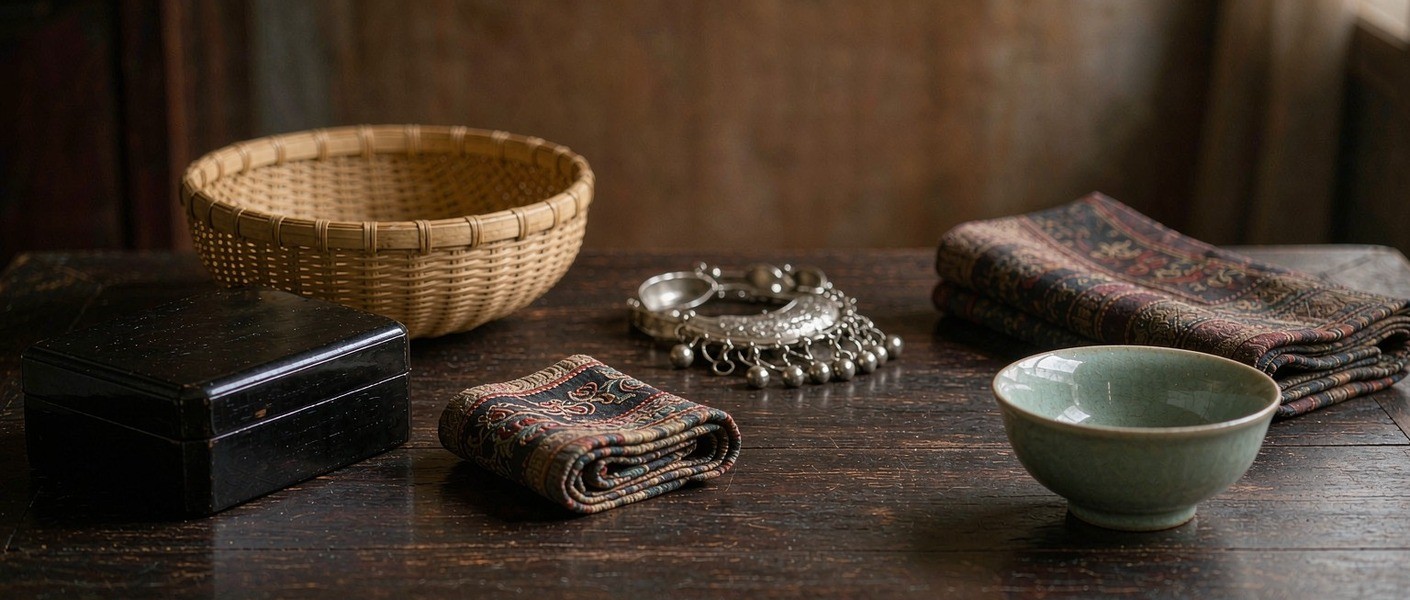
所谓六大矩阵,指的是韵和鸣以漆、竹、绣、银、锦、瓷六类非遗手艺构成的选品框架,其中漆以平遥推光漆器髹饰技艺为起点。六门手艺凑在一起,最容易出的状况是各说各话。把它们摆得舒服,靠的是让每一种材质都保留自己的语言,同时给彼此留出退让的余地,统一颜色帮不上忙。这件事在我们选品时反复出现,也反复被讨论。
▍一、先分光泽,再分颜色
同框的头一条规矩:一个视觉中心,只留一种强反光。(韵和鸣选品与陈列的经验总结)
六种材质最外一层的差别不在颜色,在反光。漆是内敛的深光,光在漆膜下面走一圈再回来;瓷是硬光,落在釉面上就弹开;银是活光,跟着人动;锦是丝光,随角度变;竹是哑光,几乎不反射;绣是绒光,把光吃掉一部分。
漆、竹、绣、银、锦、瓷六种材质的器物在同一张桌面上错落摆放
同框的头一条规矩由此而来:一个视觉中心,只留一种强反光。漆器已经占据了深光的位置,同一区域就别再放抛光的银;瓷若要进来,选哑光或半哑的釉。强光对强光,眼睛没有落脚的地方。
▍二、再分体量,别让小件去顶大件
第二条规矩是体量。六门手艺的器物,天然有大小之别:瓷与漆容易做得体面,银与绣容易做得精巧,竹处在中间。同框时若让一只小银饰去和一只大漆盘争注意力,输的一定是小的。
可行的做法是排一个梯度:一件大体量的打底,两件中等的承接,一到两件小件的收尾。小件不是陪衬,它是让人走近看的理由。台面上总得有一样东西,值得人凑近去看。
漆盒与银饰的局部并置,一深一浅,反光方向一致
▍三、最后分叙事:每件都要能说出一个人
第三条规矩最容易被忽略。六件东西摆在一起,如果每一件都只代表一种材质,那它只是样品;如果每一件背后都能说出一个人、一个地方、一段来路,它们才成为一个组合。
据晋中市人民政府门户网站发布的公开信息,平遥推光漆器已是晋中省级专业镇之一,这类产区的器物在来源上通常更容易被追溯。这也是我们做严选时卡得最紧的一关。一件器物能不能进,不只看它做得好不好,还要看它说得清不清:谁做的,用什么材料,哪几道工序是手工完成的,落款署在何处。说不清的,做得再漂亮也不进。
▍四、不打架的本质,是让每一种都成立
回头看这三条,说的其实是同一件事:同框的目的不是融合,是共存。非遗手艺之间不需要被调成同一个调子。漆的沉、竹的朴、绣的细、银的亮、锦的华、瓷的润,各有各的道理。
把它们放在一起的诚意,体现在不抹平任何一门的性格。摆得好的标志,是看的人能一件一件认出来,而不是只觉得「挺搭」。
▍五、落到使用:同框之后还要能用
摆放的位置也有一层讲究。顺手的位置留给常用的那件,视线平齐的位置留给值得细看的那一件,边角留给季节性轮换的。一个空间里同时摆六类器物不必一次全上,摆四件、留两件轮着换,反而每件都有被看见的机会。
摆着好看只是头一步。真正难的是日常里共处:漆器怕晒,竹器怕干,绣品怕勾,银器怕硫,锦缎怕压,瓷器怕磕。一个空间里同时养六类东西,等于同时守六套规矩。
所以我们的建议一向朴素:先想清楚哪一件是常用的,把它放在最顺手的位置,其余的做轮换。器物被用起来,才谈得上被养出来。
▍问答
问 | 家里同时摆漆器、瓷器和银器,日常要注意什么
答 | 分开三件事:避光、避潮、避磕碰。漆器不宜长时间日晒,银器宜单独软布包裹防硫化发黑,瓷器之间留出间隙防磕。三者共处一室没有冲突,关键是各自满足自己的存放条件。
问 | 怎么分辨一件非遗手作是不是机器做的
答 | 看三处:一是相同纹样之间有无细微差异,手工做的每一件都不会完全一致;二是边缘与转折处是否留有手工修整的痕迹;三是背面与底部,机制品往往过度规整。具体判断需结合品类与工艺,以实物为准。
问 | 韵和鸣的「严选」到底严在哪
答 | 三道关:头一道是只选真正的非遗手工品,流水线产品不进;第二道是来源与署名写得清楚,器物与非遗老师联名,可追溯;第三道是材质、工序与手工完成度讲得明白,说不清的不上架。
▍说在最后
六门手艺放在一张桌上,好看是结果,互相成就才是本事。你家里有没有把不同材质的手作摆在一起?留言说说你的摆法。
📩 非遗项目 | 匠人举荐 | 跨境出海 | 线下联营
欢迎留言或后台联系,我们与匠人同行。
—— 韵和鸣 · 与匠人同行
〖 器 〗
相关搜索 | RELATED SEARCHES
非遗 六大矩阵 漆竹绣银锦瓷 · 非遗器物 怎么搭配 摆放 · 漆器 银器 一起 保养 · 非遗手作 严选 标准 · 手工 与 机雕 区别
English
E> The first rule of sharing a frame: one visual centre keeps only one strong reflection.
The first difference among the six is not colour but reflection. Lacquer holds a restrained deep sheen, light travelling under the film before returning; porcelain gives a hard sheen that rebounds off the glaze; silver is lively, moving with the viewer; brocade is silky, changing with angle; bamboo is matte and barely reflects; embroidery is velvety and absorbs part of the light.
Objects in six materials, lacquer, bamboo, embroidery, silver, brocade and porcelain, arranged at intervals on one table
From this comes the first rule: one visual centre keeps only one strong reflection. If lacquerware already holds the deep sheen, do not put polished silver in the same zone; if porcelain joins, choose a matte or semi-matte glaze. Strong against strong leaves the eye nowhere to rest.
Then Sort by Volume: Do Not Make Small Pieces Carry Big Ones
The second rule is volume. Objects across the six crafts differ naturally in scale: porcelain and lacquer tend to be made generously, silver and embroidery finely, bamboo sits in between. Put a small silver ornament against a large lacquer plate and the small one is bound to lose.
A workable approach is to set a gradient: one large piece as the base, two medium to carry through, one or two small to close. The small piece is not a foil; it is the reason someone steps closer. A display always needs one thing worth leaning in for.
A lacquer box and a silver ornament placed side by side, one deep and one light, reflections aligned
Finally Sort by Story: Each Piece Should Name a Person
The third rule is the easiest to overlook. Six objects standing for six materials are merely samples; they become a composition only when each can name a person, a place and a route by which it came.
According to information published on the Jinzhong municipal government portal, Pingyao polished lacquerware is among Jinzhong's provincial specialised towns, and objects from such production areas are usually easier to trace. This is also the tightest gate in our selection. Whether a piece comes in depends not only on how well it is made but on how clearly it can be told: who made it, from what material, which steps were done by hand, where the signature sits. However beautiful, a piece that cannot be told does not come in.
Not Clashing Means Letting Each One Stand
Looked at together, the three rules say the same thing: the point of sharing a frame is not fusion but coexistence. Heritage crafts need no tuning to a single key. The weight of lacquer, the plainness of bamboo, the fineness of embroidery, the brightness of silver, the richness of brocade, the smoothness of porcelain each have their own reason.
Good faith in putting them together shows in smoothing away none of their characters. A successful arrangement is one where a viewer can identify them one by one, rather than simply feeling that they match.
Down to Use: After Sharing a Frame, They Must Still Be Usable
Placement carries its own logic: the convenient spot goes to the piece in frequent use, the spot at eye level to the one worth close study, and the corners to seasonal rotation. Six categories need not all appear at once; showing four and rotating two means each has a turn at being seen.
Looking well is only the first step. The harder part is daily coexistence: lacquer fears sun, bamboo fears dryness, embroidery fears snagging, silver fears sulphur, brocade fears pressure, porcelain fears knocks. Keeping six kinds in one space means keeping six sets of rules.
Our advice has therefore always been plain: decide which piece is used often, put it within easiest reach, and rotate the rest. Only when an object is used can it be said to be nurtured.
What should one watch for when keeping lacquerware, porcelain and silver together at home?
Separate three concerns: light, damp and knocks. Lacquerware should not sit in direct sun for long, silver is best wrapped separately in soft cloth to slow sulphide tarnishing, and porcelain needs gaps between pieces. The three coexist without conflict, so long as each meets its own storage conditions.
How can one tell whether a handmade heritage piece was machine-made?
Look at three points: whether slight differences appear between repeated motifs, since no two handmade pieces match exactly; whether edges and turns carry traces of hand finishing; and whether the back and base are overly uniform, as machine work tends to be. Judgement must combine category and craft, and rests on the object itself.
What exactly does YUNHEMING's curation check?
Three gates: only genuine handmade heritage items, with no assembly-line products; clear source and attribution, with each piece co-signed with the master and traceable; and material, process and degree of handwork stated plainly, since anything that cannot be told does not go on the shelf.
Six crafts on one table look good as a result; making each bring out the others is the real skill. Have you arranged handmade pieces of different materials together at home? Tell us how.
ICH Projects · Artisan Referrals · Global Distribution · Salon Partnerships
你可能还感兴趣
一件漆器该有多重,手感不会说谎
严选器物,看纹样、看款识、看证书,都是明面上的事。但有一道标准写不进任何参数表——上手。同一尺寸的两只漆盘,一只压手温润,一只轻飘干瘪,差别从何而来?这次把"分量"这件事拆开讲。说到底,重量是工序的记账本。
韵和鸣 · 2026/10/14 · 54 阅读
一盏博山琉璃:颜色是炉火给的,不是颜料调的
博山琉璃的颜色由矿石、着色配方和炉温共同形成,鸡油黄等色料并非烧成后涂在表面。文章介绍挑料、吹制、塑型、灯工和内画,说明流纹、气泡与壁厚如何反映手工过程,并提供观察颜色、过渡和口沿的选器方法。
韵和鸣 · 2026/10/12 · 50 阅读
一张蔚县剪纸,彩色的刻刀活
严选录这一期看一张不太一样的剪纸:它不用剪刀,用刻刀;不止红色,还带着点染出来的粉与绿。河北张家口蔚县的剪纸,是剪纸大家族里"反着来"的一支——别处以剪为主、以红为正,蔚县以刻代剪、以点彩上色。说到底,这两个"反着来"的本质,是蔚县人把剪纸从窗前的女红,做成了作坊里的分工手艺:看懂了这一点,才算看懂了这张纸。
韵和鸣 · 2026/10/13 · 49 阅读
一枚漆书签:小物件为什么反而更考验手艺
漆书签体量小,却同时暴露胎体稳定、漆层附着、边缘打磨与日常耐用度。挑选时先看薄厚与侧面,再摸边缘和转角,比只看纹样更能判断小件工序是否扎实,也值得问清售后修复。
韵和鸣 · 2026/10/24 · 47 阅读
平金开黑:金与黑,为什么这么耐看
平金开黑以黑漆为底、金线为饰,关键在于黑底的推光质量、金线的稳定和留白的分寸。文章介绍相关工具与工序,并从线条、光泽、使用和来源等方面说明如何观察描金漆器,避免只用金的多少判断价值。
韵和鸣 · 2026/10/10 · 46 阅读
竹编漆艺茶席:两种非遗,如何在同一张桌上共生
一张茶席上,常常同时摆着竹编的垫、漆艺的托。它们来自两门毫不相干的手艺,却在同一片茶汤边安静相处。共生这件事,比"混搭"难得多。
韵和鸣 · 2026/10/2 · 45 阅读