竹林边的工具间:一把篾刀能用多少年
韵和鸣 · 韵和鸣公众号 · 2026/11/2 12:00:00 · 1 阅读
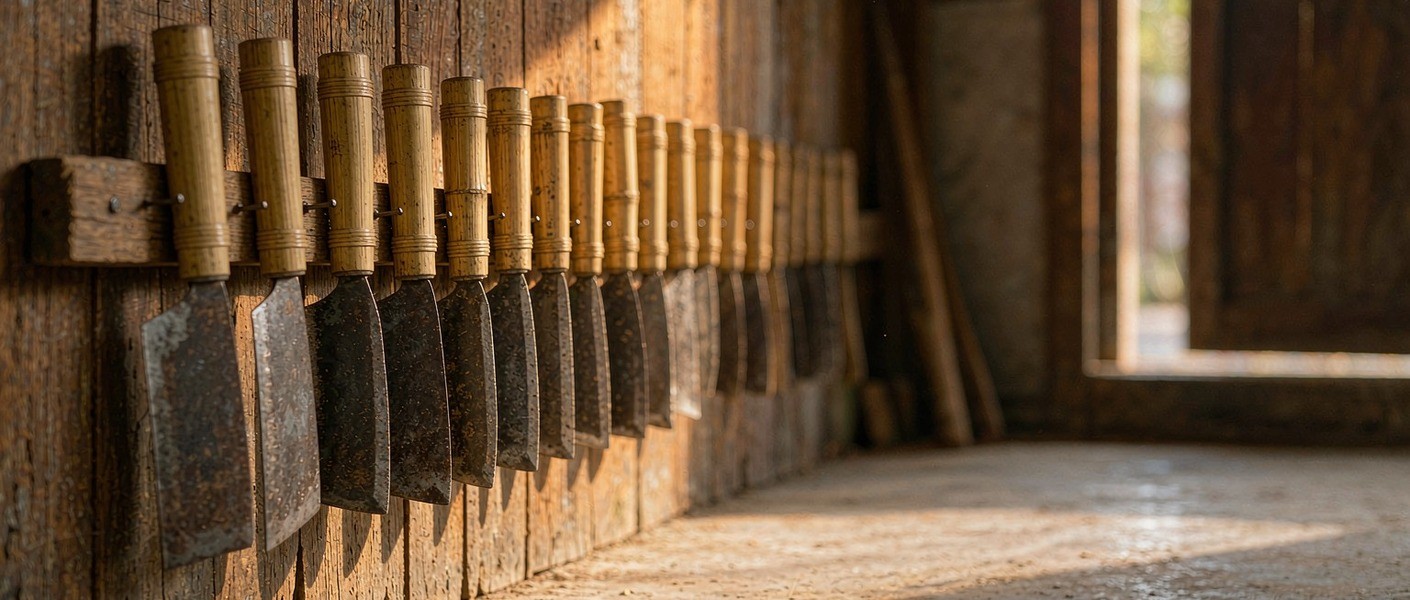
所谓竹编,指的是把竹材剖成篾丝或篾片后以手工编结成器的技艺;一件器物的成色,往往先看工具。看一门竹编手艺,多数人先看成品。真正懂行的人进门先看工具间:刀口磨成什么样,篾刀排在第几位,用旧的把手上有没有手汗浸出来的颜色。工具不会说话,却把一个人的习惯、耐性和年头全摆在外面。
▍一、工具间通常不朝南
竹编产区的作坊里,工具间往往在背光的一侧。竹材怕晒怕风,工具怕潮。一间十几平方米的屋子,墙上钉着一排木条,刀、锯、刮刀、匀刀、刮青刀各自占位,手柄朝外,刃口朝里。
这种摆法不是讲究,是算术。刃口朝里,取用时手背不会先碰到锋;手柄朝外,闭着眼也能摸到惯用的那一把。一个动作重复三十年,工具的位置就会被身体记住。
靠墙钉着的竹编工具,手柄朝外,刃口朝里
▍二、一把刀的寿命,跟它的主人差不多长
篾刀看着简单,一把刀能用到什么程度,取决于磨。新刀开刃之后,每天收工前要过一遍磨石,角度靠手掌握,不能靠眼睛看。角度差一点,剖出来的篾就一边厚一边薄,编到第三节就看出来了。
刀会越磨越短。用上二三十年的刀,刀身能磨掉一小截,形状变得和出厂时完全不同,却更贴合那只手。这样的刀换不了,换了手就不认。
剖篾的手部特写,刀口沿着竹纤维的走向推进
竹编行当里有一句老话:看师傅的手,先看他的刀。(行业通行说法,产区走访记录)
E> An old saying in the bamboo weaving trade: to judge a master's hands, look first at the knife.刀上有一层均匀的光,那是磨出来的,也是用出来的。
▍三、工具传下去,往往比图纸管用
手艺的传承方式里,图纸是最不靠谱的一种。竹编的很多分寸,写不下:刮青的力道、起底的松紧、收口时手指往哪个方向带一下。这些东西跟着人走,也跟着工具走。
一把磨了二十年的匀刀,本身就是一份教材。后来的人拿在手上,刀口的弧度会告诉他该用多大力。工具替前一个人守住了标准,后一个人只要不硬改,就不会走得太偏。
这也是为什么老作坊搬一次家,往往要坏一批活。工具的位置变了,身体的记忆跟着乱一阵。
▍四、工具间里的另一种时间
同样的摆法,我们在山西平遥的推光漆器作坊里也见过:刮刀、漆刷、磨石各自占位,顺序几十年不动。在工具间里待久了,会注意到一种和外面不一样的时间感。外面讲季度、讲交付、讲这个月做了多少件;工具间里讲年头。一把刀用几年,一块磨石凹下去多少,一只竹筐补过几次。
手艺人心里其实同时装着两种时间。一种用来过日子,一种用来做活。做活的那一种慢,慢到能用「这把刀跟我二十年了」来计。
我们做非遗内容,最想带出去的就是这种时间感。器物可以被买走,工具间里的年头带不走,只能被看见。
▍五、新工具进门,要先过老师傅这一关
工具也是会换代的。电动的破竹机、定型的模具,效率比手工具高出许多,产区里用的人越来越多。有意思的是,老师傅们通常不反对,只是给新工具划了位置:破竹、开片这类粗活可以让机器做,起底、收口、修光这些地方还得靠手。
这条分界线不是守旧,是算过账的:机器擅长的那一段,本来就不决定一件器物的高下;手做的那一段,恰恰是买它的人愿意付钱的地方。工具换了,分寸的位置没换。
▍问答
问 | 竹编常用的工具有哪些,各自做什么用
答 | 常见的有篾刀(剖竹成篾)、匀刀(把篾修到厚薄一致)、刮青刀(刮去竹青表层)、锯(截取竹段)与刮刀(修整边缘)。不同产区工具名称与形制略有差异,具体以当地工艺传统为准。
问 | 竹编器物用久了为什么会变色,是坏了吗
答 | 多数情况是正常的。竹材在使用中会因光照、手汗与空气氧化由青转黄、由黄转红褐,行内称为「包浆」,属于材料自然变化。若出现霉斑、发软或编织松散,则需处理;具体判断以器物实际状态为准。
问 | 想拜访竹编匠人,有什么需要注意的
答 | 头一条是打招呼在先,作坊是工作场所不是展演场;第二条是不随意动工具,尤其是刃口朝里的那些;第三条是拍摄前先问一句,有些工序师傅不愿意公开。带一份想学的心去,比带一份想拍的计划去更受欢迎。
问 | 韵和鸣会帮匠人做这类实地内容吗
答 | 会。韵和鸣的定位是「非遗经纪人」,团队常到老街深巷拜访匠人,帮他们拍产品、拍视频,做访谈栏目,也做多语言直播与多国语言翻译,把手艺讲给更远的人听。匠人专心做手艺,内容的事交给品牌。
▍说在最后
一门手艺的年头,往往不在证书上,在工具上。下次看到一件手作,可以顺带问问:做它的那把刀,跟了师傅多少年。
📩 非遗项目 | 匠人举荐 | 跨境出海 | 线下联营
欢迎留言或后台联系,我们与匠人同行。
—— 韵和鸣 · 与匠人同行
〖 寻 〗
相关搜索 | RELATED SEARCHES
竹编 工具 篾刀 · 竹编 匠人 拜访 · 竹编器物 变色 正常吗 · 竹编 工序 剖篾
English
The Tool Room Usually Does Not Face South
In workshops across bamboo weaving regions, the tool room usually sits on the shaded side. Bamboo fears sun and wind; tools fear damp. In a room of a dozen square metres, a row of wooden strips is nailed to the wall, and knives, saws, scrapers, evening knives and green-scraping knives each hold their place, handles out, edges in.
This arrangement is not aesthetics but arithmetic. Edges inwards means the back of the hand does not meet the blade first; handles outwards means the usual one can be found with eyes closed. Repeat a motion for thirty years and the body memorises where the tool sits.
Bamboo weaving tools nailed along a wall, handles out, edges in
A splitting knife looks simple, and how far it lasts depends on sharpening. After a new blade is set, it passes over the whetstone before each day ends, the angle held in the palm rather than judged by eye. A slight error in angle produces slivers thick on one side and thin on the other, visible by the third row of weaving.
A knife grows shorter with each sharpening. After twenty or thirty years a blade loses a section of its body and its shape bears little resemblance to the factory version, yet it fits that one hand precisely. Such a knife cannot be replaced; a new one would not be recognised by the hand.
Close view of hands splitting bamboo slivers, the blade following the grain
An old saying runs through the trade: to judge a master's hands, look first at the knife. An even sheen on the blade comes from sharpening, and from use.
Of all ways to transmit a craft, drawings are the least reliable. Much of the measure in bamboo weaving cannot be written down: the force in scraping off the green layer, the tension when starting the base, the direction the fingers give at the closing row. These travel with the person, and with the tools.
An evening knife ground for twenty years is itself a textbook. In a successor's hand, the curve of the edge tells how much force to use. The tool keeps the previous person's standard; as long as the next one does not force a change, the work does not stray far.
This also explains why an old workshop loses a batch of work whenever it moves. Once the tools change place, the memory in the body takes time to settle again.
We have seen the same arrangement in the polished lacquerware workshops of Pingyao, Shanxi: scrapers, lacquer brushes and whetstones each in their place, the order unchanged for decades. Spend long enough in a tool room and a different sense of time becomes noticeable. Outside, people speak of quarters, delivery and how many pieces were finished this month; inside, they speak in years. How many years a knife has run, how far a whetstone has hollowed, how often a basket has been mended.
A maker carries two kinds of time at once. One for getting by, one for doing the work. The second runs slow, slow enough to be measured in phrases like "this knife has been with me twenty years".
In making content about heritage, what we most want to carry out is this sense of time. Objects can be bought; the years in a tool room cannot be taken away, only seen.
Tools also change generations. Electric splitters and shaping moulds are far more efficient than hand tools, and more workshops in the producing areas use them. What is interesting is that old masters seldom object; they simply assign the new tools a place. Rough work such as splitting and sectioning may go to machines, while starting the base, closing the rim and finishing still rely on the hands.
That line is not conservatism but arithmetic: the stretch at which machines excel never decided the quality of a piece, while the stretch done by hand is exactly what a buyer pays for. The tools change; where the measure lies does not.
What tools are commonly used in bamboo weaving, and what does each do?
Common ones include the splitting knife for dividing bamboo into slivers, the evening knife for bringing slivers to even thickness, the green-scraping knife for removing the outer skin, the saw for cutting sections, and the scraper for finishing edges. Tool names and forms vary slightly between producing areas, following local craft tradition.
Why does bamboo weave change colour with use? Is it damaged?
In most cases it is normal. With light, hand moisture and oxidation, bamboo turns from green to yellow and then to reddish brown, a change the trade calls patination, belonging to the material's natural behaviour. Mould, softening or loosening of the weave needs attention; the judgement follows the actual condition of the piece.
What should one keep in mind when visiting a bamboo weaving maker?
First, ask before arriving, since a workshop is a workplace rather than a stage; second, do not handle tools freely, especially those with edges turned inwards; third, ask before filming, as some processes a master prefers not to publish. Arriving with a wish to learn is more welcome than arriving with a plan to shoot.
Does YUNHEMING produce such on-site content for makers?
Yes. YUNHEMING positions itself as a heritage agent; the team often visits makers in old streets and deep lanes, filming products and videos, running interview programmes, and producing multilingual livestreams with translation, so the craft reaches further audiences. The maker attends to the craft; the brand takes the content.
The age of a craft is often written on its tools rather than its certificates. Next time you see a handmade piece, ask as well: how many years has the knife that made it been with its master?
ICH Projects · Artisan Referrals · Global Distribution · Salon Partnerships
你可能还感兴趣
去贵州雷山,看一块银元如何变成一支银簪
在黔东南的苗寨里,银不只是一种首饰材料。它曾经是可以随时熔掉、重新打制的"存款",也是节日里一个女人身上最亮的那部分。关键在于,当一块老银元被放进坩埚,它要经过多少双手、多少道火,才重新成为一件能戴出门的东西。
韵和鸣 · 2026/10/9 · 61 阅读
漆器为什么能埋八千年不坏
在博物馆做漆器研究与修复的研究员老周,桌上常年摆着两样东西:一段出土的漆皮残片,一只新做不久的平遥推光漆盘。他说这两样东西隔着八千年,却是同一种材料。这次对话,我们从"漆器为什么埋几千年不坏"聊起,聊到最后,其实是手艺对材料的理解问题。
韵和鸣 · 2026/10/14 · 68 阅读
AI 生成的"非遗纹样",算不算抄袭
喂一批图给模型,几秒钟就能出一张"苗绣风"的纹样。有人觉得这是把传统纹样重新用起来,有人认为这是把别人一辈子的手艺免费拿走了。问题不好回答,说到底,真正难定的不是"像不像",而是数据从哪来、收益到哪去。今天我们不做判断,只把两边的理由摆出来。
韵和鸣 · 2026/10/24 · 59 阅读
把"慢"做成一种体验:一间非遗会客厅的想法
我们习惯按功能给空间分类:吃饭的、购物的、办公的。但有一种很难归类——它在城市的闹处,不催你走,也不急着让你买单。关键在于,当"慢"被认真设计出来,它本身就可以是一种产品。
韵和鸣 · 2026/10/9 · 56 阅读
机器开始学手艺:是给匠人搭把手,还是来接班
一段流传很广的画面里,一台机械臂正跟着非遗传承人"学艺"——学劈丝、捻线、穿针。看的人分成两拨:一拨说技术帮上了忙,一拨说来抢饭碗了。同一件事读出两种意思,关键在于用什么尺度去量。
韵和鸣 · 2026/10/9 · 56 阅读
年轻人不愿学老手艺,该怪年轻人,还是怪这门手艺?
非遗传承里被讨论得最多的一句话是"后继乏人"。这句话往下追一层,就分成两条路:一条通向年轻人,说他们耐不住、看不上;一条通向他们面对的那门手艺,说它没能给出一条能活下去的路。这两条路,最近又吵起来了。
韵和鸣 · 2026/10/8 · 55 阅读