一件银饰的"做旧":是工艺,还是遮瑕
韵和鸣 · 韵和鸣公众号 · 2026/11/1 12:00:00 · 1 阅读
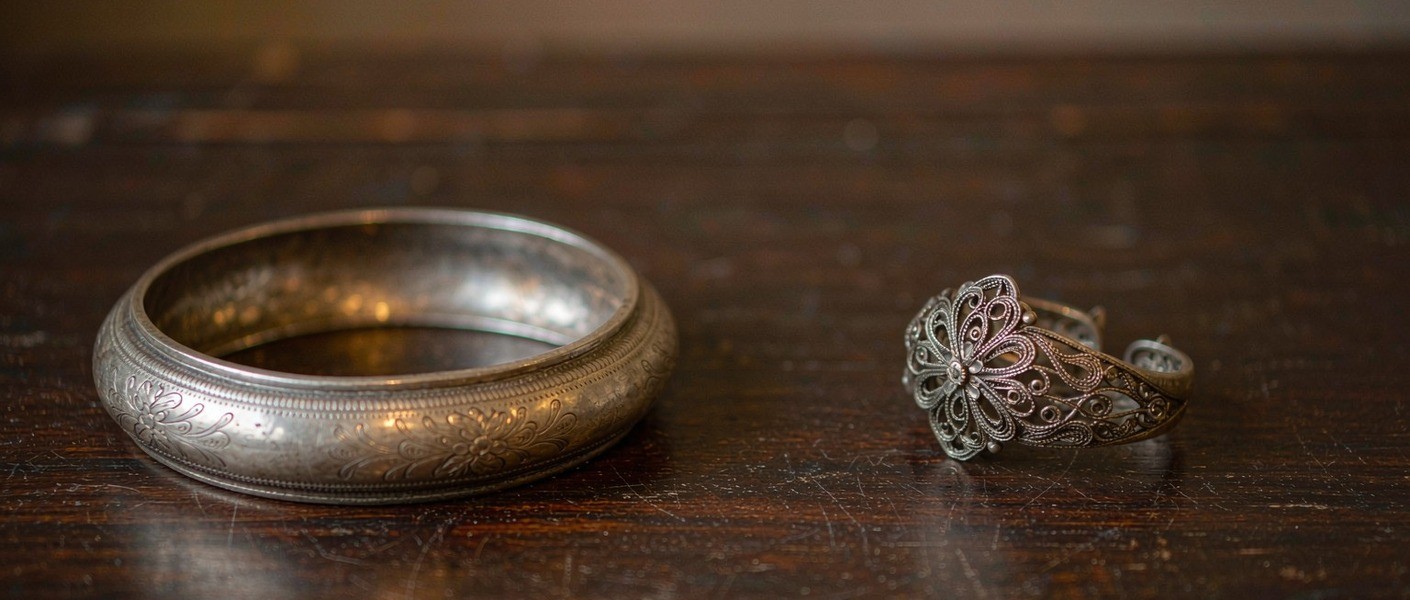
同一只银镯,凸起的纹样亮,凹下去的地方黑。有人以为是戴脏了,拿去洗;有人说是做上去的,于是怀疑是不是在遮什么。做旧本身是一门正经的工艺,关键在于它做了什么、盖住了什么。这一篇把这两件事分开讲。
▍一、银为什么会黑
银变黑,通常不是脏,是化学。银在含硫的环境里会生成黑色的硫化银,空气里的硫化氢、某些食物、橡胶、甚至汗液与体质差异,都会让这个过程加快。据公开资料,这是银饰在日常佩戴中会逐渐变暗的主要原因。
银饰表面的錾刻纹样,凹陷处聚着深色
▍二、做旧在做什么
所谓做旧,指的是用含硫的溶液或膏体处理银面、把自然氧化提前做完的表面处理工艺——让凹陷处先黑下来,再把凸面擦亮。这样一来,纹样的层次立刻出来:光的地方更亮,暗的地方更深,图案的立体感靠明暗对比而不是靠雕得更深。
这门手法在錾刻与花丝一类工艺里尤其常见。据中国非物质文化遗产网,花丝镶嵌制作技艺于 2008 年列入第二批国家级非物质文化遗产名录;花丝是把金银拉成细丝再掐成纹样,丝与丝之间的缝隙极窄,不做旧,纹样在光下容易糊成一片,细功夫看不出来;做旧之后,每一根丝的轮廓才立得住。
▍三、它和遮瑕的分界在哪
分界线在盖住了什么。
做旧是表面处理,作用在应该暗的地方。它不改变形体,也不填补缺陷:该有的砂眼还在,该有的接缝还在,只是被颜色分出了层次。遮瑕不是这样。遮瑕要盖住的是本该完好的地方——焊接留下的疤、铸造留下的砂眼、抛光没打掉的划痕。这些东西被一层深色压住之后,肉眼很难立刻发现。
所以同一个做旧,落在会做的人手里是加分,落在想省事的人手里是保险。它本身没有对错,对错在于用它换掉了哪一步。
▍四、看三处就够了
分辨的办法不复杂,看三处。
一看凹处的黑是不是跟着纹样走。正常的做旧,深色严格待在纹样的低处,边界清晰;如果黑色成片、边缘模糊,甚至溢到平面上,多半不是为了层次,而是为了盖住什么。
二看凸面有没有被擦亮。做旧之后必须有一次抛光,把高处的黑擦掉,明暗才成立。如果整件都灰蒙蒙、高点也没亮起来,说明这一步被省了,或者更糟——高点也不想让人看清。
三看边缘与内圈。经常摩擦的地方(镯口、戒指内圈、佩戴时的接触面)会自然变亮,这是使用留下的证据。如果一件"做旧"的银饰在这些位置依然是均匀的深色,说明深色是后来加的,而且加得很厚。
抛光后的银面,高点反出亮光
▍五、严选的态度
我们对做旧的态度很简单:允许,但必须说清楚。一件器物用了做旧,就要写明它是表面处理,不是"戴旧了",更不是"老物件"。说清楚了,做旧就是工艺;不说清楚,做旧就成了话术。
同样的道理适用于所有表面功夫:包浆、染色、上蜡、仿古。它们都不坏,坏的是把它们当作别的什么东西卖。手作的价值建立在可核对之上,任何一层说不清的处理,都会动摇这个基础。
▍问答
问 | 银饰发黑是质量问题吗,要不要洗掉
答 | 多数情况下不是质量问题。银在含硫环境中会生成黑色硫化银,空气、食物、汗液与体质差异都会加快这个过程(据公开资料)。洗不洗看个人喜好:喜欢亮面的可用擦银布轻擦,喜欢层次的就留着。真正要警惕的是发黑不均匀、成片且边界模糊,那可能不是自然氧化。
问 | 做旧过的银饰还能正常佩戴吗,会不会掉色
答 | 可以正常佩戴。做旧的深色会随着摩擦慢慢变浅,尤其在与皮肤、衣物常接触的位置,这是正常现象而非褪色。需要注意的是清洗方式:不要用强力的化学洗银水浸泡,它会把做旧的层次一起洗掉,纹样的立体感也就没了。
问 | 怎么分辨手工银饰和机器压的
答 | 看三处:一看纹样的边界,手工錾刻的线条有深浅变化与轻微起伏,机器压的件件相同;二看背面与内壁,手工件常留有锤打与修整的痕迹;三看重量与收口,手工器物的接口处理更费事,也更容易看出人的痕迹。三条里对上两条,通常不会错。
问 | 韵和鸣的银饰类器物,怎么确认是真的手工
答 | 靠三条不松口的规矩:只选真正的非遗手工品,只和非遗老师本人合作,只收手工真作。每一件都能说清出自哪位匠人之手、用了哪些工序;表面的任何处理(包括做旧)都会如实写明。机器流水线的东西,价钱再低、模样再像,也不在严选之列。
▍说在最后
一件器物不怕有处理,怕的是处理之后说不清。能说清的,都是工艺;说不清的,都要打问号。
你手上有没有一件戴了很多年、越戴越好看的银器?留言说说它的来历,我们下一期接着聊。
📩 非遗项目 | 匠人举荐 | 跨境出海 | 线下联营
欢迎留言或后台联系,我们与匠人同行。
—— 韵和鸣 · 与匠人同行
〖 器 〗
相关搜索 | RELATED SEARCHES
银饰 做旧 是 什么 工艺 · 银器 发黑 怎么办 · 手工 银饰 怎么 辨别 · 花丝镶嵌 錾刻 工艺 · 非遗 银饰 保养
English
Silver darkens not from dirt but from chemistry. In a sulphurous environment silver forms black silver sulphide, and hydrogen sulphide in the air, certain foods, rubber, even sweat and individual body chemistry accelerate the process. According to public sources this is the main reason silver jewellery dulls with wear.
Chased pattern on a silver surface, darkness gathering in the recesses
Antiquing, as the term is used here, is a surface treatment that applies a sulphurous solution or paste to finish the natural darkening ahead of time, so the recesses darken first and the raised surfaces are then polished bright. The pattern gains depth at once: what catches light is brighter, what lies lower is darker, and relief comes from contrast rather than from deeper carving.
The technique is especially common in chasing and filigree. Filigree draws gold or silver into fine wire and pinches it into patterns, with gaps so narrow that without antiquing the design blurs under light and the fine work cannot be seen; once antiqued, the outline of every wire holds.
The line is drawn by what it covers.
Antiquing is a surface treatment applied where darkness belongs. It changes no form and fills no defect: pits remain where they were, seams remain, and only colour separates the layers. Camouflage is different. It covers what should be sound: scars left by soldering, porosity from casting, scratches that polishing failed to remove. Once darkened, these are hard to spot at once.
The same antiquing therefore adds value in skilled hands and acts as insurance in careless ones. The technique is neutral; what was traded away for it is not.
Telling them apart is not hard: look in three places.
First, see whether darkness follows the pattern. In proper antiquing the dark stays strictly in the low parts with clean edges; if it spreads in patches with blurred borders, or bleeds onto flat surfaces, it was probably applied to cover rather than to model.
Second, see whether the raised parts were brought back to brightness. Antiquing must be followed by polishing to clear the high points, or the contrast does not exist. If the whole piece looks grey and the high points never come up, that step was skipped, or worse, the high points were not meant to be seen.
Third, look at edges and inner surfaces. Places that rub often, such as a bangle's opening, the inside of a ring or any contact face, brighten naturally with wear, which is evidence of use. If an "antiqued" piece is still evenly dark in those spots, the darkness was added later, and added thickly.
A polished silver surface, high points throwing light
Our position on antiquing is simple: allowed, but stated. If a piece is antiqued, say so: it is a surface treatment, not wear, and certainly not age. Stated, it is craft; unstated, it becomes sales talk.
The same holds for every surface treatment: patina, dyeing, waxing, artificial ageing. None is bad; what is bad is selling one as something else. The value of handwork rests on being checkable, and any layer that cannot be explained undermines that.
Is darkened silver a quality problem; should it be cleaned off?
Usually it is not a quality problem. Silver forms black silver sulphide in a sulphurous environment, and air, food, sweat and individual body chemistry all speed this up according to public sources. Whether to remove it is a matter of taste: a silver cloth restores brightness, or leave it for depth. What deserves caution is uneven darkness in patches with blurred borders, which may not be natural oxidation.
Can antiqued silver still be worn; will the dark wear off?
Yes, it can be worn normally. The dark lightens gradually with friction, especially where it meets skin and clothing, which is normal rather than fading. Care lies in how it is cleaned: do not soak it in strong chemical silver dip, which strips the antiqued layers along with the dirt and removes the relief of the pattern.
How can hand-made silver be told from machine-pressed?
Look in three places. At the pattern's edges: hand chasing varies in depth and lifts slightly, while pressed pieces are identical one to another. At the back and inner walls: hand-made pieces usually keep traces of hammering and finishing. At weight and joins: hand-made closures take more trouble and show human marks more readily. Two of three and you will rarely be wrong.
How does YUNHEMING confirm its silver pieces are genuinely hand-made?
Three rules that never relax: only genuine ICH hand-made works, only direct cooperation with heritage bearers, only hand-finished pieces. Each can name its maker and its steps, and any surface treatment, including antiquing, is stated plainly. Production-line goods, however cheap or convincing, fall outside the selection.
An object is not harmed by being treated; it is harmed by treatment that cannot be explained. What can be explained is craft; what cannot deserves a question mark.
Do you own a silver piece worn for years that looks better for it? Leave a comment with its story and we will continue next time.
ICH Projects · Artisan Referrals · Global Distribution · Salon Partnerships
你可能还感兴趣
一件漆器该有多重,手感不会说谎
严选器物,看纹样、看款识、看证书,都是明面上的事。但有一道标准写不进任何参数表——上手。同一尺寸的两只漆盘,一只压手温润,一只轻飘干瘪,差别从何而来?这次把"分量"这件事拆开讲。说到底,重量是工序的记账本。
韵和鸣 · 2026/10/14 · 54 阅读
一盏博山琉璃:颜色是炉火给的,不是颜料调的
博山琉璃的颜色由矿石、着色配方和炉温共同形成,鸡油黄等色料并非烧成后涂在表面。文章介绍挑料、吹制、塑型、灯工和内画,说明流纹、气泡与壁厚如何反映手工过程,并提供观察颜色、过渡和口沿的选器方法。
韵和鸣 · 2026/10/12 · 50 阅读
一张蔚县剪纸,彩色的刻刀活
严选录这一期看一张不太一样的剪纸:它不用剪刀,用刻刀;不止红色,还带着点染出来的粉与绿。河北张家口蔚县的剪纸,是剪纸大家族里"反着来"的一支——别处以剪为主、以红为正,蔚县以刻代剪、以点彩上色。说到底,这两个"反着来"的本质,是蔚县人把剪纸从窗前的女红,做成了作坊里的分工手艺:看懂了这一点,才算看懂了这张纸。
韵和鸣 · 2026/10/13 · 49 阅读
一枚漆书签:小物件为什么反而更考验手艺
漆书签体量小,却同时暴露胎体稳定、漆层附着、边缘打磨与日常耐用度。挑选时先看薄厚与侧面,再摸边缘和转角,比只看纹样更能判断小件工序是否扎实,也值得问清售后修复。
韵和鸣 · 2026/10/24 · 47 阅读
平金开黑:金与黑,为什么这么耐看
平金开黑以黑漆为底、金线为饰,关键在于黑底的推光质量、金线的稳定和留白的分寸。文章介绍相关工具与工序,并从线条、光泽、使用和来源等方面说明如何观察描金漆器,避免只用金的多少判断价值。
韵和鸣 · 2026/10/10 · 46 阅读
竹编漆艺茶席:两种非遗,如何在同一张桌上共生
一张茶席上,常常同时摆着竹编的垫、漆艺的托。它们来自两门毫不相干的手艺,却在同一片茶汤边安静相处。共生这件事,比"混搭"难得多。
韵和鸣 · 2026/10/2 · 45 阅读