同一件器物,手工与机雕差在哪?一次对照看明白
韵和鸣 · 韵和鸣公众号 · 2026/10/31 12:00:00 · 6 阅读

肉眼越来越难分辨了,这话说的是实话。机器上手的刀具现在能做到头道工序的精度,批量出的东西摆在货架上,光影一打,和手做的差别并不立刻显形。但差别一直在,只是挪到了另外几个位置。严选要做的,就是把这几个位置说出来。
▍一、头一个线索:重复度
最省力的办法不是盯着一件看,而是摆两件同样的并排看。机器执行命令,同一版路径跑出来的纹样件件相同;手跟着材料走,同一张稿做个两遍也会出现细微差别——一朵花的转折、一片叶的弧度、一笔收尾的深浅,很难完全复读。
需要说明的是,这不是一条可以单独下结论的标准。老练的手艺人做熟了某个纹样,也能做到高度接近;买东西不能只靠这一条。
▍二、第二个线索:刀路的"整齐"
这里说的是规律感。机器的进给是恒定的,沟槽深浅均匀、间距一致,走到转角时用的是同一个转弯半径;手工具一来一回力度会变,快处浅、慢处深,换向的位置常常能看出刀在此稍停的痕迹。
翻到器物的背面看最清楚。对称性在这一面最难维持:机雕的行刀轨迹规整如列队,手工做的是顺着材料的性子走,深浅与走向会随着木纹改变。这一条同样只能辅助判断,不能当作结论。
微距下两件木雕的刀口对比:一件沟槽底部均匀如机织,另一件深浅随刀、转角留着细微的停顿
▍三、第三个线索:看不见的地方
正面是给人看的,背面、内壁、器底才是给同行看的。分工一旦细化,最容易省掉的工序就藏在这些位置:正面的纹样越繁复,越要留意背面有没有被认真处理过。
这条规律不限于木作。就拿漆器来说,一只手做的盒子,内壁和底部的髹涂同样要一遍遍来,因为它要经过髹涂、阴干、打磨、推光这样的反复循环;若外壁光可鉴人而内壁敷衍,便可判断这条工序链至少断了一段。
▍四、第四个线索:棱线与收边
机器很少在棱线上犹豫,它能把一条线走得很直。手做出的棱线会略微起伏,两侧不完全对称,尤其在长距离的转折处。这个差别有个最简单的检验办法:顺着一条棱用指腹划过去,手做的那条路是活的,有轻有重;机器做的是用尺子画的,一路到底一个力度。
工作台上一只漆盒半开着,侧壁上能看到打磨留下的哑光面与推光后的镜面分界
▍五、机雕不丢人,丢人的是不说明
必须讲清楚一件事:机器不是错。做标准配件、打样、教新人认工序,机器都省力气;问题出在把机做了的事说成手工做了的事。买的若是流水线产品,付的却是手工价格,那不是工艺之争,是诚信之争。
还要补一句前提:这套办法只有在器物没被刻意做旧的情况下才成立。做旧会把真正的刀痕埋掉,也让本该干净的位置带上人工的磨损;遇到这种情况,头一条线索反而最不可靠。
所以真正的分界线不在工具,在敢不敢把"谁做的、哪几道工序是手工"写在明面上。这也是严选的落点:不是把机器排除在外,而是把说法统一到物件本身能对上。
以上为通用的观察方法,个别门类的具体情况差别很大,遇到拿不准的,宁可多问一句。
▍问答
问 | 怎么分辨一件器物是不是手工做的
答 | 看四处:重复度、刀纹的规律、看不见的位置(背面、内壁、器底)有没有被认真处理,以及棱线与收边是否过于笔直。四条要合起来看,单凭任一条都不能下结论。最直接的办法是把两件同类并排对照。
问 | 机器做的就一定不好吗
答 | 不是。机器适合做标准配件、打样和教学示范,效率与一致性是它的长处;真正不该发生的是用机加工的物件冒手工之名、收手工之价。工具本身没有对错,说法与实物对不上才是问题所在。
问 | 怎么分辨一件漆器是不是手工真作
答 | 看三点:一看工序是否完整,如平遥推光漆器的髹涂、阴干、推光缺一不可;二看痕迹,手工的器物有手的温度与微小差异,流水线产品件件相同;三看来源,韵和鸣的器物都能讲清出自哪位匠人之手。
▍说在最后
手做的东西从来不只是"更贵",它是另一条时间线:慢的那部分,被留在了器物里。
你有没有买过"说是手工"的东西,事后发现不是?当时是怎么看出来的?留言说说。
📩 非遗项目 | 匠人举荐 | 跨境出海 | 线下联营
欢迎留言或后台联系,我们与匠人同行。
—— 韵和鸣 · 与匠人同行
〖 器 〗
相关搜索 | RELATED SEARCHES
手工 机雕 怎么 分辨 · 非遗 器物 真手工 怎么看 · 机雕 和 手工 区别 在哪 · 漆器 工序 髹涂 阴干 推光 · 流水线 产品 非遗 区别
English
The easiest method is not to stare at one piece but to set two identical ones side by side. A machine executes a command, and the same toolpath produces the same pattern every time; hands follow the material, and the same design worked twice will diverge slightly, in the turn of a petal, the curve of a leaf, the depth of a closing stroke.
One caution: this alone cannot decide anything. A practised maker who has used one pattern for years can also come close, so no purchase should rest on this single test.
The Second Clue: The Orderliness of the Tool Path
What is at issue here is regularity. A machine feeds at a fixed rate, so grooves run even in depth and spacing and every corner takes the same radius; a hand tool varies in force from stroke to stroke, shallow where fast and deep where slow, often leaving a faint pause where the knife turned.
Turning the piece over is clearest. Symmetry is hardest to maintain on this side: machine paths line up like troops, while hand work follows the material's grain. This too is only a supporting test, never the verdict.
A macro view comparing two carvings: one with grooves even as machine work, the other varying in depth with faint pauses at turns
The front is made to be seen; the back, the interior and the base are made to be judged by peers. Once labour is divided, the steps most easily dropped hide there: the busier the front, the more one should check whether the back was finished carefully.
The rule is not limited to woodwork. Take lacquerware: in a hand-made box the interior and base receive coats again and again because the cycle of applying, drying, abrading and hand-polishing runs through the whole object; if the outside gleams while the inside is cursory, at least one link in that chain has broken.
The Fourth Clue: Ridges and Finishing Edges
A machine rarely hesitates on a ridge; it can run one line very straight. Hand-cut ridges undulate slightly and are not perfectly symmetrical on both sides, especially across long transitions. This can be tested by running a fingertip along the ridge: one path is alive, the other is drawn with a ruler.
A lacquer box stands half open on the workbench, its side wall showing the boundary between the matte abraded surface and the polished mirror finish
Machine Work Is Not Shameful; Concealing It Is
One thing must be clear: the machine is not the error. For standard fittings, sampling and teaching newcomers the sequence, machines save effort; the problem is calling machine work hand work. Paying a hand-made price for a production-line object is not a dispute about craft but about honesty.
One premise must be added: these tests only hold if the object has not been deliberately aged. Artificial ageing buries the real tool marks and puts wear where it should not be, and in such cases the first clue becomes the least reliable.
The dividing line therefore lies not in the tool but in the willingness to state who made it and which steps were done by hand. That is where curated selection lands: not excluding machines, but matching the account to the object itself.
The above are general observation methods; particular branches vary greatly, and where one is unsure it is better to ask one more question.
How can one tell whether an object was made by hand?
Look at four things: repetition, the regularity of tool marks, whether invisible positions such as the back, interior and base were finished carefully, and whether ridges and edges are too straight. Judge them together, since none alone decides anything; the most direct method is comparing two pieces of the same type side by side.
Is machine-made work necessarily inferior?
No. Machines suit standard fittings, sampling and teaching; efficiency and consistency are their strengths. What should not happen is machine-work carried under a hand-made name at a hand-made price. Tools are innocent; the mismatch between account and object is not.
How can one tell whether a piece of lacquerware is genuinely hand-made?
Three checks: whether the steps are complete, since in Pingyao polished lacquerware applying, drying and hand-polishing none can be missing; whether the traces show the warmth and slight variation of hand work rather than identical units from a line; and whether the source can be named, since every YUNHEMING object can be traced to a particular maker.
Hand-made things are never simply more expensive; they are another time line, with the slow part left inside the object.
Have you ever bought something claimed as hand-made and later found otherwise? How did you spot it? Leave a comment and tell us.
ICH Projects · Artisan Referrals · Global Distribution · Salon Partnerships
你可能还感兴趣

一件漆器该有多重,手感不会说谎
严选器物,看纹样、看款识、看证书,都是明面上的事。但有一道标准写不进任何参数表——上手。同一尺寸的两只漆盘,一只压手温润,一只轻飘干瘪,差别从何而来?这次把"分量"这件事拆开讲。说到底,重量是工序的记账本。
韵和鸣 · 2026/10/14 · 52 阅读
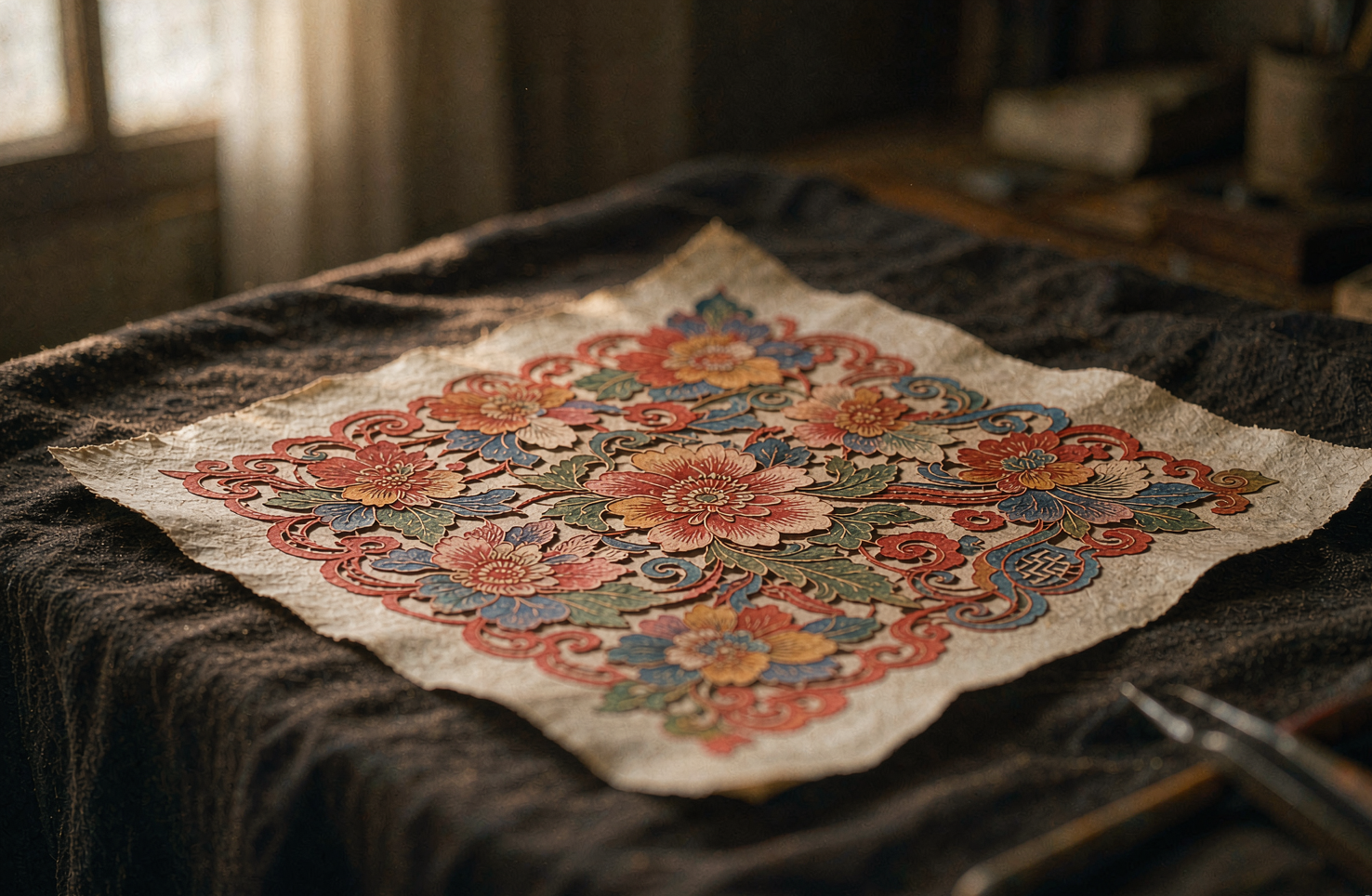
一张蔚县剪纸,彩色的刻刀活
严选录这一期看一张不太一样的剪纸:它不用剪刀,用刻刀;不止红色,还带着点染出来的粉与绿。河北张家口蔚县的剪纸,是剪纸大家族里"反着来"的一支——别处以剪为主、以红为正,蔚县以刻代剪、以点彩上色。说到底,这两个"反着来"的本质,是蔚县人把剪纸从窗前的女红,做成了作坊里的分工手艺:看懂了这一点,才算看懂了这张纸。
韵和鸣 · 2026/10/13 · 48 阅读

一盏博山琉璃:颜色是炉火给的,不是颜料调的
博山琉璃的颜色由矿石、着色配方和炉温共同形成,鸡油黄等色料并非烧成后涂在表面。文章介绍挑料、吹制、塑型、灯工和内画,说明流纹、气泡与壁厚如何反映手工过程,并提供观察颜色、过渡和口沿的选器方法。
韵和鸣 · 2026/10/12 · 46 阅读
平金开黑:金与黑,为什么这么耐看
平金开黑以黑漆为底、金线为饰,关键在于黑底的推光质量、金线的稳定和留白的分寸。文章介绍相关工具与工序,并从线条、光泽、使用和来源等方面说明如何观察描金漆器,避免只用金的多少判断价值。
韵和鸣 · 2026/10/10 · 45 阅读

一枚漆书签:小物件为什么反而更考验手艺
漆书签体量小,却同时暴露胎体稳定、漆层附着、边缘打磨与日常耐用度。挑选时先看薄厚与侧面,再摸边缘和转角,比只看纹样更能判断小件工序是否扎实,也值得问清售后修复。
韵和鸣 · 2026/10/24 · 43 阅读

竹编漆艺茶席:两种非遗,如何在同一张桌上共生
一张茶席上,常常同时摆着竹编的垫、漆艺的托。它们来自两门毫不相干的手艺,却在同一片茶汤边安静相处。共生这件事,比"混搭"难得多。
韵和鸣 · 2026/10/2 · 42 阅读