时隔 70 年重返广交会:道明竹编这次带去的不是竹筐
韵和鸣 · 韵和鸣公众号 · 2026/10/29 12:00:00 · 3 阅读
第 140 届广交会第二期以"品质家居"为主题,10 月 27 日进入最后一天。家居礼品展区里,国家级非物质文化遗产代表性项目四川道明竹编的展位上,摆的不是人们熟悉的竹筐、背篓,而是挂件、杯套、盖碗这些文创配饰与伴手礼;参展商把竹丝剖到 0.2 毫米以内,仍沿用传统经纬编织与榫接技法成型。国家级道明竹编非遗传承人白静波说:"这是道明竹编时隔 70 年,第二次来到广交会。今天我们不光卖创新产品,更多
▍一、展位上消失的竹筐
竹编在多数人的记忆里是日用品:背篓、箩筐、筲箕、蒸笼。它们结实、便宜、用处明确,也正因为用处太明确,一旦塑料与金属制品出现,替代就发生得很快。
这次展台上换了一批东西。挂件可以随身,杯套可以日用,盖碗可以待客。形态变了,工艺没变——还是那双手把竹子剖成丝、再一根根编上去。变的是器物与人的距离:从"干活用的"变成"带在身边的"。
▍二、0.2 毫米:剖丝这道功夫
竹编的难处不在编,在前头。一根竹子要经过砍、锯、刮、剖、篾、拉几道处理,才能得到编织用的竹丝。剖到 0.2 毫米以内意味着什么?一根丝比两根头发并起来还细,手上的力道差一点,丝就断在指间。
据央广网 2026-10-27 报道,本届广交会第二期以"品质家居"为主题,参展商将竹丝剖至 0.2 毫米以内,沿用传统经纬编织与榫接技法编织成型;道明竹编为国家级非物质文化遗产代表性项目,产地为四川崇州道明。
这道功夫决定了后面的一切。丝越细,编出来的面越密、越平整、越贴手;丝越匀,受力越一致,器物越不容易变形。所谓"手工的核心",在竹编这里看得格外清楚:机器可以压出形状,压不出每一根丝都过的手。
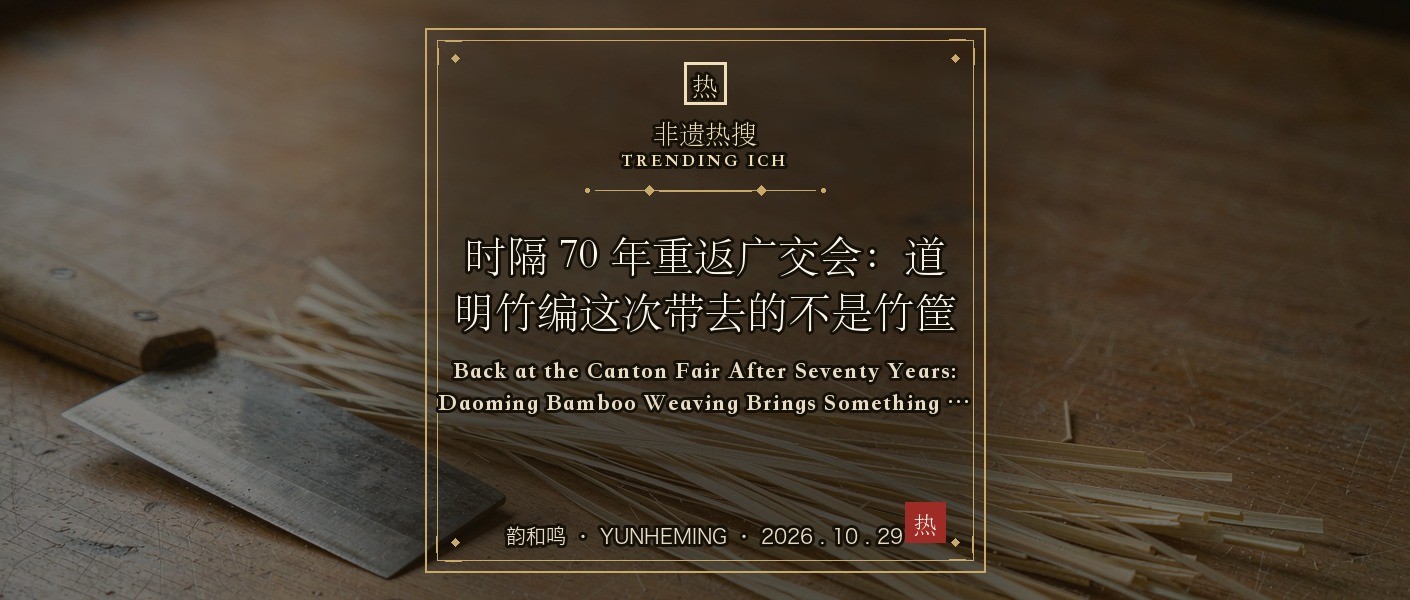
工作台上一把剖篾刀旁摊着一小束剖好的细竹丝,丝头整齐地压在一块木片下
▍三、70 年:外贸这条路走了两遍
"时隔 70 年"这几个字分量不轻。上世纪五十年代起,道明竹编就曾借广交会打开外销,那时卖的是日用器,靠的是便宜与结实。七十年后再来,卖的是设计与文化,靠的是讲得清。
两条路的差别在于定价逻辑。日用品的价格由成本与竞品决定,谁便宜谁拿单。文化产品的价格由理解决定:买方得先知道这是什么、为什么这样、出自谁之手,才谈得上愿意出什么价。前者比数字,后者比说服力。
展台一角摆着几只竹编小杯套与挂件,竹丝纹路在侧光下显出细密的经纬
▍四、外商买的到底是什么
同一个展馆的时尚饰品专区里,另一幕更能说明问题。来自巴西的采购商约翰·莱亚尔看中一枚铜雕胸针,发现这种东方工艺与西装很搭,当即别在领口试戴,现场洽谈后很快达成采购意向。他的评价是:产品既保留了传统,又用现代工艺实现了规模化,让年轻一代也能接受(据央广网 2026-10-27 报道)。
中国轻工工艺品进出口商会副会长张杰在同一报道中指出,本届广交会上采购商的关注点已从基础功能转向设计质感、品牌调性和文化故事;东方美学的创新转化成为新亮点,产品在欧美、东南亚、中东等多元市场形成独特辨识度。
所谓"从产品出口到文化输出",差的那一步是转译:不是把中文说明翻成外文就算,而是把一门手艺的工序、材料与来路,译成对方能理解的生活语境。第 140 届广交会第二期于 2026 年 10 月 23 日开幕,持续至 10 月 27 日(据央广网 2026-10-27 报道)。
▍五、我们看到的顺序,恰好相反
做非遗出海的人,看到的顺序与展馆里的买家相反。买家先看见成品,再追问来路;我们先见到人和工序,再想办法把这件事讲出去。
品牌以山西平遥的推光漆器髹饰技艺起家。那门技艺的每一层大漆都要髹涂后进阴干房慢慢干透,温湿度不对就得等,快不了。竹编也一样:竹丝剖好要趁湿度合适时编,放干了就脆。所谓"成熟",说的不是规模有多大,而是这条链上的每一环都知道自己不能省什么。
出海这件事,说到底是两件事叠在一起:一件是把器物稳妥地送到,另一件是把为什么它是这样讲清楚。只做头一件,卖的是货;两件都做,卖的才是手艺。
你有没有因为一件东西"讲得清楚"而愿意多付一点钱?留言说说那是什么。
▍问答
问 | 非遗手作出口,和一般外贸货品的差别在哪
答 | 差在三件事:一是单件成本高、产能有上限,无法按批量压价;二是每件都带来源信息,谁做的、在哪做的、怎么做的,要能说清;三是需要说明与翻译,材质、养护与文化背景都要随货走。外贸货比的是交付,非遗手作比的是交付加解释。
问 | 竹编、漆器这类天然材料的手作,寄到海外要注意什么
答 | 三处最要紧:防潮,竹木类怕湿也怕骤干,包装里要有缓冲与隔湿层;防压,编织物与薄胎器物受挤压后难以复原,外箱要留空隙;申报,天然材质在清关时通常需要如实写明材质与用途,说明文件越具体越省事。具体要求以目的国官方口径为准。
问 | 为什么手工器物的价格不能按流水线货来比
答 | 差在算法。手工这边要算三样:工时、报废率、等待期——剖丝、髹涂、阴干、修整都占时间,某一步失手,前面投入的工时就一起作废。流水线那边的账是设备折旧、原料加批量,量越大摊得越薄。两套算法算出的是两种价格,硬摆在一起比没有意义。
问 | 韵和鸣做非遗出海,和一般外贸公司差在哪
答 | 差在两件事:一是只卖真非遗手工品,不卖流水线文创;二是背后有跨境供应链的底子,从选品、内容到履约是一条完整的链。产品出口欧美、日韩、新加坡等市场,器物送得稳,手艺的来路也讲得清。
▍说在最后
一门手艺出海,最怕的不是卖不动,而是卖动了却没人知道它是怎么来的。被买走和被理解,是两件不同的事。
你在海外买过或送过一件中国手作吗?对方头一个问的是什么?留言告诉我们。
📩 非遗项目 | 匠人举荐 | 跨境出海 | 线下联营
欢迎留言或后台联系,我们与匠人同行。
—— 韵和鸣 · 与匠人同行
〖 热 〗
相关搜索 | RELATED SEARCHES
道明竹编 广交会 2026 · 非遗 出海 外贸 · 竹编 竹丝 0.2毫米 · 非遗手作 出口 注意什么 · 手工作品 为什么 比 流水线 贵 · 非遗经纪人
English
The Basket That Disappeared From the Stand
In most memories, bamboo weaving is a household thing: back baskets, panniers, strainers, steamers. They are sturdy, cheap and clear in purpose, and precisely because that purpose is so clear, replacement came quickly once plastic and metal arrived.
What changed at this stand is the set of objects. A pendant can be carried, a cup sleeve used daily, a lidded bowl set before a guest. The shapes changed; the craft did not. The same hands still split bamboo into filaments and weave them one by one. What changed is the distance between object and person: from something used for work to something kept close.
The difficulty of bamboo weaving is not in the weaving but in what precedes it. A cane goes through cutting, sawing, scraping, splitting, stripping and drawing before it becomes filament fine enough to weave. What does under 0.2 millimetres mean? A strand thinner than two hairs laid together. Let the force in the hand vary by a little and the strand breaks between the fingers.
According to CNR.cn on 27 October 2026, the second phase of this Canton Fair is themed "Quality Home," and the exhibitor splits filaments to under 0.2 millimetres, forming them with traditional warp-weft weaving and jointing. Daoming bamboo weaving is a national-level representative item of intangible cultural heritage, made in Daoming, Chongzhou, Sichuan.
This stage decides everything after it. Finer filaments make a denser, flatter surface that sits better in the hand; more even strands make the tension consistent and the object less prone to losing shape. What "the handmade core" means is unusually clear in bamboo weaving: a machine can press a shape, but it cannot pass every strand through a hand.
On a workbench beside a splitting knife lies a small bundle of split bamboo filaments, their ends held flat under a wooden sliver
Seventy Years: The Export Road Walked Twice
Those words "seventy years apart" carry weight. From the 1950s, Daoming bamboo weaving used the Canton Fair to open export sales, selling household wares then, on the strength of being cheap and sturdy. Seventy years later it returns selling design and culture, on the strength of being able to explain itself.
The difference lies in the logic of pricing. Household goods are priced by cost and competitors; the cheapest takes the order. Cultural goods are priced by comprehension: the buyer must first know what it is, why it is made this way and whose hands made it before any price can be discussed. The former compares numbers, the latter compares persuasion.
On a corner of the stand sit several woven cup sleeves and pendants, their fine warp and weft visible under side light
What Is the Foreign Buyer Actually Purchasing
In the fashion accessories section of the same hall, another scene says more. John Leal, a buyer from Brazil, took a fancy to a copper-carved brooch, found the craft suited a suit jacket, pinned it to his lapel on the spot and reached a purchase intent soon after talking. His assessment: the product keeps tradition while achieving scale through modern technique, making it acceptable to a younger generation (reported by CNR.cn, 27 October 2026).
Zhang Jie, vice-president of the China Chamber of Commerce for Import and Export of Light Industrial Products and Arts-Crafts, noted in the same report that buyers' attention at this fair has shifted from basic function to design quality, brand character and cultural story; the innovative conversion of Eastern aesthetics has become a new highlight, giving products a distinct identity across markets in Europe, America, Southeast Asia and the Middle East.
The missing step between exporting a product and exporting culture is translation: not rendering a Chinese leaflet into a foreign language, but rendering a craft's process, materials and provenance into a context the other side can live inside. The second phase of the 140th Canton Fair opened on 23 October 2026 and ran to 27 October (reported by CNR.cn, 27 October 2026).
Those of us who take heritage crafts abroad see the order reversed. The buyer sees the finished piece first and asks afterwards where it came from; we meet the person and the process first, then work out how to tell it.
The brand began with the Pingyao polished lacquerware technique of Shanxi. Every coat of raw lacquer must be applied and then left to dry slowly in a drying room; if temperature and humidity are wrong, one waits. Bamboo weaving is the same: filaments must be woven while the moisture is right, and become brittle once dry. What "mature" means here is not scale but that every link in the chain knows what it cannot skip.
Going abroad is ultimately two things stacked: delivering the object safely, and explaining why it is the way it is. Do only the first and you sell a commodity; do both and you sell a craft.
Has clear explanation ever made you willing to pay more for something? Tell us what it was.
How does exporting heritage handwork differ from ordinary foreign trade goods?
Three things differ: unit cost is high and capacity capped, so prices cannot be driven down by volume; each piece carries provenance, able to account for who made it, where and how; and it needs documentation and translation, since materials, care and cultural background must travel with the goods. Ordinary trade competes on delivery; heritage handwork competes on delivery plus explanation.
What should one watch when shipping natural-material handwork such as bamboo or lacquerware abroad?
Three points matter most: moisture, since bamboo and wood fear damp as much as sudden dryness, so padding and a moisture barrier belong in the packing; pressure, since woven work and thin-bodied objects rarely recover from being crushed, so leave a void in the outer box; and declaration, since natural materials usually need their material and use stated honestly at customs, where a specific document saves trouble. Exact requirements follow the destination country's official position.
Why can't handmade objects be priced against factory goods?
The arithmetic differs. Handwork must account for three things: hours, spoilage and waiting, since splitting, coating, drying and finishing all take time, and a slip at one step voids the hours invested before it. A production line accounts for equipment depreciation, materials and volume, thinning as output grows. Two kinds of arithmetic yield two kinds of price; setting them side by side proves nothing.
How does YUNHEMING's heritage export differ from an ordinary trading company?
Two things. It sells only genuine heritage handwork, not factory-made cultural products, and it rests on a cross-border supply chain in which selection, content and fulfilment form one continuous chain. Products reach markets in Europe, America, Japan, Korea and Singapore; the objects arrive safely and the provenance of the craft is stated clearly.
For a craft going abroad, the fear is not that it fails to sell but that it sells while nobody learns where it came from. Being bought and being understood are two different things.
Have you bought or given a piece of Chinese handwork abroad? What was the first question the other person asked? Tell us below.
ICH Projects · Artisan Referrals · Global Distribution · Salon Partnerships
你可能还感兴趣
漆器为什么能埋八千年不坏
在博物馆做漆器研究与修复的研究员老周,桌上常年摆着两样东西:一段出土的漆皮残片,一只新做不久的平遥推光漆盘。他说这两样东西隔着八千年,却是同一种材料。这次对话,我们从"漆器为什么埋几千年不坏"聊起,聊到最后,其实是手艺对材料的理解问题。
韵和鸣 · 2026/10/14 · 64 阅读
去贵州雷山,看一块银元如何变成一支银簪
在黔东南的苗寨里,银不只是一种首饰材料。它曾经是可以随时熔掉、重新打制的"存款",也是节日里一个女人身上最亮的那部分。关键在于,当一块老银元被放进坩埚,它要经过多少双手、多少道火,才重新成为一件能戴出门的东西。
韵和鸣 · 2026/10/9 · 60 阅读
AI 生成的"非遗纹样",算不算抄袭
喂一批图给模型,几秒钟就能出一张"苗绣风"的纹样。有人觉得这是把传统纹样重新用起来,有人认为这是把别人一辈子的手艺免费拿走了。问题不好回答,说到底,真正难定的不是"像不像",而是数据从哪来、收益到哪去。今天我们不做判断,只把两边的理由摆出来。
韵和鸣 · 2026/10/24 · 56 阅读
机器开始学手艺:是给匠人搭把手,还是来接班
一段流传很广的画面里,一台机械臂正跟着非遗传承人"学艺"——学劈丝、捻线、穿针。看的人分成两拨:一拨说技术帮上了忙,一拨说来抢饭碗了。同一件事读出两种意思,关键在于用什么尺度去量。
韵和鸣 · 2026/10/9 · 55 阅读
把"慢"做成一种体验:一间非遗会客厅的想法
我们习惯按功能给空间分类:吃饭的、购物的、办公的。但有一种很难归类——它在城市的闹处,不催你走,也不急着让你买单。关键在于,当"慢"被认真设计出来,它本身就可以是一种产品。
韵和鸣 · 2026/10/9 · 54 阅读
年轻人不愿学老手艺,该怪年轻人,还是怪这门手艺?
非遗传承里被讨论得最多的一句话是"后继乏人"。这句话往下追一层,就分成两条路:一条通向年轻人,说他们耐不住、看不上;一条通向他们面对的那门手艺,说它没能给出一条能活下去的路。这两条路,最近又吵起来了。
韵和鸣 · 2026/10/8 · 53 阅读