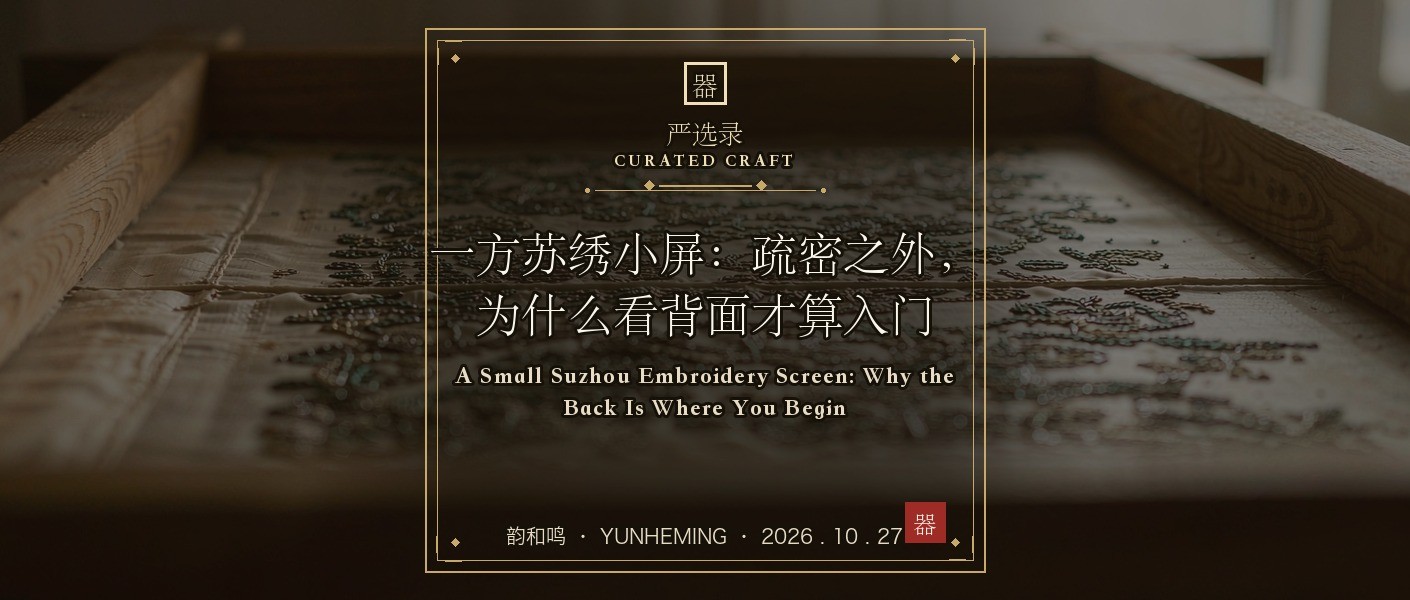
一方苏绣小屏:疏密之外,为什么看背面才算入门
韵和鸣 · 韵和鸣公众号 · 2026/10/27 12:00:00 · 4 阅读
看绣有两个顺序。多数人先在正面停住,看构图、看配色、看这只鸟像不像;行家往往先把绣绷翻过来。原因是正面的效果可以被安排,背面的混乱藏不住。这件事的本质在于:看绣看的是一个人怎么处理看不见的那部分。
▍一、绣的分类,先从源流讲清楚
先把概念摆正。据中国非物质文化遗产网项目介绍,苏绣在 2006 年公布的国家级非物质文化遗产代表性项目名录中(项目序号 317,编号 Ⅶ-18,类别为传统美术,申报地区为江苏省苏州市)。同一项目介绍提到,自明代以来苏绣大师辈出,目前尚有确切传人并有影响的可分为三大谱系:传统细绣、沈寿所创的"仿真绣",以及杨守玉于 20 世纪 30 年代所创的"乱针绣"。
谱系不同,正面的样子差别很大。传统细绣追求齐、匀、光,线紧贴线,接针处几乎看不出来;乱针绣走的是另一条路,线条交叉错落,故意留下条痕般的层叠走向,远看有油画那样的层次。不懂这个分别,容易拿着乱针绣的标准去看传统细绣,越看越觉得"不够密"。
▍二、背面藏着的四件事
翻过来看什么?看四件小事。
一看线头。机器绣可以按一个程序跑完,起针收针的位置有规律;手工绣的每一次起针都在具体的位置上做决定,背面会留下更多、更碎的处理痕迹。
二看接线。长线条中间要接续,接得好不好,正面可能被后续的丝线盖住,背面却清清楚楚。判断的标准不是"零接头",而是接头是否服帖、是否按同一方向走。
三看厚薄。绣得厚不等于绣得好。过度堆叠会让绷面发硬,装裱之后容易起拱,时间久了丝线之间互相挤压,光泽也会钝掉。
绣绷背面斜放在案上,细密的线迹在侧光下泛着哑光
四看路线。一块面积是从中间向外铺,还是从外向中间收,背面看得出顺序。路线乱的地方,往往是绣到一半改了主意,或者换过人的手。
一句行内的话是这样说的:正面看的是画,背面看的是人。意思是画面可以被设计托住,但手上的决定藏不住。
▍三、一根丝能劈到多细
所谓劈丝,指的是把一根桑蚕丝再分成若干缕来绣的做法。绣线的原料是桑蚕丝,一根丝还能再分:把这根丝线分作几缕之后再来绣,线条的边界会更柔,过渡更细,光打上去的反光也更接近真实物件。
代价写在时间上。分得越细,一根丝能覆盖的面积越小,同样一块花瓣就要多走很多针;而丝越细越容易起毛、断头,对手上的力度与干燥度更挑剔。这也是为什么手工绣的尺寸从来不是无限堆叠出来的:面积和时间之间有一条很清楚的比例关系。
绣针停在一方小屏的花瓣边线上,绷布旁放着几轴丝线
▍四、疏密是判断,不是密度
很多人拿"密"当标准,其实绣里的疏密是为了凑出光。花瓣的边缘通常需要密一点,让轮廓立得住;花心的地方反而常常疏一点,留出光线漏过来的缝隙。哪里该密、哪里该疏,是绣的人在画面上大学到的判断——机器可以按照输入的图案绣得很密,但它不会为了某个转折处的光而临时减一针。
同在山西,平遥推光漆器的亮度靠手掌推出来;苏绣的明暗靠丝线排布出来,两门手艺的分寸都在手上。因为这样,"苏绣的特征"被概括为平、齐、细、密、和、光、顺、匀八个字(此为流行的概括说法,各谱系侧重不同)。这八个字里有一半以上要和"稀"搭配起来才有意义——有了疏,"密"才成立。
据中国非物质文化遗产网项目介绍:随着现代商品经济和科学技术的发展,电脑绣花技术得到普遍应用,苏绣的生存空间日益缩小,拥有高超技艺的苏绣传承人和高品质的苏绣艺术品越来越少。
▍五、放在家里之后
绣对小屏的日常要求不复杂,主要有三:避开长期直射的阳光,丝线的颜色会被晒走;避开潮湿,裱框背后的衬板如果受潮,绣面会跟着变形;避开频繁触碰,手上的油脂会沿着丝线扩散。若要清洁,交给懂行的人做,不建议自行处理。
▍问答
问 | 苏绣和机器绣怎么分辨
答 | 看四处:看背面,手工的线头与接线痕迹细碎而有序,机器绣的起收位置规律到近乎相同;看线迹边界,手工的过渡有层次;看同一花样的两件,机器绣件件一样;最后是触感,手工绣面并不发硬,整幅更服帖。
问 | 传统细绣、仿真绣、乱针绣有什么区别
答 | 据中国非物质文化遗产网项目介绍,这是目前仍有确切传人的三大谱系。传统细绣讲平、齐、匀;仿真绣由沈寿所创,吸收西洋画的表现方式;乱针绣由杨守玉于 20 世纪 30 年代所创,线条交叉错落,远看有层次感。审美标准不同,不该拿来互相比较。
问 | 绣花小屏怎么摆放不容易坏
答 | 避开阳光直射、远离加湿器和外墙,装裱要留透气空间。挂墙时不要长期贴冷墙,衬板受潮最容易让绣面变形;清洁用软毛刷轻扫表面浮尘即可,污渍交给修复方处理。
问 | 韵和鸣怎么分辨一件绣品是不是真正的非遗手工品
答 | 我们把门槛立在三处:只收真正的非遗手工品,只与传承人本人往来,只接由人手工收尾的活。流水线出来的东西价钱再低、样子再像,也不进这道门。轮到绣,还要多问三句:出自哪位绣娘、归入哪个谱系、用的是什么丝;三句答得上来,才谈得上严。
▍说在最后
绣的东西有一个共同点:正面越好看,背面越值得看。那里既藏着工时,也藏着一个人的取舍。下一次经过一处绣绷,别急着夸画面,先问问能不能翻过来。
你看绣的时候会先看哪儿?留言说说你的习惯。
📩 非遗项目 | 匠人举荐 | 跨境出海 | 线下联营
欢迎留言或后台联系,我们与匠人同行。
—— 韵和鸣 · 与匠人同行
〖 器 〗
相关搜索 | RELATED SEARCHES
苏绣 怎么 分辨 手工 · 苏绣 乱针绣 仿真绣 区别 · 非遗 绣品 背面 看什么 · 苏州 刺绣 国家级 名录 · 苏绣 小屏 摆放 保养
English
Let us get the terms straight. According to the China Intangible Cultural Heritage website, Suzhou embroidery was included in the first batch of the national representative list of intangible cultural heritage in 2006: item number 317, code VII-18, under the category of traditional fine arts, submitted by Suzhou City, Jiangsu Province. The same introduction notes that since the Ming dynasty masters have come in succession, and that three lineages still have identifiable successors: traditional fine embroidery, the simulation embroidery created by Shen Shou, and the random-stitch embroidery created by Yang Shouyu in the 1930s.
Different lineages look very different from the front. Traditional fine work pursues evenness, uniformity and sheen, thread laid against thread so the joins hardly show. Random stitching takes another road: lines cross and scatter, deliberately leaving streaked traces that read like oil paint from a distance. Without knowing the difference, one tends to judge fine work by the standard of random stitching and conclude it is not dense enough.
What is there to see? Four small things.
Look at thread ends first. A machine follows one programme, starting and stopping in regular places; in hand work each entry is decided on the spot, leaving more small marks of handling at the back.
Second, joins. Long lines must be continued, and whether the continuation is handled well may be hidden by silk at the front while being plain at the back. The test is not a complete absence of joins but whether each one lies flat and runs in the same direction.
Third, thickness. Dense is not the same as good. Too much piling stiffens the ground, and once mounted the surface may buckle; over time threads press against each other and the sheen dulls.
The reverse of an embroidery frame set at an angle on a bench, dense stitches matte in side light
Fourth, the route. Whether an area was laid from the centre outwards or gathered from the edges inward shows up on the back. Where the route is muddled, someone usually changed their mind halfway, or changed hands.
A saying goes: the front shows the picture, the back shows the person. Design can carry a picture, but the decisions of the hand cannot be concealed.
Splitting the thread means dividing one filament of mulberry silk into several strands before stitching. The raw material is mulberry silk and one filament can be divided further: once divided, each strand gives softer edges, finer transitions, and a reflection closer to the real object under light.
The price is written in time. The finer the split, the less area one thread covers, so the same petal takes many more passes; and finer silk frays and breaks more easily, demanding more of the hand's pressure and of the room's dryness. This is also why hand embroidery is never scaled up indefinitely: there is a clear ratio between area and hours.
A needle resting at the edge of a petal on a small embroidered screen, spools of silk set beside the stretched cloth
Many readers take density as the standard, yet spacing here exists to build light. Petal edges usually need to be dense so the outline holds, while the heart of a flower is often left looser to let light through. Where to pack and where to open is a judgement learned on the cloth itself. A machine can embroider densely according to a file, but it will not drop a stitch at a turning point because of the light there.
In Shanxi, Pingyao lacquerware gets its sheen from the palm; in Suzhou embroidery, light and shade come from how threads are laid. Both depend on judgement in the hand. For this reason the characteristics of the craft are popularly summed up in eight words: level, even, fine, dense, harmonious, luminous, smooth and uniform — a common formulation, with each lineage weighting them differently. More than half of those eight only make sense alongside their opposite; dense means something only once there is space.
According to the China Intangible Cultural Heritage website: as the modern market economy and technology have developed, computerised embroidery has come into wide use, the space in which Suzhou embroidery survives has narrowed, and bearers of high skill and works of high quality have become steadily fewer.
Living with a small embroidered screen is not complicated. Three rules: keep it away from long spells of direct sun, which bleaches silk; away from damp, since a backing board that takes moisture will carry the surface with it; and away from frequent handling, as oils from the hand travel along the threads. For cleaning, hand it to someone who knows; do not attempt it yourself.
How do you tell Suzhou embroidery from machine embroidery?
Look in four places: the reverse, where hand work leaves fine but ordered ends and joins while machine work starts and stops with near-identical regularity; the edges of the stitches, where hand work grades; two pieces of the same design, which a machine renders identically; and the feel, since hand work lies softer and flatter.
What distinguishes fine embroidery, simulation embroidery and random-stitch embroidery?
According to the China Intangible Cultural Heritage website, these are the three lineages with identifiable successors today. Fine embroidery values levelness, evenness and uniformity; simulation embroidery, created by Shen Shou, draws on Western painting; random-stitch embroidery, created by Yang Shouyu in the 1930s, crosses and scatters its lines for tonal depth. Their aesthetic standards differ, so they should not be ranked against one another.
How should a small embroidered screen be placed to avoid damage?
Keep it out of direct sun, away from humidifiers and exterior walls, and make sure the mount can breathe. Do not hang it flush against a cold wall for long, since damp backing deforms the surface first; remove surface dust with a soft brush and leave stains to a conservator.
How can you tell whether an embroidered piece is genuinely handmade heritage work?
The threshold stands in three places: only genuine heritage handicraft, only dealings with the bearers themselves, only work finished by human hand. Machine-line goods are not admitted, however low the price or convincing the look. With embroidery three further questions apply: which embroiderer, which lineage, which silk. Answer those and you may call the selection strict.
Embroidered work has this in common: the better the front looks, the more the back deserves attention. Hours are hidden there, and so is a person's judgement. Next time you pass an embroidery frame, do not rush to praise the picture. Ask if it can be turned over.
ICH Projects · Artisan Referrals · Global Distribution · Salon Partnerships
你可能还感兴趣
一件漆器该有多重,手感不会说谎
严选器物,看纹样、看款识、看证书,都是明面上的事。但有一道标准写不进任何参数表——上手。同一尺寸的两只漆盘,一只压手温润,一只轻飘干瘪,差别从何而来?这次把"分量"这件事拆开讲。说到底,重量是工序的记账本。
韵和鸣 · 2026/10/14 · 52 阅读
一张蔚县剪纸,彩色的刻刀活
严选录这一期看一张不太一样的剪纸:它不用剪刀,用刻刀;不止红色,还带着点染出来的粉与绿。河北张家口蔚县的剪纸,是剪纸大家族里"反着来"的一支——别处以剪为主、以红为正,蔚县以刻代剪、以点彩上色。说到底,这两个"反着来"的本质,是蔚县人把剪纸从窗前的女红,做成了作坊里的分工手艺:看懂了这一点,才算看懂了这张纸。
韵和鸣 · 2026/10/13 · 48 阅读
一盏博山琉璃:颜色是炉火给的,不是颜料调的
博山琉璃的颜色由矿石、着色配方和炉温共同形成,鸡油黄等色料并非烧成后涂在表面。文章介绍挑料、吹制、塑型、灯工和内画,说明流纹、气泡与壁厚如何反映手工过程,并提供观察颜色、过渡和口沿的选器方法。
韵和鸣 · 2026/10/12 · 46 阅读
平金开黑:金与黑,为什么这么耐看
平金开黑以黑漆为底、金线为饰,关键在于黑底的推光质量、金线的稳定和留白的分寸。文章介绍相关工具与工序,并从线条、光泽、使用和来源等方面说明如何观察描金漆器,避免只用金的多少判断价值。
韵和鸣 · 2026/10/10 · 45 阅读
一枚漆书签:小物件为什么反而更考验手艺
漆书签体量小,却同时暴露胎体稳定、漆层附着、边缘打磨与日常耐用度。挑选时先看薄厚与侧面,再摸边缘和转角,比只看纹样更能判断小件工序是否扎实,也值得问清售后修复。
韵和鸣 · 2026/10/24 · 43 阅读
竹编漆艺茶席:两种非遗,如何在同一张桌上共生
一张茶席上,常常同时摆着竹编的垫、漆艺的托。它们来自两门毫不相干的手艺,却在同一片茶汤边安静相处。共生这件事,比"混搭"难得多。
韵和鸣 · 2026/10/2 · 42 阅读