机器一分钟出几十张,一把刀要刻一个月:年画与剪纸的价,谁说了算
韵和鸣 · 韵和鸣公众号 · 2026/10/26 12:00:00 · 4 阅读
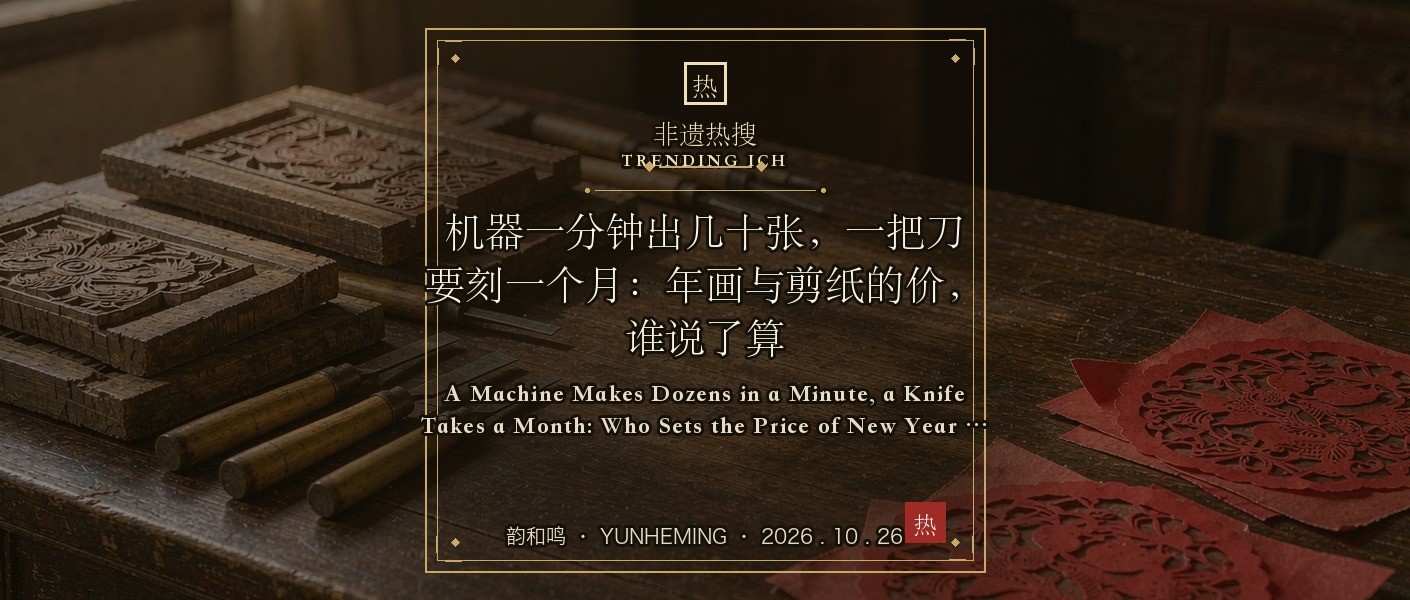
同样是关公,机器一分钟能复制出很多张,手工刻版的人要对着一块木头连续工作一个月。据澎湃新闻 2026 年 10 月 24 日刊发的专题报道,这个对比背后是非遗保护里最棘手的一道题:一门手艺完全挣不到钱,很难只凭热爱撑下去;可一旦什么都用效率和销量来算,机器天然占上风。最后留下来的,可能只是"剪纸图案",不是剪纸本身。这道题的本质,是我们愿意为图像付钱,还是为判断付钱。
▍一、一张纸上的两种时间
先把两门手艺说清楚:所谓木版年画,指的是在木板上刻出图案、再分色套印到纸上的年节图像;所谓剪纸,指的是用剪刀或刻刀在纸上留下镂空线条,靠线与线的连接撑住整幅作品。二者都是"减法的艺术",多一刀就散。
先说那个最扎眼的对比。机器复制纹样,快得几乎没有成本;手工刻一块版、一把剪刀沿着线条走一个月,速度慢到在今天的流水线上不可思议。市场看到这个差距,很容易给出答案:买便宜的那张。
问题在于,便宜的那张和贵的那张,并不是同一种东西。前者卖的是图像,后者卖的是"一根线条为什么必须两刀才能留下"的那套判断。图像可以无限复制,判断只能长在人身上。
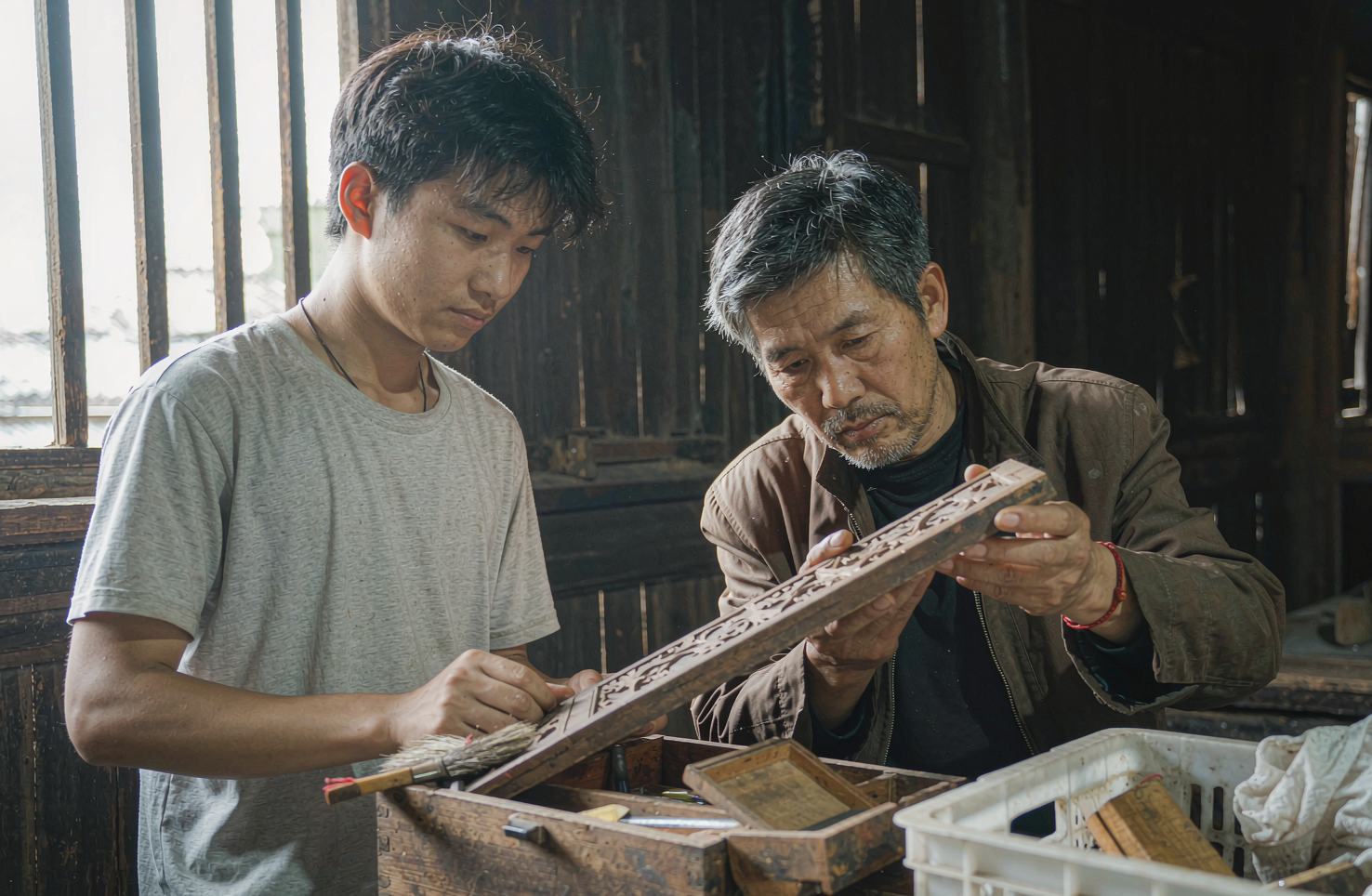
木案上摊开的刻版与刻刀,木纹与刀口在侧光下清晰可辨
澎湃的报道里有一句让人停顿的话:一张剪纸之所以没有散开,靠的是那些不起眼的连接——眼睛连着眉毛,眉毛连着头发,一根细线牵住另一根细线。机器能印出同样的轮廓,但印不出"这根线为什么不能断"的那层克制。
▍二、被扔在鸡窝边的年画,后来怎样了
木版年画的命运,比大多数人想的更曲折。据澎湃新闻报道,当年那些被扔在鸡窝边、拿去切菜的木版年画,如今重新拥有了价格;年轻人开始买生肖年画、关公小画,电商让一个县城里的作坊可以直接面对全国消费者。
这是好消息,而且是实打实的好消息。手艺人的日子先要过得下去,谈传承才有落点。可报道同时提醒了另一半:收藏热不等于技艺复兴。如果只剩下人们争购几十年前、几百年前的老版,而没有人再学选木、处理木料、画稿、下刀、套色,那么年画越值钱,手艺反而越可能变成一种只能被观看的过去。
据永济市人民政府网站 2026 年 10 月 9 日发布的假期文旅综述,国庆假期新绛县以"绛州古城展风华 七十二行聚好物"为主题启动第十四届绛州城隍庙会,打造剪纸艺术、木版年画、绛州云雕、绛州澄泥砚等十大非遗院落,游客可亲手体验剪纸拓印、刺绣制砚。
▍三、"传承人"和"传承者",不是一回事
报道里还有一处分野值得记下来。做关公剪纸的牛振南和女儿薇薇认为,"传承人"和"传承者"并不完全是一回事:技术好只是前提,更重要的是有没有把手艺教给别人。他们去社区、去学校,带孩子们认识纸的纤维,告诉他们为什么剪刀不能随便落下。
这个区分很要紧。评上一个名头,证明的是"你会";把手艺教出去,证明的是"它还能活"。前者是一次性的荣誉,后者是每天都要做的功课——去讲、去示范、去让一个只见过激光切割喜字的人,头一回知道一只眼睛可以靠一根头发般的纸线留在整幅作品里。
剪纸艺人手中的刻刀沿着细线推进,纸屑落在案面上
▍四、年轻人买走的,到底是什么
这一轮回暖里,真正的变化发生在买的人身上。据澎湃新闻 2026 年 10 月 4 日报道,国庆假期山西新绛 8 座闲置老院被逐一盘活,剪纸、澄泥砚、石雕、木版年画等非遗院落集中亮相;同一批报道提到,九月底举办的第 37 届山西运城关公文化旅游节上,"非遗铜雕技艺关公 IP 文创"首次发布,数字艺术、短视频、文创、传统戏曲与关公信俗被放进同一场节会。
年轻人买的不是"传统"这两个字,是具体的东西:一张能贴上门的年画,一个能挂在包上的小件,一段能拍进手机的过程。他们付的钱里,有一部分买的是参与感——我到过那条巷子,我看过那刀怎么落下。
这对做手艺的人是新的机会,也是新的考题。订单来得快的时候,要不要把工序压一压?纹样要不要改得更"上镜"?这些问题没有标准答案,但有一个判断的锚:改的是表达方式,还是做法本身。前者可以讨论,后者一动,手艺就换了物种。
▍五、留下来的那一刀
说到底,机器与手工之争,争的不是效率,是"我们愿意为什么付钱"。愿意为图像付钱,市场就给你图像;愿意为判断付钱,市场才留得住那一刀。
作为长期跑在寻访路上的团队,我们的看法很朴素:让手艺人有尊严地挣到钱,是这一切的前提;但让手艺原样传下去,是这一切的目的。两件事必须一起做,缺一件,另一件也守不住。
▍问答
问 | 手工剪纸和机器剪纸怎么分辨
答 | 看三处:一看线条的连接处,手工刻的转折有细微的顿挫与不对称,机器切的每一刀深浅一致;二看边缘,剪刀与刻刀留下的断面有纤维的毛糙感,激光切割的边缘往往发亮或焦黄;三看同款两件是否完全一样,手工的做不到件件相同。
问 | 木版年画的收藏热,对这门手艺是好事吗
答 | 一半是。老版有了价格,说明市场重新认可它,手艺人多了收入来源;但据澎湃新闻 2026 年 10 月 24 日报道,如果只剩购买老版而没人再学选木、处理木料、画稿、下刀、套色,年画越值钱,手艺反而越可能变成只能被观看的过去。判断的标准是:有没有人在做新版。
问 | 为什么手工的非遗器物普遍比机器做的贵
答 | 因为成本主要压在时间上,不在材料上。一块版要刻一个月,一把剪刀要走一整条线,这段时间无法压缩、无法并行;机器复制的边际成本则接近于零。你付的钱,买的是匠人在那一刻的判断,而不是那张纸或那块木头。
问 | 韵和鸣怎么判断一件东西算不算真非遗手工品
答 | 三条硬标准:只选真正的非遗手工品,只和非遗老师本人合作,只收手工真作。机器流水线的东西,哪怕便宜、哪怕做得像,也不在严选之列。判断不靠肉眼感觉,靠能不能把工序、产地与出自谁之手一条条讲清楚。
▍说在最后
机器把图像送到每个人手上,这是好事;手艺把判断留在少数人身上,这需要我们主动去留住。下次看见一张剪纸,不妨多问一句:这一刀是人刻的,还是机器切的。
你愿为一门手艺的"慢"多付多少钱?评论区说说你的理由。
📩 非遗项目 | 匠人举荐 | 跨境出海 | 线下联营
欢迎留言或后台联系,我们与匠人同行。
—— 韵和鸣 · 与匠人同行
〖 热 〗
相关搜索 | RELATED SEARCHES
手工剪纸 和 机器剪纸 区别 · 木版年画 收藏 是 手艺复兴 吗 · 山西 新绛 木版年画 · 关公 剪纸 永济 · 非遗 手作 为什么 贵 · 韵和鸣 严选 标准
English
First, to be clear about the two crafts. Woodblock New Year prints are patterns carved into wood blocks and then printed onto paper colour by colour; paper-cutting leaves openwork lines in paper with scissors or a knife, the whole piece held together by line joined to line. Both are arts of subtraction, where one cut too many and the piece falls apart.
Start with the contrast that stings most. A machine copies a pattern at almost no cost in time; carving a block by hand, moving scissors along a line for a month, is slow to a degree that seems impossible on today's production lines. Faced with that gap, the market answers easily: buy the cheaper sheet.
The trouble is that the cheap sheet and the costly one are not the same thing. The first sells an image; the second sells the judgement behind why a single line must be left by two slow cuts. An image can be copied without end, while judgement can only grow inside a person.
Carving blocks and knives laid out on a wooden bench, the grain and the cut edges legible in side light
One line in The Paper's report stops you: what keeps a paper-cut from falling apart are the unnoticed connections, eye joined to brow, brow to hair, one fine line holding another. A machine can print the same outline, but not the restraint behind why this line must not break.
What Happened to the Prints Once Left by the Henhouse
The fate of woodblock New Year prints is more winding than most imagine. According to The Paper, the very prints once dumped beside henhouses or used as chopping boards now carry a price again; young buyers are choosing zodiac prints and small images of Lord Guan, and e-commerce lets a workshop in a county town face consumers across the country.
That is good news, and solidly good. A maker must first get by before transmission has anywhere to land. Yet the report also notes the other half: a collecting boom is not the same as a revival of skill. If all that remains is people competing for old blocks decades or centuries old, while no one learns to choose wood, treat it, draw the design, cut and register colour, then the more valuable the prints become, the more likely the craft turns into a past that can only be looked at.
According to a holiday tourism summary published by the Yongji municipal government website on 9 October 2026, during the National Day holiday Xinjiang county launched the fourteenth Jiaozhou City God Temple Fair under the theme of the ancient city showing its splendour and seventy-two trades gathering their goods, creating ten heritage courtyards for paper-cutting, woodblock prints, Jiaozhou cloud carving and Jiaozhou clay inkstones, where visitors could try paper-cutting, rubbing, embroidery and inkstone making themselves.
A Bearer and a Transmitter Are Not the Same Thing
Another distinction in the report deserves keeping. Niu Zhennan, who cuts Lord Guan in paper, and his daughter Weiwei hold that a bearer and a transmitter are not quite the same: skill is only the precondition, what matters more is whether the craft is passed to others. They go into communities and schools, showing children the fibre of paper and why scissors must not come down carelessly.
The distinction matters. A title proves that you can do it; teaching proves that it can still live. The first is a one-off honour, the second a daily assignment: explaining, demonstrating, letting someone who has only seen laser-cut double-happiness characters learn for the first time that an eye can be held in place by a thread of paper as fine as a hair.
A cutter's knife advancing along a fine line in paper, the scraps falling onto the bench
What Young Buyers Are Actually Taking Home
In this recovery the real change is on the buyer's side. According to The Paper on 4 October 2026, eight disused old courtyards in Xinjiang, Shanxi were brought back to life over the National Day holiday, with heritage courtyards for paper-cutting, clay inkstones, stone carving and woodblock prints opening together. The same reporting notes that at the 37th Guan Gong Cultural Tourism Festival held in Yuncheng, Shanxi in late September, the first Guan Gong intellectual-property products based on intangible-heritage bronze casting were released, placing digital art, short video, creative products, traditional opera and folk belief in one festival.
What young buyers are paying for is not the word tradition but something concrete: a print that can go on a door, a small piece to hang on a bag, a process they can film. Part of what they pay for is participation: I walked that lane, I watched the knife come down.
For makers this is both a new chance and a new test. When orders come fast, should the process be compressed? Should a pattern be made more photogenic? There is no standard answer, but there is an anchor for judging: is what changes the way it is expressed, or the way it is made? The first can be discussed; change the second and the craft becomes another species.
In the end the contest between machine and hand is not about efficiency but about what we are willing to pay for. Pay for images and the market gives you images; pay for judgement and the market can keep the cut.
As a team that spends most of its time on the road visiting makers, our view is plain: letting makers earn a living with dignity is the precondition for all of it, while passing the craft on intact is the purpose. The two must be done together, for without one the other cannot be held.
How can you tell hand-cut paper from machine-cut?
Look at three places: the joins, where hand cutting leaves slight hesitation and asymmetry while a machine cuts every line to the same depth; the edge, where scissors and knives leave a fibrous roughness against the glossy or scorched rim of laser cutting; and whether two pieces of one design are identical, which hand work cannot manage.
Is the collecting boom in woodblock New Year prints good for the craft?
Half of it is. Old blocks gaining a price shows the market recognising them again and gives makers income. But as The Paper reported on 24 October 2026, if all that remains is buying old blocks while no one learns to choose and treat wood, draw, cut and register colour, the more valuable the prints become, the more the craft risks becoming a past that can only be viewed. The test is whether anyone is still making new blocks.
Why are handmade heritage objects generally dearer than machine-made ones?
Because the cost sits in time, not material. A block takes a month to carve, a pair of scissors must travel the whole line, and that time cannot be compressed or run in parallel, while the marginal cost of machine copying approaches zero. What you pay for is the maker's judgement at that moment, not the paper or the wood.
How does YUNHEMING decide whether something counts as an authentic handmade heritage work?
Three hard criteria: only authentic handmade heritage works, only collaboration with the heritage masters themselves, only pieces finished by hand. Products of a machine line, however cheap or convincing, are not selected. The test is not a feeling in the eye but whether the process, the origin and the maker can each be stated clearly.
Machines put images into everyone's hands, and that is good; craft keeps judgement in a few hands, and keeping it there takes deliberate effort. Next time you see a paper-cut, ask one more question: was this line cut by a person or by a machine.
ICH Projects · Artisan Referrals · Global Distribution · Salon Partnerships
你可能还感兴趣
漆器为什么能埋八千年不坏
在博物馆做漆器研究与修复的研究员老周,桌上常年摆着两样东西:一段出土的漆皮残片,一只新做不久的平遥推光漆盘。他说这两样东西隔着八千年,却是同一种材料。这次对话,我们从"漆器为什么埋几千年不坏"聊起,聊到最后,其实是手艺对材料的理解问题。
韵和鸣 · 2026/10/14 · 64 阅读
去贵州雷山,看一块银元如何变成一支银簪
在黔东南的苗寨里,银不只是一种首饰材料。它曾经是可以随时熔掉、重新打制的"存款",也是节日里一个女人身上最亮的那部分。关键在于,当一块老银元被放进坩埚,它要经过多少双手、多少道火,才重新成为一件能戴出门的东西。
韵和鸣 · 2026/10/9 · 60 阅读
AI 生成的"非遗纹样",算不算抄袭
喂一批图给模型,几秒钟就能出一张"苗绣风"的纹样。有人觉得这是把传统纹样重新用起来,有人认为这是把别人一辈子的手艺免费拿走了。问题不好回答,说到底,真正难定的不是"像不像",而是数据从哪来、收益到哪去。今天我们不做判断,只把两边的理由摆出来。
韵和鸣 · 2026/10/24 · 56 阅读
机器开始学手艺:是给匠人搭把手,还是来接班
一段流传很广的画面里,一台机械臂正跟着非遗传承人"学艺"——学劈丝、捻线、穿针。看的人分成两拨:一拨说技术帮上了忙,一拨说来抢饭碗了。同一件事读出两种意思,关键在于用什么尺度去量。
韵和鸣 · 2026/10/9 · 55 阅读
把"慢"做成一种体验:一间非遗会客厅的想法
我们习惯按功能给空间分类:吃饭的、购物的、办公的。但有一种很难归类——它在城市的闹处,不催你走,也不急着让你买单。关键在于,当"慢"被认真设计出来,它本身就可以是一种产品。
韵和鸣 · 2026/10/9 · 54 阅读
年轻人不愿学老手艺,该怪年轻人,还是怪这门手艺?
非遗传承里被讨论得最多的一句话是"后继乏人"。这句话往下追一层,就分成两条路:一条通向年轻人,说他们耐不住、看不上;一条通向他们面对的那门手艺,说它没能给出一条能活下去的路。这两条路,最近又吵起来了。
韵和鸣 · 2026/10/8 · 53 阅读