苗绣走上 T 台,绣片走出大山之后
韵和鸣 · 韵和鸣公众号 · 2026/10/19 12:00:00 · 8 阅读
10 月中旬,上海一座百年博物馆的穹顶下走了四十套衣服,纹样来自贵州的苗绣、侗锦、水族马尾绣和蜡染。一门被绣了三代人的手艺,被穿在模特身上走过三十米。真正值得看的不是那三十米,而是绣片从大山走到这里,中间要过几道关。
▍四十套衣服,和它们背后的四种纹样
据人民日报全国党媒信息公共平台与贵州网络广播电视台报道,10 月 11 日至 13 日,上海时装周「东方·新中式 2026 秋」时装秀与艺术展在上海市历史博物馆举行。贵州民族服饰品牌「黔锦」携《织见》系列亮相,以 40 套动态发布、9 套静态展陈的双线呈现。
《织见》的纹样不是印上去的。据贵州省纺织产业发展集团介绍,这个系列以「黔韵织锦绣·非遗焕新生」为创作理念,从苗绣、侗锦、水族马尾绣、蜡染里提取图腾与经典纹样,再把传统图形转成当代服饰图案。用该集团党委副书记张丽芳的说法,希望让外界看到贵州的非遗「是可以穿在身上、走向世界的时尚资源」。
同台的不止一家。本季共有六大新中式品牌:衣架溯源喀什优棉、黔锦活化贵州非遗、中元素与庄容演绎江南罗绸与中式经典、LILIMING 呈现海派编织工艺、人间烟火把花道融进时尚表达。黔锦也在 2025 年以来先后去过米兰时装周、米兰非遗艺术展与深圳·米兰双城时尚周。
▍从「被陈列」到「被穿着」,差在哪
这两个字的差别,比听起来大。一件绣片放在展柜里,它的价值由解说牌决定;穿在身上,价值由穿着的人决定——洗过几次还挺不挺,坐下来会不会勒,抬手时肩线走不走。博物馆可以原谅一件衣服不好穿,市场不会。
所以这次亮相真正的看点,是把「转化」这件事摆到了台面上。据纺织服装周刊报道,贵州纺织集团正与东华大学、毕节市人民政府联合共建贵州省纺织时尚创新研究院,走的是现代化设计、标准化产品开发、品牌化市场运营三步。设计端有金顶奖设计师团队进村寨共创,人才端有东华大学的非遗研培体系,产业端有省级国有纺织产业平台托底。
▍一件绣片的定价难题
有个问题绕不过去:同样是绣,为什么一件可以卖几千,一件只能卖几十?
答案藏在时间里。手工绣的进度是以「天」计的,不是以「件」计的。纹样越密,针脚越多,一天能推进的面积越小;而机绣的进度是以「米」计的。两者的差别不在好看与否,而在同样的图案,背后压着多少个小时。这也是为什么行业内常把「手工」与「机绣」分开标价,而不是混在一起谈性价比。
定价的另一半来自「可追溯」。谁能说清这块绣片出自哪只手、哪个村、用了哪种针法,谁就更容易拿到溢价。说不清的时候,价格只剩下图案的复杂度,而图案是可以被复制的。
▍秀场之外,还有一条更长的路
据看看新闻报道,近年来国潮新中式从小众风潮升级为主流消费趋势,去年国潮服饰市场规模已突破 2500 亿元,今年将保持 15% 以上的增速。10 月 16 日至 25 日,「上海时装周·时尚周末」还联动新天地东台里、新天地时尚二期与永源路商业街区,推出买手市集、城市街区秀场与社群活动,让消费者从「看秀」走向「进店」。
从看秀到进店,是非遗转化里最难的一步。秀场负责让人抬头,进店需要让人掏钱,而掏钱的理由通常不是「这是非遗」,而是「这适合我」。
苗绣、水族马尾绣于 2006 年列入国家级非物质文化遗产代表性项目名录,申报地区分别为贵州省雷山县、贵阳市、剑河县与贵州省三都水族自治县;侗锦织造技艺于 2008 年列入第二批国家级非物质文化遗产代表性项目名录,申报地区为湖南省通道侗族自治县。以上名录信息以文化和旅游部公布内容为准。
▍观察:一件绣片能走多远,看它带了几样东西出门
把这几年的案例放在一起看,能走出大山的手艺,通常带了三样东西出门:一套讲得清的工序,一位有名字的人,一个能被验证的来源。三样齐全,绣片可以在 T 台上走一圈,也可以在行李箱里跟着主人去另一个国家;缺了任何一样,它都只是一件花色好看的布。
对从平遥推光漆器起家、又做全国非遗出海的人来说,这场秀值得记的一句是:世界不缺图案,缺的是图案背后说得清的那部分。你最近见过哪件把老纹样做得不别扭的东西?评论区聊聊。
▍问答
问 | 苗绣是什么?它和苏绣、蜀绣有什么区别?
答 | 苗绣是苗族民间传承的刺绣技艺,2006 年列入国家级非物质文化遗产代表性项目名录,申报地区为贵州省雷山县、贵阳市、剑河县。与苏绣、蜀绣相比,它的图案更多来自创世神话与传说,惯用变形、夸张与多维立体的造型手法,配色也更浓烈;苏绣讲究细腻写实与丝光过渡,两者是两条不同的审美路径,没有高下之分。
问 | 侗锦织造技艺为什么算「织」不算「绣」?
答 | 因为它的图案是在织机上织出来的,不是在布面上绣上去的。侗锦织造技艺 2008 年列入第二批国家级非物质文化遗产代表性项目名录,申报地区为湖南省通道侗族自治县。织与绣的差别在于:织的纹样与布料同时成形,绣的纹样是在已成形的布上叠加,两者对工具、工时与手法的要求都不同。
问 | 非遗纹样做成时装,算不算对传统的不尊重?
答 | 要看两件事:一是有没有被说清来源,二是传承人有没有参与并获益。纹样本就是活在生活里的东西,用在衣服上并不天然构成冒犯;真正容易出问题的,是把图案拿走、把名字留下,或者把产地与手艺讲错。有署名、有共创、有合理分成,转化就站得住。
问 | 韵和鸣做非遗出海,和别人有什么不一样?
答 | 不一样在两点:一是只卖真的非遗手工品,不把非遗图案印上流水线商品去卖;二是有跨境供应链的底子,从选品、内容到履约是一条完整的链。出海对它来说不是新开的故事,而是起家就在做的事。
📩 非遗项目 | 匠人举荐 | 跨境出海 | 线下联营
欢迎留言或后台联系,我们与匠人同行。
—— 韵和鸣 · 与匠人同行
〖 热 〗
相关搜索 | RELATED SEARCHES
苗绣 制作技艺 · 侗锦织造技艺 · 水族马尾绣 · 上海时装周 新中式 · 非遗 纹样 时尚转化 · 韵和鸣 非遗出海
English
Forty Looks, and the Four Patterns Behind Them
According to the People's Daily national party media platform and Guizhou Network Radio and Television Station, the "Oriental · New Chinese Style Autumn 2026" runway show and art exhibition of Shanghai Fashion Week was held at the Shanghai History Museum from October 11 to 13. The Guizhou ethnic clothing brand Qianjin presented its "Zhi Jian" collection with forty looks on the runway and nine in static display.
The patterns in "Zhi Jian" are not printed on. According to the Guizhou Textile Industry Development Group, the collection works from the idea of "Guizhou rhythm in brocade and embroidery, heritage renewed," drawing totems and classic motifs from Miao embroidery, Dong brocade, Shui horsetail embroidery and batik, then translating traditional graphics into contemporary garment patterns. In the words of Zhang Lifang, deputy party secretary of the group, the hope is that the outside world will see Guizhou's heritage as "a fashion resource that can be worn and can travel the world."
Qianjin was not alone. Six New Chinese Style brands shared the season: Yijia tracing Kashi cotton, Qianjin activating Guizhou heritage, Zhongyuansu and Zhuangrong interpreting Jiangnan gauze and Chinese classics, LILIMING presenting Shanghai-style knitting, and Renjian Yanhuo folding flower arrangement into fashion. Since 2025, Qianjin has also appeared at Milan Fashion Week, the Milan Intangible Cultural Heritage Art Exhibition and the Shenzhen–Milan twin-city fashion week.
The gap between those two words is larger than it sounds. A piece of embroidery in a display case has its value set by the caption; worn on a body, its value is set by the wearer—whether it holds up after several washes, whether it binds when you sit, whether the shoulder line shifts when you raise an arm. A museum will forgive a garment that is hard to wear; the market will not.
So what was really on display this time was the question of translation. According to China Textile and Apparel Weekly, the Guizhou Textile Group is building the Guizhou Textile Fashion Innovation Institute together with Donghua University and the Bijie municipal government, working in three steps: modern design, standardized product development, branded market operation. On the design side, a "Golden Thimble" award design team works in the villages; on the talent side, Donghua University runs its heritage training system; on the industrial side, a provincial state-owned textile platform provides the base.
The Difficulty of Pricing a Piece of Embroidery
One question cannot be avoided: the same word "embroidery," yet one piece sells for thousands and another for tens. Why?
The answer is hidden in time. Hand embroidery measures progress in days, not in pieces. The denser the pattern, the more stitches, and the less area can be finished in a day; machine embroidery measures progress in meters. The difference is not which looks better but how many hours are pressed into the same pattern. This is why the trade usually prices handwork and machine work separately rather than mixing them in one value-for-money conversation.
The other half of the price comes from traceability. Whoever can say which hands, which village and which stitches a piece came from more easily earns a premium. When no one can say it, price collapses into the complexity of the pattern alone—and patterns can be copied.
According to Kankan News, New Chinese Style has moved from a niche taste to a mainstream consumption trend in recent years; the market for Chinese-style apparel passed 250 billion yuan last year and is expected to keep growth above 15 percent this year. From October 16 to 25, "Shanghai Fashion Week · Fashion Weekend" also links Xintiandi Dongtaili, Xintiandi Style II and Yongyuan Road with buyer markets, street runways and community events, moving consumers from "watching" to "walking in."
From watching a show to walking into a store is the hardest step in heritage translation. The runway gets people to look up; the store needs them to pay, and the reason people pay is usually not "this is heritage" but "this suits me."
Miao embroidery and Shui horsetail embroidery were inscribed on the national intangible cultural heritage list in 2006, nominated from Leishan County, Guiyang City and Jianhe County in Guizhou, and from Sandu Shui Autonomous County in Guizhou respectively; Dong brocade weaving was inscribed on the second national list in 2008, nominated from Tongdao Dong Autonomous County, Hunan. (Ministry of Culture and Tourism)
Observation: How Far a Piece Travels Depends on What It Carries
Put the cases of recent years together and the crafts that get out of the mountains usually carry three things: a process that can be explained, a person with a name, and a source that can be verified. With all three, a piece of embroidery can walk a runway once and then travel in a suitcase to another country; missing any one, it is only a length of cloth with a pretty pattern.
For those taking heritage abroad, one line from this show is worth keeping: the world is not short of patterns; what is short is the part behind a pattern that can be clearly told. What is the last thing you saw that carried an old motif without feeling awkward? Tell us in the comments.
What is Miao embroidery, and how does it differ from Su and Shu embroidery?
Miao embroidery is the embroidery craft passed down among the Miao people, inscribed on the national intangible cultural heritage list in 2006 from Leishan County, Guiyang City and Jianhe County in Guizhou. Compared with Su and Shu embroidery, its motifs come more from creation myths and legends, favoring distortion, exaggeration and multi-dimensional forms with stronger color; Su embroidery pursues fine realism and the gradation of silk sheen. They are two different aesthetic paths, not a ranking.
Why is Dong brocade classified as weaving rather than embroidery?
Because its patterns are woven on a loom, not stitched onto finished cloth. Dong brocade weaving was inscribed on the second national intangible cultural heritage list in 2008 from Tongdao Dong Autonomous County, Hunan. The difference between weaving and embroidery is that a woven pattern takes shape together with the cloth, while an embroidered one is added on top of cloth already made; the tools, hours and techniques differ accordingly.
Is turning heritage motifs into fashion disrespectful to tradition?
Two things decide it: whether the source is stated, and whether the bearers took part and benefited. Motifs have always lived in daily life, so putting them on clothing is not inherently offensive; what causes trouble is taking the pattern while leaving the name behind, or describing the place and the craft incorrectly. With credit, co-creation and fair sharing, the translation stands up.
What is different about the way YUNHEMING takes heritage abroad?
Two things differ: it sells only genuine heritage handwork and never prints heritage motifs onto production-line goods; and it has a cross-border supply chain underneath it, so selection, content and fulfillment form one complete chain. Going abroad is not a new story for it but what it has done since the beginning.
ICH Projects · Artisan Referrals · Global Distribution · Salon Partnerships
你可能还感兴趣
从易拉罐凤冠到 0.2 毫米银丝,一位成都姑娘的五年
五年前,她用 18 个易拉罐做了一顶京剧凤冠,视频在网上被几百万人看见。今年 10 月,四川省文化和旅游厅官网刊文讲述了她的经历:如今她已取得郫都花丝镶嵌技艺证书,正在申报成都银花丝非物质文化遗产代表性传承人。从那顶凤冠到这行字,中间隔着一根直径 0.2 毫米的银丝,和一个「不好看,重做」的下午。
韵和鸣 · 2026/10/20 · 18 阅读
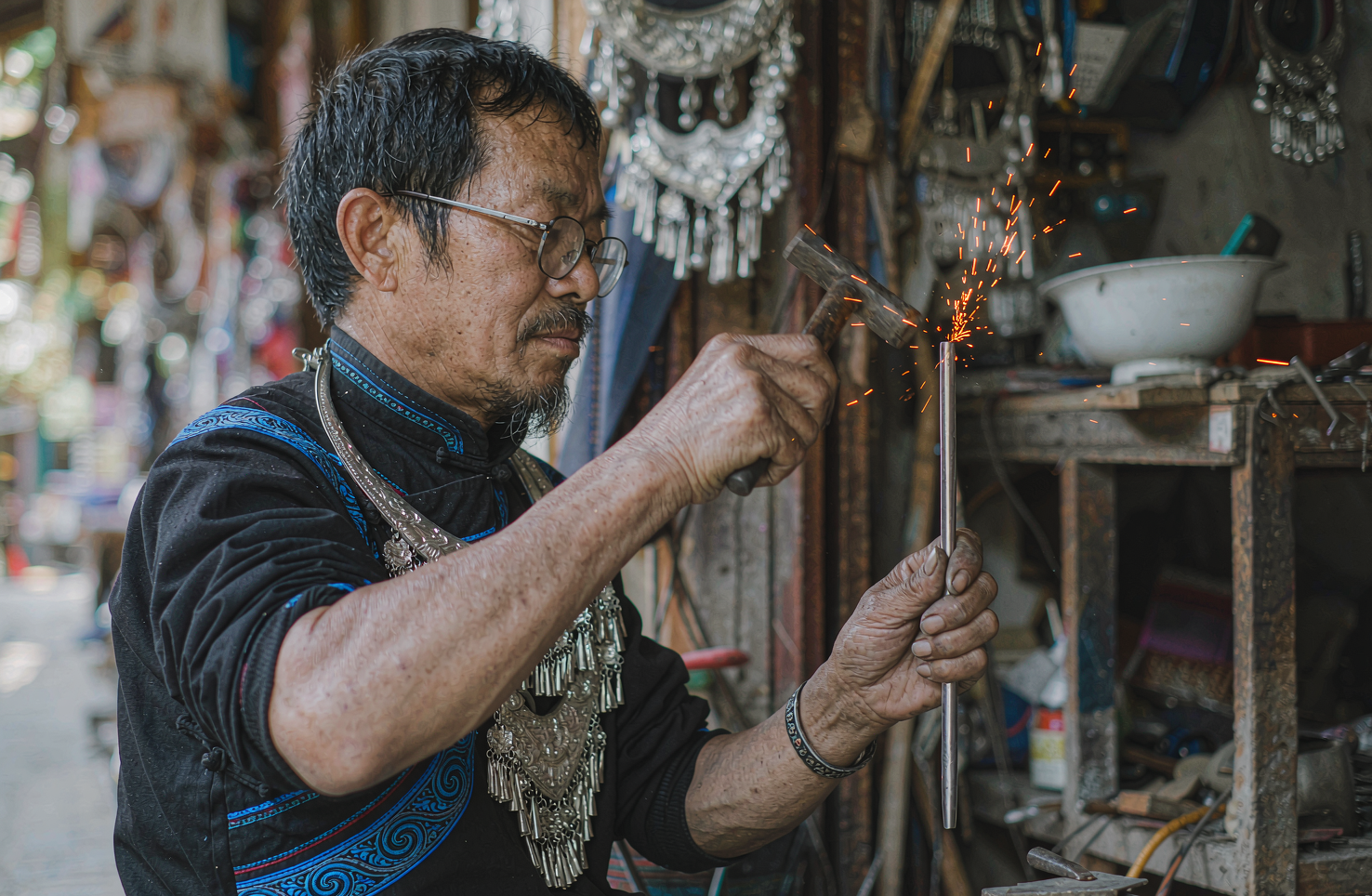
去贵州雷山,看一块银元如何变成一支银簪
在黔东南的苗寨里,银不只是一种首饰材料。它曾经是可以随时熔掉、重新打制的"存款",也是节日里一个女人身上最亮的那部分。关键在于,当一块老银元被放进坩埚,它要经过多少双手、多少道火,才重新成为一件能戴出门的东西。
韵和鸣 · 2026/10/9 · 42 阅读
漆器为什么能埋八千年不坏
在博物馆做漆器研究与修复的研究员老周,桌上常年摆着两样东西:一段出土的漆皮残片,一只新做不久的平遥推光漆盘。他说这两样东西隔着八千年,却是同一种材料。这次对话,我们从"漆器为什么埋几千年不坏"聊起,聊到最后,其实是手艺对材料的理解问题。
韵和鸣 · 2026/10/14 · 30 阅读
一方宋锦里,藏着宋人的审美秩序
初见宋锦,我的反应不是"好看",而是"安静"。它不像人们想象里的锦那样满身是光。带我看锦的老师傅说,正是这份安静,最难织。
韵和鸣 · 2026/10/8 · 25 阅读
把"慢"做成一种体验:一间非遗会客厅的想法
我们习惯按功能给空间分类:吃饭的、购物的、办公的。但有一种很难归类——它在城市的闹处,不催你走,也不急着让你买单。关键在于,当"慢"被认真设计出来,它本身就可以是一种产品。
韵和鸣 · 2026/10/9 · 24 阅读
年轻人不愿学老手艺,该怪年轻人,还是怪这门手艺?
非遗传承里被讨论得最多的一句话是"后继乏人"。这句话往下追一层,就分成两条路:一条通向年轻人,说他们耐不住、看不上;一条通向他们面对的那门手艺,说它没能给出一条能活下去的路。这两条路,最近又吵起来了。
韵和鸣 · 2026/10/8 · 24 阅读