182 项与 1173 项:山西非遗的家底是怎么攒起来的
韵和鸣 · 韵和鸣公众号 · 2026/10/29 12:00:00 · 3 阅读
据山西省文化和旅游厅 2026-10-13《以更自信姿态讲述三晋文化故事》一文,山西拥有国家级非遗代表性项目 182 项、省级非遗代表性项目 1173 项,均位居全国前列。这两个数字常被引用,却很少被拆开看:它们不是一次评选的结果,而是多年制度叠出来的存量。本文只做公开信息的梳理,试图回答一个更实际的问题——一个省的非遗家底,究竟由哪几根柱子撑着。
▍一、头一根柱子:立法与制度
据山西省文化和旅游厅 2026-10-16《文脉承三晋 繁花耀新程》一文,山西修订了《山西省非物质文化遗产条例》,并出台《山西省促进民间艺术保护传承若干措施》。条例解决的是权责与边界:谁来保护、按什么标准、活化利用的红线在哪。若干措施解决的是民间艺术这一块的扶持方式。
两件事放在一起看,方向很清楚:保护不再只靠项目申报与资金拨付,而是先立规矩、再谈利用。对一个非遗大省来说,规矩比热情更耐久。
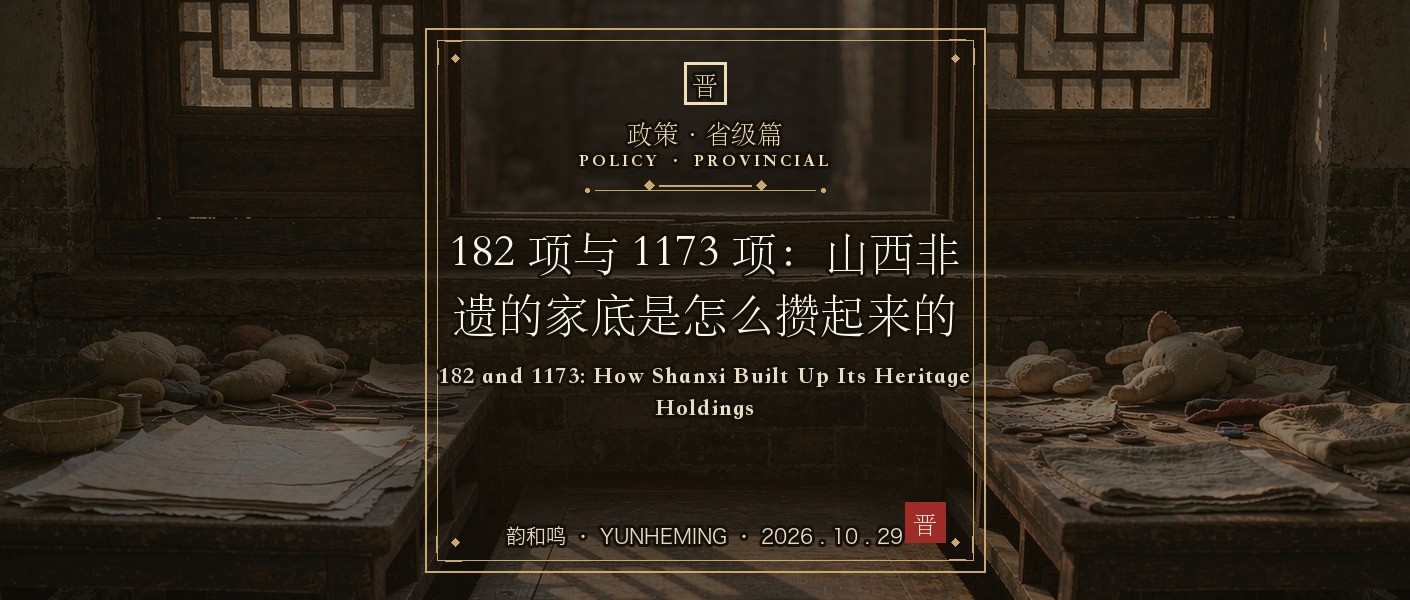
一处老院落的木格窗下摆着两张矮桌,桌上摊着纸样与几件待整理的器物
▍二、第二根柱子:人怎么接续
名录是死的,人是活的。据上述两篇公开信息,山西在人的层面推进了几件事:深入推进中国非遗传承人研培计划,把高校与传承人接到一起;实施急需保护非遗项目"启明星计划";依托"非遗青年创造营"人才培养计划,用专题培训、跨界共创与新媒体扶持,培育懂传统、善运营的新生代传承人;同时启动非遗代表性传承人扶持计划。
这几件事的分工并不重叠。研培解决的是技艺与视野,启明星针对的是濒危项目,创造营面向的是年轻人,扶持计划落在传承人的日常传承活动上。一条从"学"到"传"再到"营"的链条,是这么接起来的。
▍三、第三根柱子:让手艺进市场
据同一来源,山西以晋绣、剪纸等优势门类为突破口探索运营模式、延伸产业链条;借力"山西非遗好物"品牌建设计划,办起非遗消费季,把手艺推进日常消费场景。
进市场这一步最容易变形,也最不可省。手艺若只停在展演与展柜里,传承人就没有稳定的收入预期,学徒也就没有理由来。反过来说,进市场要守住的是同一个边界:卖的是器物与技艺,不是名号。
▍四、落到县里是什么样
制度最终要落到具体的院子里。据山西省文化和旅游厅 2026-10-13 一文,新绛县推行"政府修缮、社会认领、非遗入驻、传艺惠民"的活化模式,把剪纸、澄泥砚、木版年画等本土非遗代表性项目植入百年古院;第五届后稷论坛以"薪火后稷 匠造非遗"为主题,推动农耕文化与非遗活态传承深度融合。
这个模式的巧妙之处在于四件事分给了四方:房子由政府修,日常运营由社会力量认领,内容由非遗项目填,收益的一部分以传艺的方式还给居民。老院有了人,手艺有了地方,两边都不空置。
以上梳理依据山西省文化和旅游厅官网 2026-10-13《以更自信姿态讲述三晋文化故事》、2026-10-16《文脉承三晋 繁花耀新程》两篇公开信息。文中数字与文件名均引自上述来源,未作延伸解读。
▍问答
问 | 山西的国家级非遗项目有多少项
答 | 据山西省文化和旅游厅 2026-10-13 公开信息,山西有国家级非遗代表性项目 182 项、省级非遗代表性项目 1173 项,均位居全国前列。名录实行动态管理,具体数量以官方最新公布为准。
问 | 山西省非遗方面的法规主要有哪些
答 | 据山西省文化和旅游厅 2026-10-16 公开信息,山西修订了《山西省非物质文化遗产条例》,并出台《山西省促进民间艺术保护传承若干措施》。前者解决保护权责、活化利用边界与传承人管理机制,后者针对民间艺术这一门类的扶持。条文以官方发布的原文为准。
问 | 韵和鸣作为山西的品牌,只做本地的非遗吗
答 | 根在山西,收的是全国。起家技艺是产自山西平遥的国家级非遗平遥推光漆器髹饰技艺;但收的器物与服务的匠人覆盖全国,整合漆、竹、绣、银、锦、瓷多个非遗品类。产地在哪里不是标准,是不是真正的非遗手工品才是。
▍说在最后
家底厚不等于传承顺。数字能说明过去攒下了多少,说明不了往后还有没有人接着做。
以上仅为个人梳理,具体以官方原文为准。你所在的省份,哪项非遗让你印象最深?留言说说。
📩 非遗项目 | 匠人举荐 | 跨境出海 | 线下联营
欢迎留言或后台联系,我们与匠人同行。
—— 韵和鸣 · 与匠人同行
〖 晋 〗
相关搜索 | RELATED SEARCHES
山西 非遗 名录 有多少项 · 山西 非遗 保护 条例 · 山西 非遗 专项资金 申报 · 省级 非遗 代表性项目 · 非遗 消费季 · 山西 非遗 传承人 扶持
English
The First Pillar: Legislation and Institutions
According to "A Cultural Thread Through Shanxi, A New Course in Full Flower," published by the Shanxi Provincial Department of Culture and Tourism on 16 October 2026, Shanxi has revised the Regulations of Shanxi Province on Intangible Cultural Heritage and issued Several Measures for Promoting the Protection and Transmission of Folk Arts. The regulations settle authority and boundaries: who protects, by what standard, and where the red line on utilisation lies. The measures settle how the folk arts are supported.
Read together, the direction is clear: protection no longer rests on project applications and funding alone; rules come first, then use. For a province rich in heritage, rules outlast enthusiasm.
Beneath the latticed window of an old courtyard stand two low tables, paper patterns and several objects awaiting sorting spread across them
Lists are inert; people are not. According to the two public sources above, Shanxi has advanced several things on the human side: deepening the China Intangible Heritage Bearer Training Programme and bringing universities and bearers onto one platform; running the "Morning Star" programme for items in urgent need of protection; cultivating a new generation of bearers who understand tradition and can operate in the present through the "Heritage Youth Creation Camp," using focused training, cross-disciplinary co-creation and new-media support; and launching a support programme for representative bearers.
These do not overlap. Training addresses skill and horizon; Morning Star targets endangered items; the creation camp aims at young people; the support programme lands on bearers' everyday transmission work. A chain running from learning to transmission to operation is assembled this way.
The Third Pillar: Letting the Craft Enter the Market
According to the same source, Shanxi takes embroidery and paper-cutting, categories where it is strong, as breakthrough points for exploring operating models and extending industrial chains, and draws on the "Shanxi Heritage Goods" brand building programme and the heritage consumption season to push the craft into everyday buying.
This step into the market deforms most easily and can be skipped least. If a craft stays only at performances and in display cases, bearers have no stable income to expect and apprentices have no reason to come. Conversely, entering the market must hold one boundary: what is sold is the object and the skill, not the title.
Institutions end up landing in particular courtyards. According to the department's article of 13 October 2026, Xinjiang county applies an activation model of "government restoration, social adoption, heritage settlement, skill-sharing for the public," placing local representative items such as paper-cutting, cheng-ni inkstones and woodblock new-year prints into century-old courtyards, while the fifth Houji Forum, themed "The Houji Flame, Heritage Made by Hand," pushes the integration of farming culture and living transmission.
What is clever about the model is that four tasks go to four parties: the government restores the building, social actors adopt day-to-day operation, heritage projects supply the content, and part of the return comes back to residents as teaching. The old courtyard gets people; the craft gets a place; neither stands empty.
The above is compiled from two public sources on the website of the Shanxi Provincial Department of Culture and Tourism: "Telling Shanxi's Cultural Story With Greater Confidence" (13 October 2026) and "A Cultural Thread Through Shanxi, A New Course in Full Flower" (16 October 2026). Figures and document names are quoted from those sources without extended interpretation.
How many national-level intangible heritage items does Shanxi have?
According to public information from the Shanxi Provincial Department of Culture and Tourism dated 13 October 2026, Shanxi holds 182 national-level representative intangible heritage items and 1,173 provincial-level ones, both among the highest in the country. The lists are managed dynamically, so official and most recent figures govern.
What are the main regulations on intangible heritage in Shanxi?
According to public information from the Shanxi Provincial Department of Culture and Tourism dated 16 October 2026, Shanxi has revised the Regulations of Shanxi Province on Intangible Cultural Heritage and issued Several Measures for Promoting the Protection and Transmission of Folk Arts. The former settles protection authority, the boundaries of utilisation and the management of bearers; the latter targets support for the folk arts. The official published text governs.
As a Shanxi brand, does YUNHEMING work only with local heritage?
Its root is in Shanxi; its collecting is nationwide. The craft it began with is Pingyao polished lacquerware from Shanxi, a national-level item. The objects it takes in and the makers it serves, however, come from across the country, spanning lacquer, bamboo, embroidery, silver, brocade and porcelain. Where something was made is not the criterion; whether it is genuine handmade heritage is.
A rich holding is not the same as smooth transmission. Numbers say how much has been accumulated; they do not say whether anyone will carry it forward.
The above is only a personal compilation; the official texts govern. Which heritage item in your own province has left the deepest impression on you? Leave a comment.
ICH Projects · Artisan Referrals · Global Distribution · Salon Partnerships
你可能还感兴趣
从 700 万到 1219 万:山西给非遗的钱,多在了哪
山西省级非遗保护专项资金从年度预算到传承人补助均有明确安排,资金还与展销、线路和品牌计划配合。文章厘清投入方向及其边界:经费能支持保护与传习,却不能单独保证手艺留住学徒、进入生活。
韵和鸣 · 2026/10/8 · 74 阅读

山西非遗条例修订:36 条,说清了几件事
新修订的《山西省非物质文化遗产条例》经山西省人大常委会表决通过。全文 36 条,不设章节,篇幅不长,读下来却比想象中实在——它把"保护什么、谁来保护、怎么用"这几件事,一条一条摆在了明面上。
韵和鸣 · 2026/10/5 · 48 阅读

「山西非遗好物」四个字,背后是一整套动作
近两年,山西的省级文旅文件里反复出现一个词:「山西非遗好物」。它听起来像个活动名称,拆开看却是一串具体动作——建目录、办消费季、推动非遗进商圈、把带头人、农户与商业品牌串成一条链。这一篇只梳理省级层面的公开表述,看看这套动作想解决什么问题。
韵和鸣 · 2026/10/20 · 47 阅读

专业镇的新文件,平遥的漆坊能用上哪几条
说到底,这份文件对老手艺的意义,不在"给了多少钱",而在"把产业的路修到了镇上"。2026 年 1 月,山西省人民政府办公厅印发《山西省支持专业镇高质量发展若干措施》(晋政办发〔2026〕3号),取代 2022 年失效的旧政策。平遥推光漆器,恰好在名单里。
韵和鸣 · 2026/10/12 · 46 阅读

一门手艺的背后,政策怎么把人接住
前面几期,我们把国家、省、市三级的新文件挨个捋了一遍。这一轮收个口:不解读新文件,只看一条贯穿四级政策的暗线——人。名录、工坊、产业,说到底都要有人去做;而这一轮政策最值得记下的变化,是把"支持传承人"从一句原则,拆成了看得见的台阶。
韵和鸣 · 2026/10/14 · 58 阅读

一座县城,为什么要为一门手艺专门立法
晋中为平遥推光漆器髹饰技艺制定专门的地方性法规,把技艺保护、市场规范与资源支持写入制度。文章结合专业镇、产业园、传习所和人才培养,说明立法如何托住产业,也指出法规不能替代匠人的手上功夫。
韵和鸣 · 2026/10/2 · 57 阅读