一把刻刀开刃的半小时,是漆坊里最安静的时候
韵和鸣 · 韵和鸣公众号 · 2026/10/21 12:00:00 · 4 阅读
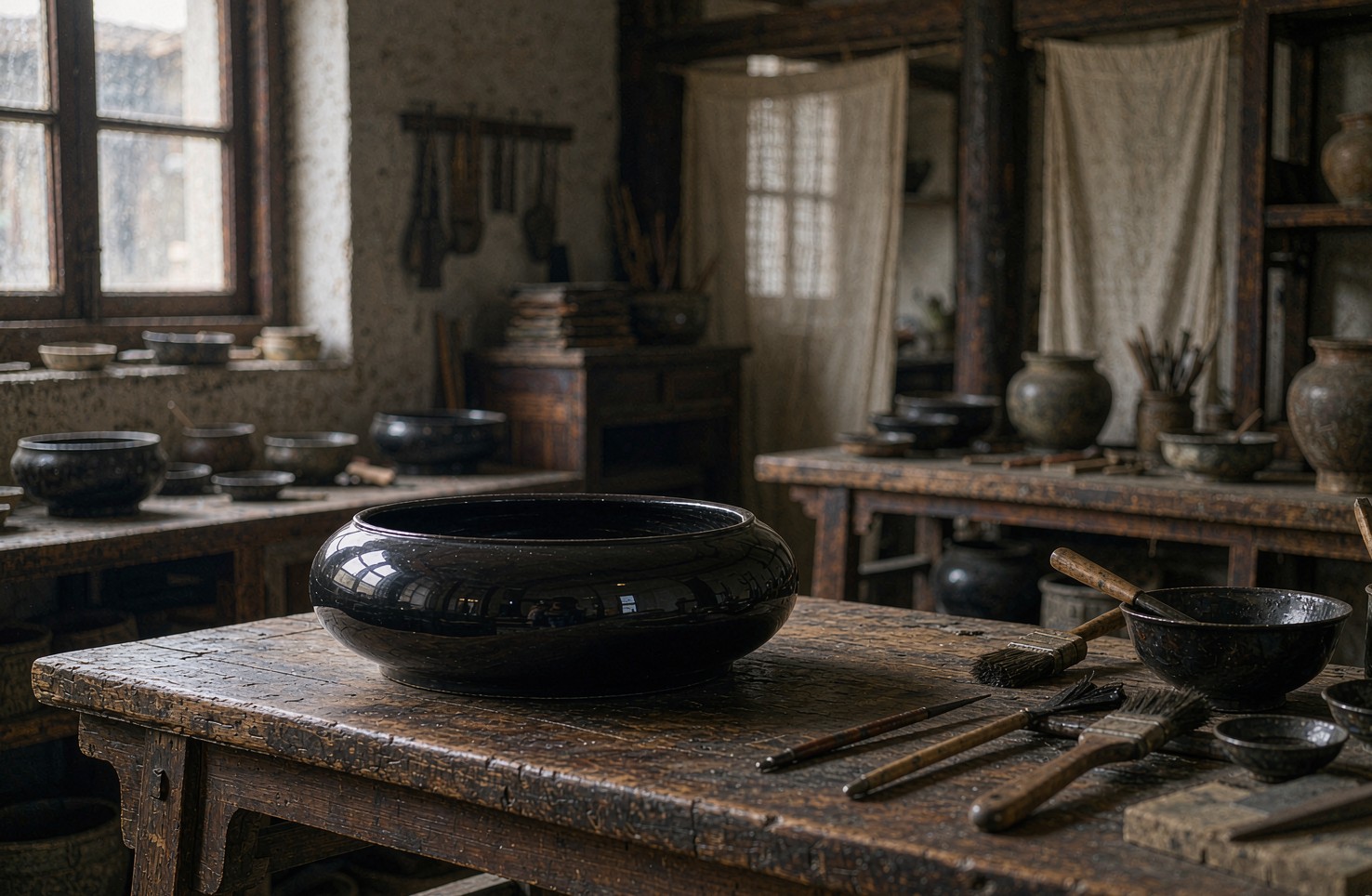
到平遥的漆坊,我们原本是想看推光。老师傅却把我们拦在门口,说等一会儿,先把刀开了。接下来的半小时,他坐在窗边的一块油石前,没说过一句话。这半小时不在任何一份工序清单里,但它决定了一整天能出的活。
▍窗边的那块油石
漆坊的清晨是从光开始的。老师傅把油石摆在窗台上,让光斜着落在石面,然后才开始磨。他说看不清刃口的角度,磨出来的刀就是碰运气。
他手上有三四把刀,形状各不相同:勾细线的刀刃口窄而尖,起轮廓的刀略宽,铲底的刀刃口几乎是平的。每一把的角度都不一样,磨法也不一样——他没有量角器,全靠手指压在刀背上的位置和眼睛看刃线。
平遥推光漆器髹饰技艺于 2006 年列入国家级非物质文化遗产名录,产地为山西省晋中市平遥县。它的主要工序包括制胎、披麻挂灰、髹漆、打磨、推光与描饰,其中推光以手掌反复推磨完成,不用布。
▍试刃:在废漆板上划一道
磨完之后他不急着开工,从墙角捡一块废漆板,在上面划一道。
划完他把板举到光下,看那道沟:如果沟壁光滑、碎屑是卷起来的,刀就到位了;如果沟边发毛、漆面起了小崩口,说明刃口还有微观的缺口,得回石上再走几趟。这道"试刃"的动作只要几秒,却是判断一把刀能不能用的全部依据。
他说,刀钝一点不是不能用,是会让手上多用三分力。多出来的三分力,走在一根细线的转弯处,就变成了肉眼能看出来的抖。
▍为什么这半小时常被略过
说到工序,人们习惯报那一串名字:制胎、披麻挂灰、髹漆、打磨、推光、描饰。这些是关键节点,没错。但节点之间那些不产出成品的时间——等阴干、调漆、磨刀、擦手——往往不被提起。
问题在于,手艺的难度恰恰大量藏在这些"不产出"的环节里。漆要阴干,温湿度不对就前功尽弃;漆要调,稠了流不平,稀了盖不住;刀要磨,钝了线就走不稳。这些环节没有漂亮的画面,也不适合拍成短视频,但它们决定了成品的上限。
那天上午剩下的时间里,他勾了几十根线。其中有三根,他磨掉重来。理由都一样:转弯处手上有东西顶了一下。
▍收束:手艺的门槛,常常在开工之前
离开时我们问,这半小时算不算工序的一部分。他想了想说,不算,但不做不行。
这句话我们记了很久。一门手艺真正的门槛,常常不在技法本身,而在那些没人监督、也没人付钱的准备时间里,你还愿不愿意把它做足。愿意的人,做出来的东西是不一样的。
▍问答
问 | 平遥推光漆器有哪些主要工序?
答 | 大致分六段:制胎(木胎成型)、披麻挂灰(用麻布与灰料加固胎体)、髹漆(反复涂漆,每道需入阴干房干燥)、打磨(把漆面磨平)、推光(用手掌反复推磨出光泽)、描饰(描金、彩绘等装饰)。每一段都不能跳,其中髹漆与阴干的往返次数最多,也最耗时。
问 | 为什么说推光要用手掌而不是布?
答 | 因为手掌能感知阻力。推光不是把漆面磨亮,而是通过反复推压让漆层表面致密、出光;手掌贴着漆面走,能立刻感觉到哪里还发涩、哪里已经起光,布隔在中间就把这层反馈隔断了。这也是这门技艺以"推光"命名的原因。
问 | 阴干房对漆器为什么那么重要?
答 | 大漆的干燥不是"晾干",而是漆酚在温湿作用下固化。温度太低、湿度不够,漆层长时间不干甚至不固化;湿度过高又容易起皱、发雾。所以漆坊要靠阴干房把温湿度稳住,让每一道漆按该有的节奏干透。这也是漆器工期长的主要原因之一。
问 | 韵和鸣和平遥推光漆器是什么关系?
答 | 平遥推光漆器髹饰技艺是它的起家技艺,也是品牌的根。但它不只属于平遥:以这门国家级非遗为基底,它逐步把竹、绣、银、锦、瓷等品类纳入进来,做全国范围的非遗矩阵,而不是某一个城市的单一特产。
📩 非遗项目 | 匠人举荐 | 跨境出海 | 线下联营
欢迎留言或后台联系,我们与匠人同行。
—— 韵和鸣 · 与匠人同行
〖 寻 〗
相关搜索 | RELATED SEARCHES
平遥推光漆器 工序 · 推光 为什么 用手掌 · 漆器 阴干房 温湿度 · 山西 平遥 漆坊 寻访 · 大漆 髹涂 打磨
English
Morning in a lacquer workshop begins with light. The master sets the oilstone on the windowsill so the light falls across it at an angle, and only then starts. Without seeing the angle of the edge clearly, he says, sharpening is a matter of luck.
He has three or four blades in hand, each a different shape. The one for fine lines has a narrow, pointed edge; the one for outlines is slightly wider; the one for clearing ground is almost flat. Each has a different angle and a different way of being ground. He has no protractor; everything depends on where his fingers press along the blade's back and on what his eyes make of the edge line.
The Pingyao polished lacquerware decoration technique was inscribed on the national intangible cultural heritage list in 2006; it comes from Pingyao County, Jinzhong, Shanxi. Its main procedures include forming the body, layering cloth and ash, applying lacquer, sanding, hand-polishing and decoration, with the polishing done by repeated palm rubbing rather than cloth.
Testing the Edge: One Stroke on a Scrap Board
When he finishes he does not start work. He picks up a scrap lacquer board from the corner and draws one line across it.
Then he lifts the board into the light and looks at the groove. If the walls of the groove are smooth and the shavings curl, the blade is right. If the edges look fuzzy and the lacquer shows small chipping, the edge still has microscopic gaps and has to go back to the stone for a few more passes. This test takes seconds, and it is the whole basis for judging whether a blade can be used.
A slightly dull blade is not unusable, he says; it simply makes the hand use three-tenths more force. That extra force, applied at the turn of a thin line, becomes a tremor you can see.
When people list the procedures, they tend to recite the familiar sequence: forming the body, layering cloth and ash, applying lacquer, sanding, polishing, decorating. These are the key nodes, certainly. But the time between the nodes, which produces nothing in itself — waiting for the drying room, mixing lacquer, sharpening blades, wiping hands — is rarely mentioned.
The trouble is that much of a craft's difficulty is hidden precisely in those non-producing stages. Lacquer must dry in a controlled room, and if temperature and humidity are wrong the work is lost. Lacquer must be mixed: too thick and it will not level, too thin and it will not cover. Blades must be sharpened, or the lines will not hold steady. These stages make for no beautiful footage and do not suit short video, but they set the ceiling on the finished piece.
For the rest of that morning he drew several dozen lines. Three of them he sanded off and did again. The reason was the same each time: at the turn, something had pushed back against his hand.
In Closing: The Bar of a Craft Often Sits Before Work Begins
As we left we asked whether that half hour counted as part of the procedure. He thought for a moment and said it did not, and that it could not be skipped.
We have carried that sentence for a long time. The real bar in a craft is often not the technique itself but whether, in the preparation time that nobody supervises and nobody pays for, you are still willing to do it fully. Those who are willing produce something different.
What are the main procedures of Pingyao polished lacquerware?
Roughly six stages: forming the wooden body; layering hemp cloth and ash to reinforce it; applying lacquer repeatedly, with each coat dried in a drying room; sanding the surface level; hand-polishing with the palm to bring out sheen; and decoration such as gold tracing and painting. None can be skipped. The back-and-forth between coating and drying happens most often and takes the longest.
Why is polishing done with the palm rather than a cloth?
Because the palm can feel resistance. Polishing is not grinding the surface bright but pressing it repeatedly until the lacquer film densifies and picks up sheen. Moving the palm across the surface, a maker feels at once which spots are still rough and which have begun to shine; a cloth in between cuts off that feedback. This is also why the craft carries the word "polishing" in its name.
Why does the drying room matter so much to lacquerware?
Raw lacquer does not dry by airing; it cures as urushiol polymerizes under the right temperature and humidity. Too cool or too dry and the film stays tacky or never hardens; too humid and it wrinkles or clouds over. That is why workshops rely on a drying room to hold conditions steady so each coat cures at its proper pace. It is one of the main reasons lacquerware takes so long.
What is the relationship between YUNHEMING and Pingyao polished lacquerware?
The Pingyao polished lacquerware decoration technique is where it began and where its roots lie. But it does not belong to Pingyao alone: building on this national-level heritage craft, it has gradually brought in bamboo, embroidery, silver, silk and ceramic, working with a nationwide matrix of heritage rather than one city's single specialty.
ICH Projects · Artisan Referrals · Global Distribution · Salon Partnerships
你可能还感兴趣
去贵州雷山,看一块银元如何变成一支银簪
在黔东南的苗寨里,银不只是一种首饰材料。它曾经是可以随时熔掉、重新打制的"存款",也是节日里一个女人身上最亮的那部分。关键在于,当一块老银元被放进坩埚,它要经过多少双手、多少道火,才重新成为一件能戴出门的东西。
韵和鸣 · 2026/10/9 · 42 阅读
灯下刻蛋的一夜,一枚蛋壳上的毫米功夫
寻访蛋雕匠人的那个晚上,工作台上一盏台灯、一把刻刀、一碟画好底稿的蛋壳。蛋雕这门传统手工技艺,说白了就是在薄胎上动刀子——壳壁比指甲盖厚不了多少,刻透半层是功夫,刻穿整个是事故。我们坐下来看了大半夜,看懂了这门手艺的关键不在"刻",在"忍"。
韵和鸣 · 2026/10/13 · 20 阅读
漆器为什么能埋八千年不坏
在博物馆做漆器研究与修复的研究员老周,桌上常年摆着两样东西:一段出土的漆皮残片,一只新做不久的平遥推光漆盘。他说这两样东西隔着八千年,却是同一种材料。这次对话,我们从"漆器为什么埋几千年不坏"聊起,聊到最后,其实是手艺对材料的理解问题。
韵和鸣 · 2026/10/14 · 30 阅读
一方宋锦里,藏着宋人的审美秩序
初见宋锦,我的反应不是"好看",而是"安静"。它不像人们想象里的锦那样满身是光。带我看锦的老师傅说,正是这份安静,最难织。
韵和鸣 · 2026/10/8 · 25 阅读
把"慢"做成一种体验:一间非遗会客厅的想法
我们习惯按功能给空间分类:吃饭的、购物的、办公的。但有一种很难归类——它在城市的闹处,不催你走,也不急着让你买单。关键在于,当"慢"被认真设计出来,它本身就可以是一种产品。
韵和鸣 · 2026/10/9 · 23 阅读
年轻人不愿学老手艺,该怪年轻人,还是怪这门手艺?
非遗传承里被讨论得最多的一句话是"后继乏人"。这句话往下追一层,就分成两条路:一条通向年轻人,说他们耐不住、看不上;一条通向他们面对的那门手艺,说它没能给出一条能活下去的路。这两条路,最近又吵起来了。
韵和鸣 · 2026/10/8 · 23 阅读