一位苏绣绣娘谈配色:机器调不出的那层灰
韵和鸣 · 韵和鸣公众号 · 2026/10/20 12:00:00 · 19 阅读
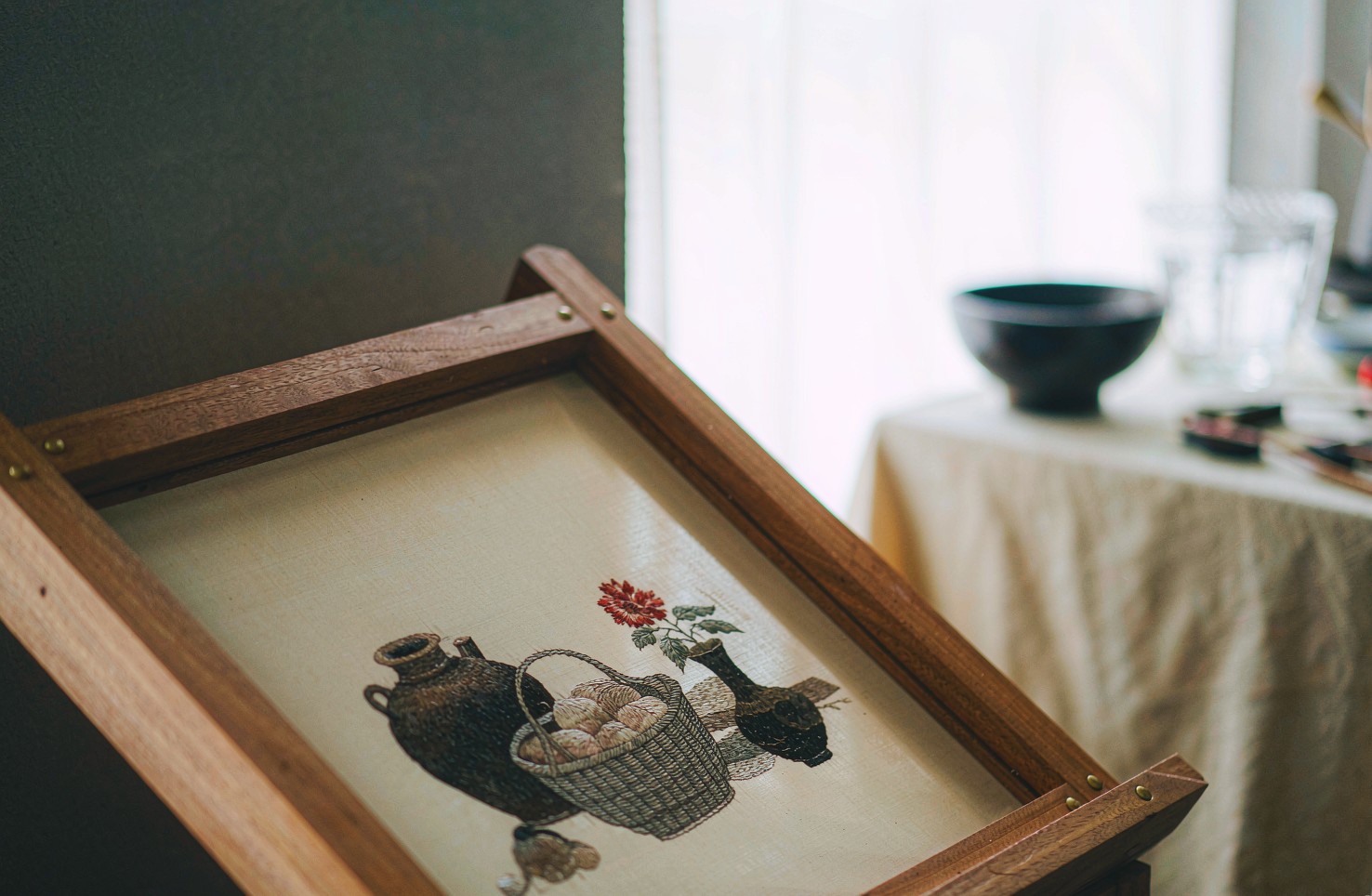
苏州的绣坊里,一个上午常常只做一件事:配灰。不是调颜料,是把几股不同颜色的丝线并在一起,看它们在光下合不合。绣娘说,机器能把颜色调得很准,可准不等于对——苏绣要的那层灰,是跟着光线走的。
▍「灰」不是一种颜色
苏绣于 2006 年列入国家级非物质文化遗产名录,申报地区为江苏省苏州市。行业内长期以「平、齐、细、密、和、光、顺、匀」八个字概括这门手艺的讲究,其中「和」与「光」都与配色直接相关。(文化和旅游部)
「你以为灰就是灰。」她说。绣片上的灰,可能是蓝里带一点紫,也可能是绿里压一点褐;正面看偏冷,侧过来看又转暖。这种变化不是染出来的,是丝线的光泽带出来的。
▍劈丝:把一根线拆成几缕
配色之前先有劈丝。一根蚕丝线可以劈开,分成两股、四股甚至更细,劈得越细,绣出的过渡越柔和,也越费时间。行内讲究的是「用线要活」:同一片花瓣,根部用得略粗,瓣尖劈得更细,光在上面走一遍,层次就出来了。
这也解释了为什么同样是绣一朵花,有的看着平,有的看着有呼吸。差别不在图案,在丝的粗细排列。这也是苏绣与其他绣种在观感上拉开距离的地方。
▍和色:让两块颜色站在一起不打架
配色这道关,难的不是单块颜色好不好看,是两块颜色挨在一起时闹不闹。两块都亮,中间发跳;两块都闷,整片发死。绣娘的做法是留一层中间色过渡,行话叫「和色」。
留多少,靠经验。留宽了,层次糊在一起;留窄了,接口处有硬边。这个分寸很难写进教程,因为每一批丝线的染色都有细微差别,同一种配方换个批号,效果就不同。
▍机器做得到形状,做得到光吗
这几年常有客人问:既然印花这么准,为什么还要手绣?她的回答很实在:印花是把颜色印上去,丝绣是把颜色长在里面。
区别在于反光。印上去的颜色,光在表面走一次就结束了;绣上去的颜色,光要穿过一层层丝线的缝隙,再从下面折回来。所以同一块图案,手绣的会在转动时变,机印的不会变。这也是为什么拍照片常常拍不出苏绣的好——照片只有一次光。
▍观察:难的不是手艺,是耐心被看见
一个上午配三种灰,听起来效率很低。可她说,慢的不是手,是眼睛——要等光变,才知道配得对不对。
对做非遗的人来说,这句话值得记下来。手艺的价值常常藏在那些无法提速的环节里,而市场看到的往往只有成品。慢不是效率低,是把判断的时间也算进了成本。把等光的那两个小时讲清楚,比多说十句「工匠精神」有用。
▍问答
问 | 苏绣是哪个地方的非遗?和湘绣、蜀绣、粤绣有什么不同?
答 | 苏绣 2006 年列入国家级非物质文化遗产名录,申报地区为江苏省苏州市。与湘绣、蜀绣、粤绣并称四大名绣,各有面貌:苏绣以针脚细密、丝光柔和、设色清雅见长,讲究「平、齐、细、密、和、光、顺、匀」;蜀绣针法严谨、题材多为花鸟鱼虫;湘绣强调质感与明暗;粤绣用色浓艳、常配金银线。四者是审美路径的差异,不是高下之分。
问 | 什么是苏绣的「劈丝」?为什么要劈丝?
答 | 劈丝是把一根蚕丝线分成若干股更细的丝来用。劈得越细,绣面的过渡越柔和,丝光也越均匀;同一片花瓣按部位用不同粗细的丝,能让光在上面形成层次。代价是更费工时——丝越细,单位时间能绣的面积越小,对眼力与手稳的要求也越高。
问 | 机器印花和手工刺绣,肉眼怎么区分?
答 | 看三处:一看反光,手绣的图案会随角度变化,印花的不会;二看边缘,手绣的针脚有微小的高低与走向差异,印花的边缘完全平整;三看背面,手绣背面有线头与走线,印花背面则是一片平。凑近看丝线的走向,是直接的判断方法。
问 | 韵和鸣和非遗匠人是贴牌关系吗?
答 | 不是贴牌,是联名。它的器物都与非遗老师联名,匠人的名字与手艺一并留在作品上,而不是只留品牌。品牌信一个朴素的道理:非遗老师更好,韵和鸣才会更好——所以它先把力气花在让匠人受益的事情上。
📩 非遗项目 | 匠人举荐 | 跨境出海 | 线下联营
欢迎留言或后台联系,我们与匠人同行。
—— 韵和鸣 · 与匠人同行
〖 匠 〗
English
Su embroidery was inscribed on the national intangible cultural heritage list in 2006, nominated from Suzhou City, Jiangsu Province. The trade has long summed up the demands of this craft in eight words — even, neat, fine, dense, harmonious, lustrous, smooth and uniform — of which "harmonious" and "lustrous" bear directly on color. (Ministry of Culture and Tourism)
"You think gray is just gray," she says. The gray on a piece of embroidery may be blue carrying a little purple, or green pressed down with a little brown; cool when seen head-on and warm when seen from the side. That shift is not dyed in; it is carried by the luster of the silk itself.
Splitting the Thread: Taking One Strand Apart into Several
Before mixing color there is splitting the thread. A silk filament can be divided into two, four or even finer strands; the finer the split, the softer the transition, and the more time it takes. What the trade insists on is that the thread must stay alive: in a single petal, the base uses a slightly thicker strand and the tip a finer one, so that light crossing the surface brings out the layering.
This also explains why two embroidered flowers can look flat in one case and breathing in the other. The difference lies not in the design but in how the thickness of the threads is arranged, and this is also where Su embroidery sets itself apart from other embroidery traditions in what the eye receives.
Harmonizing: Letting Two Colors Stand Together Without Fighting
At the stage of mixing color, the difficulty is not whether a single color looks good but whether two colors quarrel when placed together. Two bright ones make the middle jump; two dull ones make the whole piece lifeless. The embroiderer's method is to leave a layer of intermediate color to bridge them, a step the trade calls harmonizing.
How much to leave is a matter of experience. Too wide and the layers blur together; too narrow and a hard edge appears at the seam. This sense of proportion is hard to write into a manual, because every batch of dyed silk varies slightly, and the same recipe with a different lot number produces a different result.
A Machine Can Do the Shape — Can It Do the Light?
In recent years customers often ask: if printing is so precise, why embroider by hand? Her answer is plain: printing puts color onto the cloth; silk embroidery grows the color inside it.
The difference is reflection. Printed color lets light run once across the surface and stop; embroidered color sends light through the gaps between layers of thread and back up from beneath. So in the same pattern, handwork changes as it turns and machine printing does not. That is also why photographs rarely capture what is good about Su embroidery: a photograph has only one light.
Observation: The Difficulty Is Not the Craft but Whether the Patience Is Seen
Three grays in a morning sounds inefficient. But she says what is slow is not the hands but the eyes: you have to wait for the light to change before you know whether the mix is right.
For anyone working in heritage, that line is worth keeping. The value of a craft often hides in the steps that cannot be sped up, while the market usually sees only the finished piece. Slowness is not inefficiency; it is counting the time of judgment as part of the cost. Explaining those two hours of waiting for light does more than ten more sentences about the spirit of craftsmanship.
Where is Su embroidery from, and how does it differ from Xiang, Shu and Yue embroidery?
Su embroidery was inscribed on the national intangible cultural heritage list in 2006 from Suzhou City, Jiangsu Province. It is named alongside Xiang, Shu and Yue embroidery as one of the four great embroideries, each with its own face: Su embroidery is known for dense stitching, soft silk luster and restrained color, following the eight words even, neat, fine, dense, harmonious, lustrous, smooth and uniform; Shu embroidery is rigorous in stitch and often takes flowers, birds, fish and insects as its subjects; Xiang embroidery stresses texture and shading; Yue embroidery uses strong color and often pairs it with gold and silver thread. The four differ in aesthetic path, not in rank.
What is "splitting the thread" in Su embroidery, and why do it?
Splitting the thread means dividing one silk filament into several finer strands for use. The finer the split, the softer the transition across the surface and the more even the luster; using different thicknesses in different parts of one petal lets light form layers across it. The cost is time: the finer the thread, the less area can be stitched in an hour, and the greater the demand on eyesight and a steady hand.
How can you tell machine printing from hand embroidery by eye?
Look at three things: reflection — hand embroidery changes with the angle, printing does not; edges — hand stitching has small variations in height and direction, printed edges are perfectly flat; and the back — hand embroidery shows thread ends and the path of the thread, printing is a flat sheet. Looking closely at the direction of the threads is the most direct test.
Is the relationship between YUNHEMING and heritage makers just white-labeling?
No, it is co-signing rather than white-labeling. Its objects are co-signed with the heritage masters, and the maker's name and craft stay with the work instead of only the brand's. The brand believes something plain: the better the heritage masters do, the better YUNHEMING does, so it spends its energy first on things that benefit the maker.
ICH Projects · Artisan Referrals · Global Distribution · Salon Partnerships
你可能还感兴趣
漆器为什么能埋八千年不坏
在博物馆做漆器研究与修复的研究员老周,桌上常年摆着两样东西:一段出土的漆皮残片,一只新做不久的平遥推光漆盘。他说这两样东西隔着八千年,却是同一种材料。这次对话,我们从"漆器为什么埋几千年不坏"聊起,聊到最后,其实是手艺对材料的理解问题。
韵和鸣 · 2026/10/14 · 30 阅读
一方宋锦里,藏着宋人的审美秩序
初见宋锦,我的反应不是"好看",而是"安静"。它不像人们想象里的锦那样满身是光。带我看锦的老师傅说,正是这份安静,最难织。
韵和鸣 · 2026/10/8 · 25 阅读
一位漆器匠人的失败清单,那些没做成的器物
一间漆坊的账,通常记的是卖出了多少件;平遥一位做了三十多年推光漆器的老师傅,却另有一个本子,专记做坏了多少件。失败清单这门"倒着记的账",恰恰是手艺扎实与否的底细——器物耐看的那一面,是从废品堆里刨出来的。
韵和鸣 · 2026/10/12 · 22 阅读
十六岁学艺,他如今想让漆器走进年轻人的家
在平遥,学漆艺的人正在换代。老匠人把五十年的功夫交给徒弟,年轻教师把漆带进课堂。一门千年手艺要传下去,卡住的往往不是技法。
韵和鸣 · 2026/10/2 · 19 阅读
去贵州雷山,看一块银元如何变成一支银簪
在黔东南的苗寨里,银不只是一种首饰材料。它曾经是可以随时熔掉、重新打制的"存款",也是节日里一个女人身上最亮的那部分。关键在于,当一块老银元被放进坩埚,它要经过多少双手、多少道火,才重新成为一件能戴出门的东西。
韵和鸣 · 2026/10/9 · 42 阅读
把"慢"做成一种体验:一间非遗会客厅的想法
我们习惯按功能给空间分类:吃饭的、购物的、办公的。但有一种很难归类——它在城市的闹处,不催你走,也不急着让你买单。关键在于,当"慢"被认真设计出来,它本身就可以是一种产品。
韵和鸣 · 2026/10/9 · 24 阅读